
Homework Answers
Add Answer to:
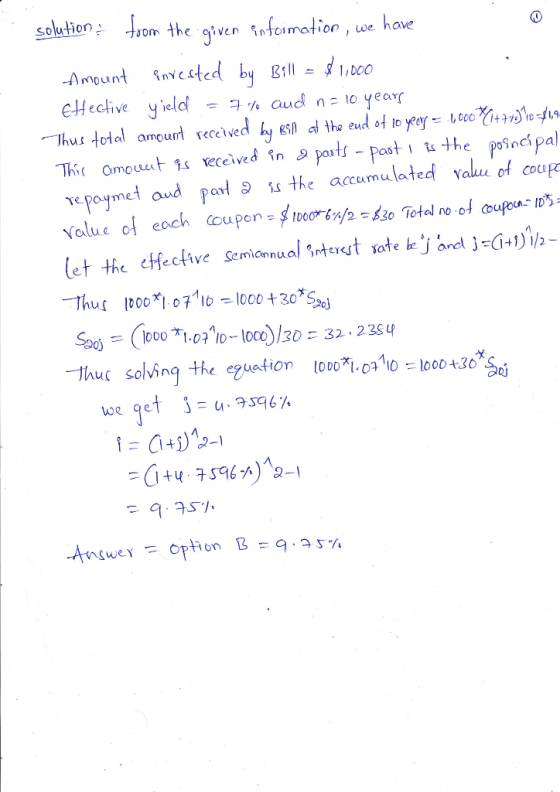
18. Bill buys a 10-year 1000 par value 6% bond with semi-annual coupons. The price assumes...
5. A 30-year 1000 par value bond with coupons at 9% payable semiannually and a redemption...
 5. A 30-year 1000 par value bond with coupons at 9% payable semiannually and a redemption value of 1100 is purchased for a price that results in a yield of 12% compounded semiannually. Suppose that the bond is called (i.e. redeemed) prior to the actual maturity date and results in an actual nominal yield rate convertible semiannually of 14%. Note: Assume that the bond is called immediately after a coupon payment is made. Calculate the number of years the bond...
A bond with a redemption value of £100 pays coupons of £1.50 semi-annually (i.e. the bond...
A bond with a redemption value of £100 pays coupons of £1.50 semi-annually (i.e. the bond holder receives £1.50 twice per year), with the first coupon due in half a year. The bond will mature in ten years’ time. It is currently selling for £95.25. By using interpolation method, compute the redemption yield (annual effective).
Consider a 2-year $1000 par value bond that pays semi-annual coupons at a rate of 42)...
 Consider a 2-year $1000 par value bond that pays semi-annual coupons at a rate of 42) purchased for $1058.82 6%. Suppose that the bond was (a) Use the method of averages to approximate the effective yield rate compounded semi-annually. State the result as a percent to 1 decimal place % compounded semi-annually (b) Complete the chart below by performing 2 iterations of the bisection method to approximate the effective yield rate compounded semi-annually [Note: For the initial interval [a(0),b(0) use...
2. * A bond with a redemption value of £100 pays coupons of £1.50 semi-annually (i.e....
 2. * A bond with a redemption value of £100 pays coupons of £1.50 semi-annually (i.e. the bond holder receives £1.50 twice per year), with the first coupon due in half a year. The bond will mature in ten years' time. It is currently selling for £95.25. (a) Without making any calculations can you determine what is greater between the redemption yield and the interest yield? Why? (b) Compute the redemption yield (annual effective)?
A 10-year bond pays semi-annual coupons at j2= 9.3% and has a yield rate of j2...
A 10-year bond pays semi-annual coupons at j2= 9.3% and has a yield rate of j2 = 7.8%. If the book value immediately after the 7th coupon payment is $1047.77, and the book value immediately after the 11th coupon payment is $1027.81, what is the bond's face value?
Sue purchases a 10-year coupon bond with semi-annual coupons at a nominal annual rate of 4% convertible semi-annually at a price of $1,021.50. The bond can be called at its par value X on any coupon d...
Sue purchases a 10-year coupon bond with semi-annual coupons at a nominal annual rate of 4% convertible semi-annually at a price of $1,021.50. The bond can be called at its par value X on any coupon date beginning at the end of year 5. The price at which Sue purchases the bond guarantees that Sue will receive a nominal annual rate of interest convertible semi-annually at 6%. What is X?
A 15 year bond has a par-value of 500 and pays semi-annual coupons at a 7% rate. An investor purchases the bond at a pri...
A 15 year bond has a par-value of 500 and pays semi-annual coupons at a 7% rate. An investor purchases the bond at a price such that its yield to maturity is 6% convertible semi-annually. The investor sells the bond immediately after 8th payment at a price such that its new owner's yield to maturity is 5% convertible semi-annually. What was the original investor's yield convertible semi-annually on this investment over the 4-year period?
7. Ali buys a new car and finances it with a loan of 22,000. He will...
7. Ali buys a new car and finances it with a loan of 22,000. He will make n monthly payments of 450.30 starting in one month. He will make one larger payment in n + 1 months to pay off the loan. Payments are calculated using an annual nominal interest rate of 8.4%, convertible monthly. Immediately after the 18th payment he refinances the loan to pay off the remaining balance with 24 monthly payments starting one month later. This refinanced...
An investor buys a bond with the following characteristics: Maturity - 10 years Coupon - 4.5%,...
An investor buys a bond with the following characteristics: Maturity - 10 years Coupon - 4.5%, paid once per year Nominal Value - £100 The yield to maturity at the time of purchase is 8.50%. The investor sells the bond immediately after the sixth coupon payment, when the yield to maturity rises to 9.50%. a.What is the investor’s realised annual rate of return after the sale of the bond, assuming that the investor can reinvest received coupons at the yield...
4.1.2 Atwelve-year 100 par value bond pays 7% coupons semiannually. The bond is priced at 115.84...
 4.1.2 Atwelve-year 100 par value bond pays 7% coupons semiannually. The bond is priced at 115.84 to yield an annual nominal rate of 6% compounded semiannually. Calculate the redemption value of the bond.
 5. A 30-year 1000 par value bond with coupons at 9% payable semiannually and a redemption value of 1100 is purchased for a price that results in a yield of 12% compounded semiannually. Suppose that the bond is called (i.e. redeemed) prior to the actual maturity date and results in an actual nominal yield rate convertible semiannually of 14%. Note: Assume that the bond is called immediately after a coupon payment is made. Calculate the number of years the bond...
 Consider a 2-year $1000 par value bond that pays semi-annual coupons at a rate of 42) purchased for $1058.82 6%. Suppose that the bond was (a) Use the method of averages to approximate the effective yield rate compounded semi-annually. State the result as a percent to 1 decimal place % compounded semi-annually (b) Complete the chart below by performing 2 iterations of the bisection method to approximate the effective yield rate compounded semi-annually [Note: For the initial interval [a(0),b(0) use...
 2. * A bond with a redemption value of £100 pays coupons of £1.50 semi-annually (i.e. the bond holder receives £1.50 twice per year), with the first coupon due in half a year. The bond will mature in ten years' time. It is currently selling for £95.25. (a) Without making any calculations can you determine what is greater between the redemption yield and the interest yield? Why? (b) Compute the redemption yield (annual effective)?
 4.1.2 Atwelve-year 100 par value bond pays 7% coupons semiannually. The bond is priced at 115.84 to yield an annual nominal rate of 6% compounded semiannually. Calculate the redemption value of the bond.
Most questions answered within 3 hours.
-
Where is the error in this code sequence?
String s1 = "Hello";
String s2 = "ello";...
asked 11 months ago -
Financial data for Joel de Paris, Inc., for last year
follow:
Joel de Paris, Inc.
Balance...
asked 11 months ago -
Consider this reaction:
Al2(SO4)3 (aq)+ BaCl3
(aq) Al2Cl6 (aq)- +
3BaSO4(s) . What is the...
asked 11 months ago -
Suppose that Savneet is considering increasing her
recent random sample from 20 car rentals to 40...
asked 11 months ago -
Trucks arrive at an unloading terminal at an average rate of 120
per hour.
Trucks arrive...
asked 11 months ago -
Why are methanol and ethanol completely soluble in water while
octanol is not very little soluble....
asked 11 months ago -
A facilities manager at a university reads in a research report
that the mean amount of...
asked 11 months ago -
When the CuSO4 is rehydrated by adding water to the anhydrous
compound, is this an endothermic...
asked 11 months ago -
A ray of sunlight is passing from diamond into crown glass; the
angle of incidence is...
asked 11 months ago -
A block of mass 0.249 kg is placed on top of a light, vertical
spring of...
asked 11 months ago -
how do the kidneys compensate in the presences of acidosis
a) trigger hyperventilate
b) reserve acid...
asked 11 months ago -
Question 501 pts
The rental rate of capital to the firm increases. Which of the
following...
asked 11 months ago