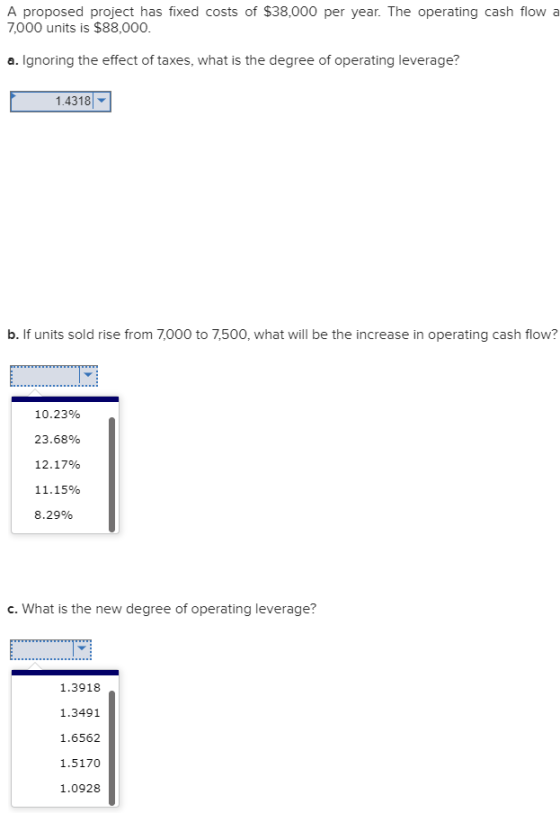
A proposed project has fixed costs of $38,000 per year. The operating cash flow at 7,000 units is $88,000.
Homework Answers
a. The formula for calculating operating leverage is Contribution / EBIT, but before we need to make ascertain contribution, this can be done as follows:
Sales
- Variable cost
= Contribution
- Fixed cost
= EBIT
Here, EBIT and fixed cost is given so both will be added to arrive at contribution.
Contribution = $88,000 + $38,000
= $126,000
So, Operating leverage = Contribution / EBIT
= $1,26,000 / 88,000
= 1.4318
b. The contribution of $1,26,000 on 7,000 units indicate $18/unit (Contribution / Total units sold) contribution. Hence, if there will be an increase of 500 units, the contribution will increase by $18 * 500 = $9,000, the new contribution will become $126,000 + $9,000 = $135,000, after deducting fixed cost of $38,000 which shall remain same, the operating cash flow comes at $97,000, which is a increase of 10.23% from $88,000.
c. The new degree of operating leverage can be calculated as follows:
Contribution / EBIT
= $135,000 / $97,000
= 1.3918
Add Answer to:
A proposed project has fixed costs of $38,000 per year. The
operating cash flow at 7,000...
A proposed project has fixed costs of $82,000 per year. The operating cash flow at 6,200...
A proposed project has fixed costs of $82,000 per year. The operating cash flow at 6,200 units is $88,400. Ignoring the effect of taxes, what is the degree of operating leverage? (Do not round intermediate calculations. Round your answer to 4 decimal places, e.g., 32.1616.) Degree of operating leverage If units sold rise from 6,200 to 6,700, what will be the new operating cash flow? (Do not round intermediate calculations. Round your answer to 2 decimal places, e.g., 32.16.) Operating...
A proposed project has fixed costs of $89,000 per year. The operating cash flow at 10,400...
A proposed project has fixed costs of $89,000 per year. The operating cash flow at 10,400 units is $127,400. Ignore the effect of taxes. a. What is the degree of operating leverage? (Do not round intermediate calculations and round your answer to 3 decimal places, e.g., 32.161.) b. If units sold rise from 10,400 to 11,100, what will be the new operating cash flow? (Do not round intermediate calculations and round your answer to 2 decimal places, e.g., 32.16.)...
A proposed project has fixed costs of $34.709 per year. The operating cash flow at 12.000...
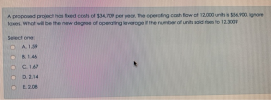 A proposed project has fixed costs of $34.709 per year. The operating cash flow at 12.000 units is $56,900. Ignore taxes. What will be the new degree of operating leveroge if the number of units sold rises to 12.300? Select one: O A.1.59 B. 1.46 O C. 1.67 D. 2.14 O E 2.08
19. Operating leverage* A project has fixed costs of $1,000 per year, depreciation charges of $500...
 19. Operating leverage* A project has fixed costs of $1,000 per year, depreciation charges of $500 a year, annual revenue of $6,000, and variable costs equal to two-thirds of revenues. a. If sales increase by 10%, what will be the increase in pretax profits? b. What is the degree of operating leverage of this project?
Intro A project has a predicted operating cash flow of $25,000 per year and a degree...
 Intro A project has a predicted operating cash flow of $25,000 per year and a degree of operating leverage of 2.6 at the predicted level of sales. Part 1 | Attempt 1/10 for 10 pts. What is the expected percentage change in operating cash flow if sales turn out to be 17% lower than expected? 3+ decimals Submit
Bonus homework for class Please show Formulas! thanks in advance! 1. Calculating OCF [LO1] Consider the...
Bonus homework for class Please show Formulas! thanks in advance! 1. Calculating OCF [LO1] Consider the following income statement: Sales $713,500 Cost 497,300 EBIT ? Taxes (34%) ? Net Income ? Fill in the missing numbers and then calculate the OCF. What is the depreciation tax shield? 2. Operating Cash Flow and Leverage [LO41 A proposed project has fixed costs of $83,000 per year. The operating cash flow at 9,100 units is $102,900. Ignoring the effect of taxes, what is...
A project has fixed costs of $2,400 per year, depreciation charges of $300 a year, annual...
A project has fixed costs of $2,400 per year, depreciation charges of $300 a year, annual revenue of $21,600 and variable costs equal to two-thirds of revenues. A.) if sales increase by 19%, what will be the percentage increase in pretax profits? B.) what is the degree of operating leverage of this project?
Consider a four-year project with the following information: initial fixed asset investment = $57...
 Consider a four-year project with the following information:
initial fixed asset investment = $570,000; straight-line
depreciation to zero over the four-year life; zero salvage value;
price = $40; variable costs = $27; fixed costs = $245,000; quantity
sold = 88,000 units; tax rate = 22 percent.
Consider a four-year project with the following information: initial fixed asset investment $570,000; straight-line depreciation to zero over the four-year life; zero salvage value price $40; variable costs-$27 fixed costs- $245,000; quantity sold -...
Consider a four-year project with the following information:
initial fixed asset investment = $570,000; straight-line
depreciation to zero over the four-year life; zero salvage value;
price = $40; variable costs = $27; fixed costs = $245,000; quantity
sold = 88,000 units; tax rate = 22 percent.
Consider a four-year project with the following information: initial fixed asset investment $570,000; straight-line depreciation to zero over the four-year life; zero salvage value price $40; variable costs-$27 fixed costs- $245,000; quantity sold -...
Wright Communications is trying to estimate the first-year operating cash flow for a proposed project. The financial sta...
Wright Communications is trying to estimate the first-year operating cash flow for a proposed project. The financial staff has collected the following information: Financial Item: Projected Sales $24.42 million Expenses $15.00 million Depreciation $5.00 million Interest Expense $3.00 million The company faces a 40.00 percent tax rate. What is the project’s operating cash flow for year 1? (answer in units of millions)
We are evaluating a project that costs $1,120,000, has a ten-year life, and has no salvage...
We are evaluating a project that costs $1,120,000, has a ten-year life, and has no salvage value. Assume that depreciation is straight-line to zero over the life of the project. Sales are projected at 64,000 units per year. Price per unit is $50, variable cost per unit is $25, and fixed costs are $620,000 per year. The tax rate is 35 percent, and we require a return of 12 percent on this project. 1.Calculate the accounting break-even point. 2. What...
 A proposed project has fixed costs of $34.709 per year. The operating cash flow at 12.000 units is $56,900. Ignore taxes. What will be the new degree of operating leveroge if the number of units sold rises to 12.300? Select one: O A.1.59 B. 1.46 O C. 1.67 D. 2.14 O E 2.08
 19. Operating leverage* A project has fixed costs of $1,000 per year, depreciation charges of $500 a year, annual revenue of $6,000, and variable costs equal to two-thirds of revenues. a. If sales increase by 10%, what will be the increase in pretax profits? b. What is the degree of operating leverage of this project?
 Intro A project has a predicted operating cash flow of $25,000 per year and a degree of operating leverage of 2.6 at the predicted level of sales. Part 1 | Attempt 1/10 for 10 pts. What is the expected percentage change in operating cash flow if sales turn out to be 17% lower than expected? 3+ decimals Submit
 Consider a four-year project with the following information:
initial fixed asset investment = $570,000; straight-line
depreciation to zero over the four-year life; zero salvage value;
price = $40; variable costs = $27; fixed costs = $245,000; quantity
sold = 88,000 units; tax rate = 22 percent.
Consider a four-year project with the following information: initial fixed asset investment $570,000; straight-line depreciation to zero over the four-year life; zero salvage value price $40; variable costs-$27 fixed costs- $245,000; quantity sold -...
Consider a four-year project with the following information:
initial fixed asset investment = $570,000; straight-line
depreciation to zero over the four-year life; zero salvage value;
price = $40; variable costs = $27; fixed costs = $245,000; quantity
sold = 88,000 units; tax rate = 22 percent.
Consider a four-year project with the following information: initial fixed asset investment $570,000; straight-line depreciation to zero over the four-year life; zero salvage value price $40; variable costs-$27 fixed costs- $245,000; quantity sold -...
Most questions answered within 3 hours.
-
Where is the error in this code sequence?
String s1 = "Hello";
String s2 = "ello";...
asked 11 months ago -
Financial data for Joel de Paris, Inc., for last year
follow:
Joel de Paris, Inc.
Balance...
asked 11 months ago -
Consider this reaction:
Al2(SO4)3 (aq)+ BaCl3
(aq) Al2Cl6 (aq)- +
3BaSO4(s) . What is the...
asked 11 months ago -
Suppose that Savneet is considering increasing her
recent random sample from 20 car rentals to 40...
asked 11 months ago -
Trucks arrive at an unloading terminal at an average rate of 120
per hour.
Trucks arrive...
asked 11 months ago -
Why are methanol and ethanol completely soluble in water while
octanol is not very little soluble....
asked 11 months ago -
A facilities manager at a university reads in a research report
that the mean amount of...
asked 11 months ago -
When the CuSO4 is rehydrated by adding water to the anhydrous
compound, is this an endothermic...
asked 11 months ago -
A ray of sunlight is passing from diamond into crown glass; the
angle of incidence is...
asked 11 months ago -
A block of mass 0.249 kg is placed on top of a light, vertical
spring of...
asked 11 months ago -
how do the kidneys compensate in the presences of acidosis
a) trigger hyperventilate
b) reserve acid...
asked 11 months ago -
Question 501 pts
The rental rate of capital to the firm increases. Which of the
following...
asked 11 months ago