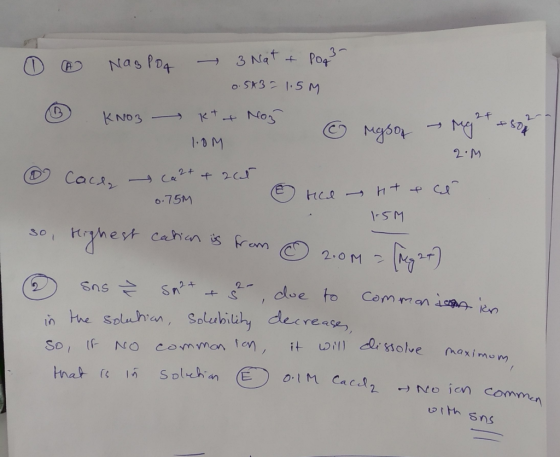
1) Which ONE of the following aqueous solutions contains the lowest concentration of cations, assuming 100%...
1) Which ONE of the following aqueous solutions contains the lowest concentration of cations, assuming 100% dissolution and ionization?
(A) 0.5 M sodium phosphate
(B) 1.0 M potassium nitrate
(C) 2.0 M magnesium sulfate
(D) 0.75 M calcium chloride
(E) 1.5 M hydrogen chloride
2) The highest mass of SnS will dissolve in 1.0 L of an aqueous solution of:
(A) 0.1 M MgS
(B) 0.1 M (NH4)2S
(C) 0.1 M Sn(NO3)2
(D) 0.1 M Na2S
(E) 0.1 M CaCl2
Homework Answers
Add Answer to:
1) Which ONE of the following aqueous solutions contains the
lowest concentration of cations, assuming 100%...
1. Aqueous solutions should be electrically neutral. In other words, cations and anions should be balanced...
 1. Aqueous solutions should be electrically neutral. In other words, cations and anions should be balanced with each other (charge balance) The following table shows the composition of typical seawater. 1. Set up a charge balance equation for the seawater. (b) Analyze the seawater whether is neutral or not. Note that the seawater constituent are expressed in mass concentrations. Constituent mg/kg (ppm) Sodium (Na*) 10,500 1,350 400 380 Magnesium (Mg2) Calcium (Ca2") Potassium (K) Chloride (Cl) Sulfate (SO2) Bicarbonate (HCO3)...
Q43. Write formulas for the following cations: a. Potassium: b. calcium: c. ammonium: d. lead(II) :...
Q43. Write formulas for the following cations: a. Potassium: b. calcium: c. ammonium: d. lead(II) : e. copper(I) : f. zinc: g. titanium(IV) : h. silver: i. nickel(III): j. hydrogen: k. tin(II) : l. mercury(II) : m. iron(III) : Q44. Write formulas for the following anions: a. fluoride: b. oxide: c. iodide: d. carbonate: e. hydrogen carbonate: f. phosphate: g. sulfide: h. sulfate: i. nitride: j. nitrate: k. phosphide: l. chloride:
Which ONE of the following aqueous solutions will contain the highest total concentration of dissolved ions (assume 100%...
Which ONE of the following aqueous solutions will contain the highest total concentration of dissolved ions (assume 100% ionized and hydrated)? (A) 0.5 M Aluminium nitrate (B) 1.0 M Sodium iodide (C) 1.5 M Sodium dihydrogen phosphate (D) 2.0 M Hydrochloric acid (E) 2.5 M Lithium bromide
1) The following molecular equation represents the reaction that occurs when aqueous solutions of lead(II) nitrate...
1) The following molecular equation represents the reaction that occurs when aqueous solutions of lead(II) nitrate and iron(II) chloride are combined. Pb(NO3)2 (aq) + FeCl2 (aq) ==> PbCl2 (s) + Fe(NO3)2 (aq) Write the balanced net ionic equation for the reaction, with states of matter (s), (aq), (l), (g) 2) Does a reaction occur when aqueous solutions of magnesium nitrate and chromium(II) sulfate are combined? yes or no If a reaction does occur, write the net ionic equation. _____(aq)(s)(l)(g) +...
1.) Which of the following aqueous solutions are good buffer systems? . 0.39 M barium chloride...
1.) Which of the following aqueous solutions are good buffer systems? . 0.39 M barium chloride + 0.26 M calcium chloride 0.29 M ammonia + 0.40 M sodium hydroxide 0.11 M calcium hydroxide + 0.20 M calcium bromide 0.24 M hydrobromic acid + 0.24 M sodium bromide 0.13 M acetic acid + 0.17 M sodium acetate 2.) Which of the following aqueous solutions are good buffer systems? . 0.11 M potassium hypochlorite + 0.20 M hypochlorous acid 0.38 M hydrocyanic...
need help, convert them like below pic S. OH- t. 10 w. CIO2 2- X. CO24...
 need help, convert them like below pic
S. OH- t. 10 w. CIO2 2- X. CO24 y. HSO3 z. CIO, u. HCO3- v. 104 5. Ionic Compounds with Polyatomic lons & Constant Charge lons a. CaCO3 i. potassium hydroxide b. KCIO j. beryllium hydroxide C. CASO k. strontium acetate d. Li2SO3 I. ammonium oxide e. Ag3PO4 m. silver cyanide f. NH,F n. zinc carbonate g. Al(NO2)3 0. aluminum bicarbonate h. Ba(HCO3)2- p. magnesium phosphate b. NiP04 6. Tonic Compounds with...
need help, convert them like below pic
S. OH- t. 10 w. CIO2 2- X. CO24 y. HSO3 z. CIO, u. HCO3- v. 104 5. Ionic Compounds with Polyatomic lons & Constant Charge lons a. CaCO3 i. potassium hydroxide b. KCIO j. beryllium hydroxide C. CASO k. strontium acetate d. Li2SO3 I. ammonium oxide e. Ag3PO4 m. silver cyanide f. NH,F n. zinc carbonate g. Al(NO2)3 0. aluminum bicarbonate h. Ba(HCO3)2- p. magnesium phosphate b. NiP04 6. Tonic Compounds with...
1) Which of the following aqueous solutions are good buffer systems? . a. 0.29 M hydroiodic...
1) Which of the following aqueous solutions are good buffer systems? . a. 0.29 M hydroiodic acid + 0.20 M sodium iodide . b. 0.12 M barium hydroxide + 0.29 M barium chloride . c. 0.14 M nitrous acid + 0.12 M potassium nitrite . d. 0.34 M ammonium nitrate + 0.36 M ammonia . e. 0.31 M hydrofluoric acid + 0.29 M potassium fluoride . 2)A solution contains 0.486 M NH4I and 0.480 M ammonia. The pH of this...
1. Which of the following compounds should be soluble in CC14? a) Naci b ) H20...
 1. Which of the following compounds should be soluble in CC14? a) Naci b ) H20 c) NaOH d) C3H18 e) None of these 2. with increasing CO2 pressure and_ with The solubility of carbon dioxide gas in water increasing temperature. a) increases, increases b) increases, decreases c) decreases, increases d) decreases, decreases e) remains constant, decreases 3. Pressure . Based on the Raoult's Law plot for a mixture of liquids A and B shown on the right, which of...
answer 1-4 Which of the following (a-d) is TRUE regarding solid NaCl dissolving in water The...
 answer 1-4
Which of the following (a-d) is TRUE regarding solid NaCl dissolving in water The attraction of the water to the ions in NaCl is through dipole-dipole IFs. Water is considered the solute and NaCl the solvent. The partially positive oxygen in water is attracted to the chloride ion. d. The process of separating the sodium ions from the chloride ions is endothermic. All of these statements are true. polar For the following solution, describe the deviation with respect...
answer 1-4
Which of the following (a-d) is TRUE regarding solid NaCl dissolving in water The attraction of the water to the ions in NaCl is through dipole-dipole IFs. Water is considered the solute and NaCl the solvent. The partially positive oxygen in water is attracted to the chloride ion. d. The process of separating the sodium ions from the chloride ions is endothermic. All of these statements are true. polar For the following solution, describe the deviation with respect...
d. NH4(C5Ohm e. (NH4)2CO3 47. Which of the following are incorrectly paired a) Sr, alkaline earth...
 d. NH4(C5Ohm e. (NH4)2CO3 47. Which of the following are incorrectly paired a) Sr, alkaline earth metal b) Ta, transition metal c) F, halogen d) As, halogen e) , transition metal 48. Which of the following are incorrectly paired? a) Phosphorus, Pr b) Palladium, Pd c) Platinum, Pt d) Lead, Pb e) Potassium, K 49. Which of the following names is incorrect? a) cobalt(II) chloride b) magnesium oxide c) aluminum(III) oxide d) diphosphorus pentoxide e) All of the above names...
 1. Aqueous solutions should be electrically neutral. In other words, cations and anions should be balanced with each other (charge balance) The following table shows the composition of typical seawater. 1. Set up a charge balance equation for the seawater. (b) Analyze the seawater whether is neutral or not. Note that the seawater constituent are expressed in mass concentrations. Constituent mg/kg (ppm) Sodium (Na*) 10,500 1,350 400 380 Magnesium (Mg2) Calcium (Ca2") Potassium (K) Chloride (Cl) Sulfate (SO2) Bicarbonate (HCO3)...
 need help, convert them like below pic
S. OH- t. 10 w. CIO2 2- X. CO24 y. HSO3 z. CIO, u. HCO3- v. 104 5. Ionic Compounds with Polyatomic lons & Constant Charge lons a. CaCO3 i. potassium hydroxide b. KCIO j. beryllium hydroxide C. CASO k. strontium acetate d. Li2SO3 I. ammonium oxide e. Ag3PO4 m. silver cyanide f. NH,F n. zinc carbonate g. Al(NO2)3 0. aluminum bicarbonate h. Ba(HCO3)2- p. magnesium phosphate b. NiP04 6. Tonic Compounds with...
need help, convert them like below pic
S. OH- t. 10 w. CIO2 2- X. CO24 y. HSO3 z. CIO, u. HCO3- v. 104 5. Ionic Compounds with Polyatomic lons & Constant Charge lons a. CaCO3 i. potassium hydroxide b. KCIO j. beryllium hydroxide C. CASO k. strontium acetate d. Li2SO3 I. ammonium oxide e. Ag3PO4 m. silver cyanide f. NH,F n. zinc carbonate g. Al(NO2)3 0. aluminum bicarbonate h. Ba(HCO3)2- p. magnesium phosphate b. NiP04 6. Tonic Compounds with...
 1. Which of the following compounds should be soluble in CC14? a) Naci b ) H20 c) NaOH d) C3H18 e) None of these 2. with increasing CO2 pressure and_ with The solubility of carbon dioxide gas in water increasing temperature. a) increases, increases b) increases, decreases c) decreases, increases d) decreases, decreases e) remains constant, decreases 3. Pressure . Based on the Raoult's Law plot for a mixture of liquids A and B shown on the right, which of...
 answer 1-4
Which of the following (a-d) is TRUE regarding solid NaCl dissolving in water The attraction of the water to the ions in NaCl is through dipole-dipole IFs. Water is considered the solute and NaCl the solvent. The partially positive oxygen in water is attracted to the chloride ion. d. The process of separating the sodium ions from the chloride ions is endothermic. All of these statements are true. polar For the following solution, describe the deviation with respect...
answer 1-4
Which of the following (a-d) is TRUE regarding solid NaCl dissolving in water The attraction of the water to the ions in NaCl is through dipole-dipole IFs. Water is considered the solute and NaCl the solvent. The partially positive oxygen in water is attracted to the chloride ion. d. The process of separating the sodium ions from the chloride ions is endothermic. All of these statements are true. polar For the following solution, describe the deviation with respect...
 d. NH4(C5Ohm e. (NH4)2CO3 47. Which of the following are incorrectly paired a) Sr, alkaline earth metal b) Ta, transition metal c) F, halogen d) As, halogen e) , transition metal 48. Which of the following are incorrectly paired? a) Phosphorus, Pr b) Palladium, Pd c) Platinum, Pt d) Lead, Pb e) Potassium, K 49. Which of the following names is incorrect? a) cobalt(II) chloride b) magnesium oxide c) aluminum(III) oxide d) diphosphorus pentoxide e) All of the above names...
Most questions answered within 3 hours.
-
Where is the error in this code sequence?
String s1 = "Hello";
String s2 = "ello";...
asked 11 months ago -
Financial data for Joel de Paris, Inc., for last year
follow:
Joel de Paris, Inc.
Balance...
asked 11 months ago -
Consider this reaction:
Al2(SO4)3 (aq)+ BaCl3
(aq) Al2Cl6 (aq)- +
3BaSO4(s) . What is the...
asked 11 months ago -
Suppose that Savneet is considering increasing her
recent random sample from 20 car rentals to 40...
asked 11 months ago -
Trucks arrive at an unloading terminal at an average rate of 120
per hour.
Trucks arrive...
asked 11 months ago -
Why are methanol and ethanol completely soluble in water while
octanol is not very little soluble....
asked 11 months ago -
A facilities manager at a university reads in a research report
that the mean amount of...
asked 11 months ago -
When the CuSO4 is rehydrated by adding water to the anhydrous
compound, is this an endothermic...
asked 11 months ago -
A ray of sunlight is passing from diamond into crown glass; the
angle of incidence is...
asked 11 months ago -
A block of mass 0.249 kg is placed on top of a light, vertical
spring of...
asked 11 months ago -
how do the kidneys compensate in the presences of acidosis
a) trigger hyperventilate
b) reserve acid...
asked 11 months ago -
Question 501 pts
The rental rate of capital to the firm increases. Which of the
following...
asked 11 months ago