A binding protein binds to a ligand with Kd=30nm. What is the concentration of ligand when...
A binding protein binds to a ligand with Kd=30nm. What is the
concentration of ligand when the [L] when the fraction
bound, ,
is a) 0.25, b) 0.6 and c) 0.95.
,
is a) 0.25, b) 0.6 and c) 0.95.
Homework Answers
![Q = [L] Kd+ [1] o Kd fraction bounded constant 1) 0 = 0.25 0.95 - (L] 30+ [4] [L] - 0.25 X 30 + 0.251 (.] (1-0.25) = 0.25x30](http://img.homeworklib.com/questions/1c1604d0-77ab-11ea-a7b4-97cb07936ec3.png?x-oss-process=image/resize,w_560)
Add Answer to:
A binding protein binds to a ligand with Kd=30nm. What is the
concentration of ligand when...
A binding protein binds to a ligand L with a K_d of 400 nM. What is...
A binding protein binds to a ligand L with a K_d of 400 nM. What is the concentration of ligand when is a) 0.25, b) 0.6, c) 0.95?
A (non-allosteric) protein binds its ligand with a Kd of 2.5 mM. What proportion of the...
A (non-allosteric) protein binds its ligand with a Kd of 2.5 mM. What proportion of the ligand-binding sites will be occupied at a protein concentration of 1.0 mM and a ligand concentration of 1.5 mM? The answer is 37.5%, but how do you find this answer?
1. What does it mean to have positive cooperatively in protein-ligand binding? 2. The protein “Mariota”...
1. What does it mean to have positive cooperatively in protein-ligand binding? 2. The protein “Mariota” binds to the ligand “football” with an association rate of 8.0 x 10 103M-1s-1 and an overall dissociation constant, Kd of 10 nM. Calculate the dissociation rate, kd, including appropriate units. 3. An antibody binds to an antigen with a Kd of 8 X 10⁻⁶M. At what concentration of antigen will the fractional saturation (Υantigen) be (a) 0.2, (b) 0.5, (c) 0.6, and (d)...
If 20% of binding sites of a protein are occupied by its ligand when the concentration...
If 20% of binding sites of a protein are occupied by its ligand when the concentration of the ligand is 1mM, what is the Kd of this protein-ligand interaction? A. 0.2mM B. 1mM C. 2.5 mM D. 4mM E. 5mM
Usually a protein-binding curve is a hyperbolic function, with theta on the y-axis and [total ligand]...
 Usually a protein-binding curve
is a hyperbolic function, with theta on the y-axis and [total
ligand] on the x-axis. We can only assume that [Free L]=[L total]
when the ligand is in excess of the protein. For example the
[protein] would be 0.001 nM and you start adding ligand in .05nm
increments. But what would the binding curve above look like if the
[receptor]=1 nM: the ligand concentration is no longer in excess of
the protein concentration? Would you still...
Usually a protein-binding curve
is a hyperbolic function, with theta on the y-axis and [total
ligand] on the x-axis. We can only assume that [Free L]=[L total]
when the ligand is in excess of the protein. For example the
[protein] would be 0.001 nM and you start adding ligand in .05nm
increments. But what would the binding curve above look like if the
[receptor]=1 nM: the ligand concentration is no longer in excess of
the protein concentration? Would you still...
Short answer questions: 21. Protein A has a binding site for ligand L with a Ka...
 Short answer questions: 21. Protein A has a binding site for ligand L with a Ka of 10-6 M. Protein B has a binding site for ligand L with a Ka of 10'M. (a). Which protein has a higher affinity for ligand L? Explain your reasoning. (b). At what concentration of ligand L is proteins A half-saturated. At what concentration of L is protein B half-saturated. [L] y = [L] + Ka 22. A protein binds to a ligand L...
(2) In isolation, a DNA-binding protein binds to its regulatory sequence with a Kd of 1.0 M. Another DNA binding protein binds to another sequence on the same DNA a few bases away with a Kd of 5....
 (2) In isolation, a DNA-binding protein binds to its regulatory sequence with a Kd of 1.0 M. Another DNA binding protein binds to another sequence on the same DNA a few bases away with a Kd of 5.0 HM when alone. The two proteins each have a domain which binds to the other with an interaction energy of -2.7 kcal/mole: (a) Draw the thermodynamic box which represents all four states of this system (b) what are the affinities for each...
Avidin binds biotin with a Kd of ~10−15 mol/L. A protein of interest can be covalently...
Avidin binds biotin with a Kd of ~10−15 mol/L. A protein of interest can be covalently linked to biotin and subsequently isolated by incubating with beads coated with avidin. If the concentration of biotinylated protein is 10-8 M at the beginning of the assay and the beads provided an excess of avidin-binding sites, then one could expect the beads to bind: a. Less then half of the biotinylated protein will be bound to the beads. b. Exactly one-half of the...
-3. (5 pt) Beginning with the equilibrium for protein-ligand binding: P + NL PLN derive the...
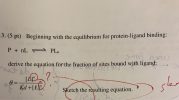 -3. (5 pt) Beginning with the equilibrium for protein-ligand binding: P + NL PLN derive the equation for the fraction of sites bound with ligand: Kd +[Lju. Sketch the resulting equation.
Assume that the concentration of the ligand is much greater than the concentration of the protein. When ligand Y is pres...
Assume that the concentration of the ligand is much greater than the concentration of the protein. When ligand Y is present at a concentration of 2 x 10⁻⁶ M, 50% of the binding sites on the molecules of protein X are found to be occupied. If the concentration of the ligand is increased to 3 x 10⁻⁶ M, what fraction of the binding sites will be occupied? Please explain the steps to solve this problem.
 Usually a protein-binding curve
is a hyperbolic function, with theta on the y-axis and [total
ligand] on the x-axis. We can only assume that [Free L]=[L total]
when the ligand is in excess of the protein. For example the
[protein] would be 0.001 nM and you start adding ligand in .05nm
increments. But what would the binding curve above look like if the
[receptor]=1 nM: the ligand concentration is no longer in excess of
the protein concentration? Would you still...
Usually a protein-binding curve
is a hyperbolic function, with theta on the y-axis and [total
ligand] on the x-axis. We can only assume that [Free L]=[L total]
when the ligand is in excess of the protein. For example the
[protein] would be 0.001 nM and you start adding ligand in .05nm
increments. But what would the binding curve above look like if the
[receptor]=1 nM: the ligand concentration is no longer in excess of
the protein concentration? Would you still...
 Short answer questions: 21. Protein A has a binding site for ligand L with a Ka of 10-6 M. Protein B has a binding site for ligand L with a Ka of 10'M. (a). Which protein has a higher affinity for ligand L? Explain your reasoning. (b). At what concentration of ligand L is proteins A half-saturated. At what concentration of L is protein B half-saturated. [L] y = [L] + Ka 22. A protein binds to a ligand L...
 (2) In isolation, a DNA-binding protein binds to its regulatory sequence with a Kd of 1.0 M. Another DNA binding protein binds to another sequence on the same DNA a few bases away with a Kd of 5.0 HM when alone. The two proteins each have a domain which binds to the other with an interaction energy of -2.7 kcal/mole: (a) Draw the thermodynamic box which represents all four states of this system (b) what are the affinities for each...
 -3. (5 pt) Beginning with the equilibrium for protein-ligand binding: P + NL PLN derive the equation for the fraction of sites bound with ligand: Kd +[Lju. Sketch the resulting equation.
Most questions answered within 3 hours.
-
Where is the error in this code sequence?
String s1 = "Hello";
String s2 = "ello";...
asked 10 months ago -
Financial data for Joel de Paris, Inc., for last year
follow:
Joel de Paris, Inc.
Balance...
asked 10 months ago -
Consider this reaction:
Al2(SO4)3 (aq)+ BaCl3
(aq) Al2Cl6 (aq)- +
3BaSO4(s) . What is the...
asked 10 months ago -
Suppose that Savneet is considering increasing her
recent random sample from 20 car rentals to 40...
asked 10 months ago -
Trucks arrive at an unloading terminal at an average rate of 120
per hour.
Trucks arrive...
asked 10 months ago -
Why are methanol and ethanol completely soluble in water while
octanol is not very little soluble....
asked 10 months ago -
A facilities manager at a university reads in a research report
that the mean amount of...
asked 10 months ago -
When the CuSO4 is rehydrated by adding water to the anhydrous
compound, is this an endothermic...
asked 10 months ago -
A ray of sunlight is passing from diamond into crown glass; the
angle of incidence is...
asked 10 months ago -
A block of mass 0.249 kg is placed on top of a light, vertical
spring of...
asked 10 months ago -
how do the kidneys compensate in the presences of acidosis
a) trigger hyperventilate
b) reserve acid...
asked 10 months ago -
Question 501 pts
The rental rate of capital to the firm increases. Which of the
following...
asked 10 months ago