
Homework Answers
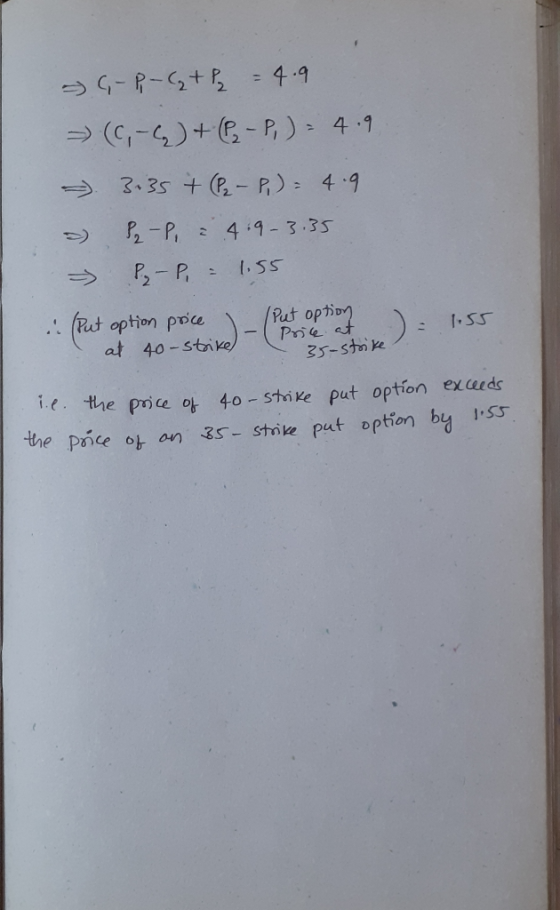
The answer is option - A) 1.55
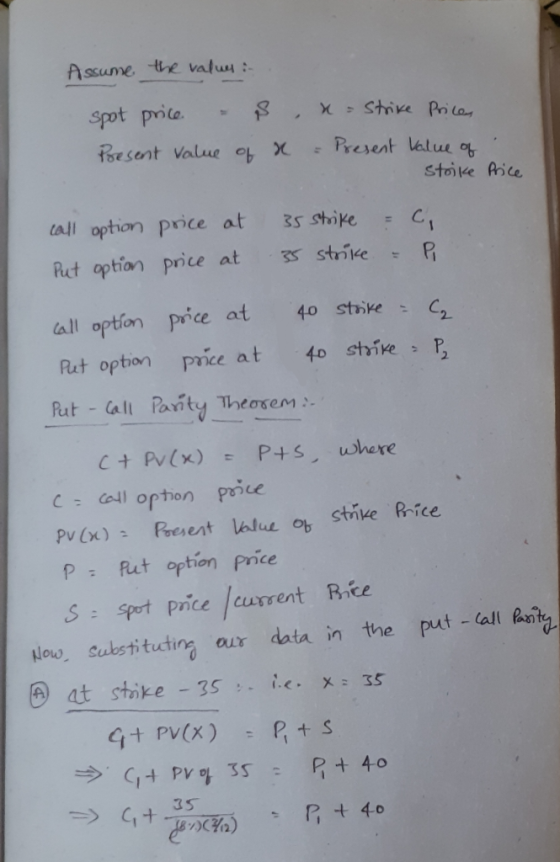
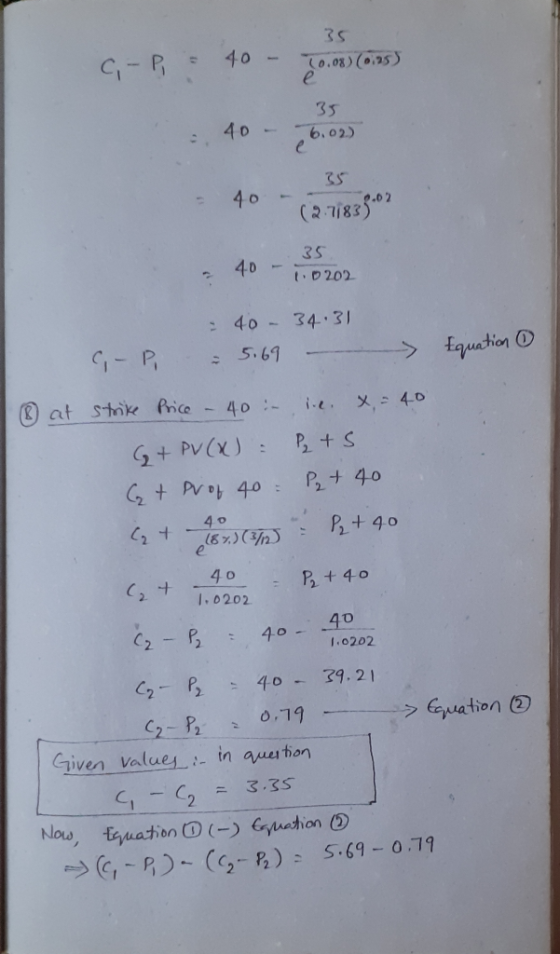
the calculation below contains the value "e" which is the factor used for the calculation of present value while continuous compounding situation. the value of e is 2.7183.
and refer in below answer e^(8%)(3/12) means the discounting factor which is CONTINUOUS COMPOUNDING at 8% per annum INTEREST RATE for a period of 3 MONTHS.
from the given data, two equations for two situations were derived by using put - call parity theorem and those two equations were subtracted to get the required answer.
Add Answer to:
14. The current price of a non-dividend paying stock is 40 and the continuously compounded risk-free...
1a) The current price of a stock is $43, and the continuously compounded risk-free rate is...
1a) The current price of a stock is $43, and the continuously compounded risk-free rate is 7.5%. The stock pays a continuous dividend yield of 1%. A European call option with a exercise price of $35 and 9 months until expiration has a current value of $11.08. What is the value of a European put option written on the stock with the same exercise price and expiration date as the call? Answers: a. $5.17 b. $3.08 c. $1.49 d. $2.50...
The price of a European call option on a non-dividend-paying stock with a strike price of...
The price of a European call option on a non-dividend-paying stock with a strike price of $50 is $6. The stock price is $51, the continuously compounded risk-free rate (all maturities) is 6% and the time to maturity is one year. What is the price of a one-year European put option on the stock with a strike price of $50? $2.09 $7.52 $3.58 $9.91
NEED HELP WITH BOTH QUESTIONS PLZ!!!!! 2. Consider call and put options on a non-dividend paying...
 NEED HELP WITH BOTH QUESTIONS PLZ!!!!!
2. Consider call and put options on a non-dividend paying stocks. The price of a call option with a strike price of $30 and 6 months to maturity is $1.75. If the current stock price is $29.8 and the interest rate is 10% per annum continuously compounded, what is the price of the put option with the same strike price and maturity? ve A. $1.32 B. $1.18 C. $0.96 $0.72 E. $0.48 3. Consider...
NEED HELP WITH BOTH QUESTIONS PLZ!!!!!
2. Consider call and put options on a non-dividend paying stocks. The price of a call option with a strike price of $30 and 6 months to maturity is $1.75. If the current stock price is $29.8 and the interest rate is 10% per annum continuously compounded, what is the price of the put option with the same strike price and maturity? ve A. $1.32 B. $1.18 C. $0.96 $0.72 E. $0.48 3. Consider...
(b) A 6-month European call option on a non-dividend paying stock is cur- rently selling for $3. The stock price is...
 (b) A 6-month European call option on a non-dividend paying stock is cur- rently selling for $3. The stock price is $50, the strike price is $55, and the risk-free interest rate is 6% per annum continuously compounded. The price for 6-months European put option with same strike, underlying and maturity is 82. What opportunities are there for an arbitrageur? Describe the strategy and compute the gain.
Q8-Part I (6 marks) The current price of a non-dividend-paying stock is $42. Over the next...
 Q8-Part I (6 marks) The current price of a non-dividend-paying stock is $42. Over the next year it is expected to rise to-$44. or fall to $39. An investor buys put options with a strike price of $43. To hedge the position, should (and by how many) the investor buy or sell the underlying share (s) for each put option purchased? (6 marks) 08-Part II (9 marks) The current price of a non-dividend paying stock is $49. Use a two-step...
Thanks anyway! For a stock, you are given: •The stock’s price is 40. •The continuously compounded...
Thanks anyway! For a stock, you are given: •The stock’s price is 40. •The continuously compounded risk-free interest rate is 5%. •The stock’s continuous dividend rate is 2%. •A one-year 35-strike European call option has premium of 10. •A one-year 45-strike European call option has premium of 2. Determine the lowest and highest arbitrage-free premiums for a one-year 40-strike European put option on the stock.
Consider a European put option on a non-dividend-paying stock. The current stock price is $69, the...
Consider a European put option on a non-dividend-paying stock. The current stock price is $69, the strike price is $70, the risk-free interest rate is 5% per annum, the volatility is 35% per annum and the time to maturity is 6 months. a. Use the Black-Scholes model to calculate the put price. b. Calculate the corresponding call option using the put-call parity relation. Use the Option Calculator Spreadsheet to verify your result.
The current stock price of a non-dividend-paying stock is $50, the risk-free interest rate is 10%...
 The current stock price of a non-dividend-paying stock is $50, the risk-free interest rate is 10% per annum, and the volatility is 30% per annum. a) According to the BSM model what is the price of a three-month European put option with a 2. strike of $50? What would be the price of this option if the stock is expected to pay a dividend of $1.50 in two months? b)
A 1-year European call and put options on a non-dividend paying stock has a strike price...
A 1-year European call and put options on a non-dividend paying stock has a strike price of 80. You are given: (i) The stock’s price is currently 75. (ii) The stock’s price will be either 85 or 65 at the end of the year. (iii) The continuously compounded risk-free rate is 4.5%. (a) Determine the premium for the call. (b) Determine the premium for the put.
A non-dividend paying stock price is $100, the strike price is $100, the risk-free rate is...
A non-dividend paying stock price is $100, the strike price is $100, the risk-free rate is 6%, the volatility is 15% and the time to maturity is 3 months which of the following is the price of an American Call option on the stock. For full credit I expect each step of the calculations tied to the correct formulas.
 NEED HELP WITH BOTH QUESTIONS PLZ!!!!!
2. Consider call and put options on a non-dividend paying stocks. The price of a call option with a strike price of $30 and 6 months to maturity is $1.75. If the current stock price is $29.8 and the interest rate is 10% per annum continuously compounded, what is the price of the put option with the same strike price and maturity? ve A. $1.32 B. $1.18 C. $0.96 $0.72 E. $0.48 3. Consider...
NEED HELP WITH BOTH QUESTIONS PLZ!!!!!
2. Consider call and put options on a non-dividend paying stocks. The price of a call option with a strike price of $30 and 6 months to maturity is $1.75. If the current stock price is $29.8 and the interest rate is 10% per annum continuously compounded, what is the price of the put option with the same strike price and maturity? ve A. $1.32 B. $1.18 C. $0.96 $0.72 E. $0.48 3. Consider...
 (b) A 6-month European call option on a non-dividend paying stock is cur- rently selling for $3. The stock price is $50, the strike price is $55, and the risk-free interest rate is 6% per annum continuously compounded. The price for 6-months European put option with same strike, underlying and maturity is 82. What opportunities are there for an arbitrageur? Describe the strategy and compute the gain.
 Q8-Part I (6 marks) The current price of a non-dividend-paying stock is $42. Over the next year it is expected to rise to-$44. or fall to $39. An investor buys put options with a strike price of $43. To hedge the position, should (and by how many) the investor buy or sell the underlying share (s) for each put option purchased? (6 marks) 08-Part II (9 marks) The current price of a non-dividend paying stock is $49. Use a two-step...
 The current stock price of a non-dividend-paying stock is $50, the risk-free interest rate is 10% per annum, and the volatility is 30% per annum. a) According to the BSM model what is the price of a three-month European put option with a 2. strike of $50? What would be the price of this option if the stock is expected to pay a dividend of $1.50 in two months? b)
Most questions answered within 3 hours.
-
Where is the error in this code sequence?
String s1 = "Hello";
String s2 = "ello";...
asked 11 months ago -
Financial data for Joel de Paris, Inc., for last year
follow:
Joel de Paris, Inc.
Balance...
asked 11 months ago -
Consider this reaction:
Al2(SO4)3 (aq)+ BaCl3
(aq) Al2Cl6 (aq)- +
3BaSO4(s) . What is the...
asked 11 months ago -
Suppose that Savneet is considering increasing her
recent random sample from 20 car rentals to 40...
asked 11 months ago -
Trucks arrive at an unloading terminal at an average rate of 120
per hour.
Trucks arrive...
asked 11 months ago -
Why are methanol and ethanol completely soluble in water while
octanol is not very little soluble....
asked 11 months ago -
A facilities manager at a university reads in a research report
that the mean amount of...
asked 11 months ago -
When the CuSO4 is rehydrated by adding water to the anhydrous
compound, is this an endothermic...
asked 11 months ago -
A ray of sunlight is passing from diamond into crown glass; the
angle of incidence is...
asked 11 months ago -
A block of mass 0.249 kg is placed on top of a light, vertical
spring of...
asked 11 months ago -
how do the kidneys compensate in the presences of acidosis
a) trigger hyperventilate
b) reserve acid...
asked 11 months ago -
Question 501 pts
The rental rate of capital to the firm increases. Which of the
following...
asked 11 months ago