
Homework Answers
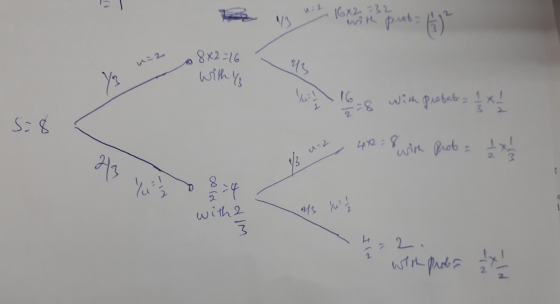
a. Uploaded the binomial tree , possible paths and stock prices. b. prob associated are explained in the picture- (1/3)^2, 1/2*1/3, 1/2*1/3, (1/2)*
Add Answer to:
2. Consider a two-period (T = 2) binomial model with initial stock price So = $8,...
NEED HELP WITH ALL QUESTIONS PLEASE!!!!! 14. Consider a one period binomial model. The initial stock...
 NEED HELP WITH ALL QUESTIONS PLEASE!!!!!
14. Consider a one period binomial model. The initial stock price is $30. Over the next 3 months, the stock price could either go up to $36 (u = 1.2) or go down to $24 (d = 0.8). The continuously compounded interest rate is 6% per annum. Use this information to answer the remaining questions in this assignment. Consider a call option whose strike price is $32. How many shares should be bought or...
NEED HELP WITH ALL QUESTIONS PLEASE!!!!!
14. Consider a one period binomial model. The initial stock price is $30. Over the next 3 months, the stock price could either go up to $36 (u = 1.2) or go down to $24 (d = 0.8). The continuously compounded interest rate is 6% per annum. Use this information to answer the remaining questions in this assignment. Consider a call option whose strike price is $32. How many shares should be bought or...
PROBLEM 2. Consider a two-step Binomial model. In Figure 1 you are given an incomplete pricing...
 PROBLEM 2. Consider a two-step Binomial model. In Figure 1 you are given an incomplete pricing tree, which corresponds to a European put option with strike price K = 65. (a) (5 Points) Compute the per period interest rate r and the risk-neutral probability p*. (b) (10 Points) Find the price of the put option at t = 0. Moreover, determine the complete binomial tree for the stock price. 2.6545 PE(O) 14.6 17.09 35.06 Figure 1: European put with K...
Consider the following one-period binomial model for stock price. At t = 0 the stock price...
Consider the following one-period binomial model for stock price. At t = 0 the stock price is $80 and at t = 1 (t is in years) it could be $70 with probability p > 0 and $y with probability 1 − p. The interest rate is assumed to be 8%. (1) Determine the range of values for y that precludes arbitrage in this model. (2) Assume that y = $83. Construct an arbitrage strategy for this model.1
2. Consider a two-period binomial tree with u = 1.16, d = 0.96, So = 49,...
 2. Consider a two-period binomial tree with u = 1.16, d = 0.96, So = 49, r = 0.07. Find the price of an American put with T = 2 and K = 50. (15 points)
1) consider a CRR model T = 2, S0= $100 , S1 = $200 or S1 = $50 an associated European call optio...
1) consider a CRR model T = 2, S0= $100 , S1 = $200 or S1 = $50 an associated European call option with strike price k = $80 and exercise time T = 2 assume that the risk free interest rate r = 0.1 a) draw the binary tree and compute the arbitrage free initial price of the European call option at time zero. b) Determine an explicit hedging strategy for this option c) Suppose that the option is...
1.2. You have a stock in the one-period binomial model such that So and r= 4,...
 1.2. You have a stock in the one-period binomial model such that So and r= 4, S1(H) = 8, S, (T) = 2, 1.5. (a) Show that this setup violates the no-arbitrage assumption. (b) Show that there is a portfolio in the one-period model such that Xo X1 > 0. Such a portfolio is an example of arbitrage extraction. 0, Ao #0, and %3D 1.3. With the same stock as in problem 1.2 but with r = 0.25, suppose that...
2. Let So and Si be the prices of a stock at t = 0. 1...
 2. Let So and Si be the prices of a stock at t = 0. 1 in the one-period binomial model. Assume the no-arbitrage condition 0 〈 d 〈 1 + r < u, and assume P(H)-p. We define θ-up + d(1-p)-1. Show that the expected value at t 0 of is 1S 1+θ Si 1+θ Eo =So-
5. Consider the single period binomial model as in Section 1.2.2. Suppose that d <1+r <u....
 5. Consider the single period binomial model as in Section 1.2.2. Suppose that d <1+r <u. Show that if there exists an arbitrage opportunity (as in Definition 1.5), then one can find an arbitrage opportunity with V = 0. This means that there is no net cash flow at time 0. (Note: This is a step in the proof of Proposition 1.7 which you should go through carefully.) 1.2.2 Formal logical content The theory we build will be a mathematical...
5. Consider the 3-period binomial model with So 100, u 2, dand r-1. (a) What is...
 5. Consider the 3-period binomial model with So 100, u 2, dand r-1. (a) What is the current price of a lookback call option with a strike price of $100 that pays off (at time three) V3- max Sn - 100 Sn3 (b) What is the time-zero price of a lookback put option with a strike price of $100 that pays off (at time three) V 100-min Sn OSnK3 (c) What is the time-zero price of an Asian call option...
Problem1 A stock is currently trading at S $40, during next 6 months stock price will increase to $44 or decrease to $32-6-month risk-free rate is rf-2%. a. [4pts) What positions in stock and T-...
 Problem1 A stock is currently trading at S $40, during next 6 months stock price will increase to $44 or decrease to $32-6-month risk-free rate is rf-2%. a. [4pts) What positions in stock and T-bills will you put to replicate the pay off of a European call option with K = $38 and maturing in 6 months. b. 1pt What is the value of this European call option? Problem 2 Suppose that stock price will increase 5% and decrease 5%...
 NEED HELP WITH ALL QUESTIONS PLEASE!!!!!
14. Consider a one period binomial model. The initial stock price is $30. Over the next 3 months, the stock price could either go up to $36 (u = 1.2) or go down to $24 (d = 0.8). The continuously compounded interest rate is 6% per annum. Use this information to answer the remaining questions in this assignment. Consider a call option whose strike price is $32. How many shares should be bought or...
NEED HELP WITH ALL QUESTIONS PLEASE!!!!!
14. Consider a one period binomial model. The initial stock price is $30. Over the next 3 months, the stock price could either go up to $36 (u = 1.2) or go down to $24 (d = 0.8). The continuously compounded interest rate is 6% per annum. Use this information to answer the remaining questions in this assignment. Consider a call option whose strike price is $32. How many shares should be bought or...
 PROBLEM 2. Consider a two-step Binomial model. In Figure 1 you are given an incomplete pricing tree, which corresponds to a European put option with strike price K = 65. (a) (5 Points) Compute the per period interest rate r and the risk-neutral probability p*. (b) (10 Points) Find the price of the put option at t = 0. Moreover, determine the complete binomial tree for the stock price. 2.6545 PE(O) 14.6 17.09 35.06 Figure 1: European put with K...
 2. Consider a two-period binomial tree with u = 1.16, d = 0.96, So = 49, r = 0.07. Find the price of an American put with T = 2 and K = 50. (15 points)
 1.2. You have a stock in the one-period binomial model such that So and r= 4, S1(H) = 8, S, (T) = 2, 1.5. (a) Show that this setup violates the no-arbitrage assumption. (b) Show that there is a portfolio in the one-period model such that Xo X1 > 0. Such a portfolio is an example of arbitrage extraction. 0, Ao #0, and %3D 1.3. With the same stock as in problem 1.2 but with r = 0.25, suppose that...
 2. Let So and Si be the prices of a stock at t = 0. 1 in the one-period binomial model. Assume the no-arbitrage condition 0 〈 d 〈 1 + r < u, and assume P(H)-p. We define θ-up + d(1-p)-1. Show that the expected value at t 0 of is 1S 1+θ Si 1+θ Eo =So-
 5. Consider the single period binomial model as in Section 1.2.2. Suppose that d <1+r <u. Show that if there exists an arbitrage opportunity (as in Definition 1.5), then one can find an arbitrage opportunity with V = 0. This means that there is no net cash flow at time 0. (Note: This is a step in the proof of Proposition 1.7 which you should go through carefully.) 1.2.2 Formal logical content The theory we build will be a mathematical...
 5. Consider the 3-period binomial model with So 100, u 2, dand r-1. (a) What is the current price of a lookback call option with a strike price of $100 that pays off (at time three) V3- max Sn - 100 Sn3 (b) What is the time-zero price of a lookback put option with a strike price of $100 that pays off (at time three) V 100-min Sn OSnK3 (c) What is the time-zero price of an Asian call option...
 Problem1 A stock is currently trading at S $40, during next 6 months stock price will increase to $44 or decrease to $32-6-month risk-free rate is rf-2%. a. [4pts) What positions in stock and T-bills will you put to replicate the pay off of a European call option with K = $38 and maturing in 6 months. b. 1pt What is the value of this European call option? Problem 2 Suppose that stock price will increase 5% and decrease 5%...
Most questions answered within 3 hours.
-
Where is the error in this code sequence?
String s1 = "Hello";
String s2 = "ello";...
asked 1 year ago -
Financial data for Joel de Paris, Inc., for last year
follow:
Joel de Paris, Inc.
Balance...
asked 1 year ago -
Consider this reaction:
Al2(SO4)3 (aq)+ BaCl3
(aq) Al2Cl6 (aq)- +
3BaSO4(s) . What is the...
asked 1 year ago -
Suppose that Savneet is considering increasing her
recent random sample from 20 car rentals to 40...
asked 1 year ago -
Trucks arrive at an unloading terminal at an average rate of 120
per hour.
Trucks arrive...
asked 1 year ago -
Why are methanol and ethanol completely soluble in water while
octanol is not very little soluble....
asked 1 year ago -
A facilities manager at a university reads in a research report
that the mean amount of...
asked 1 year ago -
When the CuSO4 is rehydrated by adding water to the anhydrous
compound, is this an endothermic...
asked 1 year ago -
A ray of sunlight is passing from diamond into crown glass; the
angle of incidence is...
asked 1 year ago -
A block of mass 0.249 kg is placed on top of a light, vertical
spring of...
asked 1 year ago -
how do the kidneys compensate in the presences of acidosis
a) trigger hyperventilate
b) reserve acid...
asked 1 year ago -
Question 501 pts
The rental rate of capital to the firm increases. Which of the
following...
asked 1 year ago