
Homework Answers
Here,

That implies,
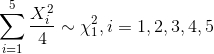
and by additive property of chi square distribution,

To find
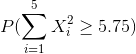
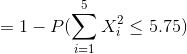
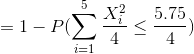



If x1 ,x2 ,x3 ,x4 ,x5 be a sample from b(1,p) where p is unknown and...
If x1 ,x2 ,x3 ,x4 ,x5 be a sample from b(1,p) where p is unknown and 0<=p<=1 test Ho:p = .5 vs H1:p ≠ .5
2. Let Xi, X2, X3, X4,X5 be a random sample of size 5 from a popula-...
 2. Let Xi, X2, X3, X4,X5 be a random sample of size 5 from a popula- tion following the standard normal distribution (mean 0 and variance 1), and let X Σ5 i Xi/5. Let 6 be another independent observation from the same popula- tion. What is the distribution of (b) Z-Σ51 (Xi-X)2, Why?
4. Let B = {x6 + 3, x5 + x3 + 1, x4 + x3, x3...
 4. Let B = {x6 + 3, x5 + x3 + 1, x4 + x3, x3 + x2} C Pg, where Pg is the polynomials of degree < 8. (a) (2 marks) Explain why B is a linearly independent subset of Pg. (b) (2 marks) Extend B to a basis of Pg by adding only polynomials from the standard basis of Pg.
Find the coefficient of x25 in (x2 + x3 + x4 + x5 + ...)8
Find the coefficient of x25 in (x2 + x3 + x4 + x5 + ...)8
Consider the following linear transformation T: RS → R3 where T(X1, X2, X3, X4, X5) =...
 Consider the following linear transformation T: RS → R3 where T(X1, X2, X3, X4, X5) = (x1-X3+X4, 2X1+X2-X3+2x4, -2X1+3x3-3x4+x5) (a) Determine the standard matrix representation A of T(x).
; Let at be a linear transformation as follows : T{x1,x2,x3,x4,x5} = {{x1-x3+2x2x5},{x2-x3+2x5},{x1+x2-2x3+x4+2x5},{2x2-2x3+x4+2x5}] a.) find the...
; Let at be a linear transformation as follows : T{x1,x2,x3,x4,x5} = {{x1-x3+2x2x5},{x2-x3+2x5},{x1+x2-2x3+x4+2x5},{2x2-2x3+x4+2x5}] a.) find the standard matrix representation A of T b.) find the basis of Col(A) c.) find a basis of Null(A) d.) is T 1-1? Is T onto?
For the data x1 = -1, x2 = -3, x3 = -2, x4 = 1, x5 = 0, find ∑...
 For the data x1 = -1, x2 =
-3, x3 = -2, x4 =
1, x5 = 0,
find ∑
(xi2).
For the data x1 = -1, x2 =
-3, x3 = -2, x4 =
1, x5 = 0,
find ∑
(xi2).
Express the following in the SIGMA notation: a. x1 +x2 +x3 +x4 +x5 b.x1 +2x2 +3x3...
Express the following in the SIGMA notation: a. x1 +x2 +x3 +x4 +x5 b.x1 +2x2 +3x3 +4x4 +5x5
Consider the following linear transformation T: R5 → R3 where T(X1, X2, X3, X4, X5) =...
 Consider the following linear transformation T: R5 → R3 where T(X1, X2, X3, X4, X5) = (*1-X3+X4, 2X1+X2-X3+2x4, -2X1+3X3-3x4+x5) (a) Determine the standard matrix representation A of T(x). (b) Find a basis for the kernel of T(x). (c) Find a basis for the range of T(x). (d) Is T(x) one-to-one? Is T(x) onto? Explain. (e) Is T(x) invertible? Explain
The coefficients respectively for X1, X2, X3, X4 and X5 are .01, .02, .03, .04 and...
The coefficients respectively for X1, X2, X3, X4 and X5 are .01, .02, .03, .04 and .05. Compute the Z score. Analyze whether this firm will fail, or not and why. Explicate the meaning of the Xs.
 2. Let Xi, X2, X3, X4,X5 be a random sample of size 5 from a popula- tion following the standard normal distribution (mean 0 and variance 1), and let X Σ5 i Xi/5. Let 6 be another independent observation from the same popula- tion. What is the distribution of (b) Z-Σ51 (Xi-X)2, Why?
 4. Let B = {x6 + 3, x5 + x3 + 1, x4 + x3, x3 + x2} C Pg, where Pg is the polynomials of degree < 8. (a) (2 marks) Explain why B is a linearly independent subset of Pg. (b) (2 marks) Extend B to a basis of Pg by adding only polynomials from the standard basis of Pg.
 Consider the following linear transformation T: RS → R3 where T(X1, X2, X3, X4, X5) = (x1-X3+X4, 2X1+X2-X3+2x4, -2X1+3x3-3x4+x5) (a) Determine the standard matrix representation A of T(x).
 For the data x1 = -1, x2 =
-3, x3 = -2, x4 =
1, x5 = 0,
find ∑
(xi2).
For the data x1 = -1, x2 =
-3, x3 = -2, x4 =
1, x5 = 0,
find ∑
(xi2).
 Consider the following linear transformation T: R5 → R3 where T(X1, X2, X3, X4, X5) = (*1-X3+X4, 2X1+X2-X3+2x4, -2X1+3X3-3x4+x5) (a) Determine the standard matrix representation A of T(x). (b) Find a basis for the kernel of T(x). (c) Find a basis for the range of T(x). (d) Is T(x) one-to-one? Is T(x) onto? Explain. (e) Is T(x) invertible? Explain
Most questions answered within 3 hours.
-
Where is the error in this code sequence?
String s1 = "Hello";
String s2 = "ello";...
asked 11 months ago -
Financial data for Joel de Paris, Inc., for last year
follow:
Joel de Paris, Inc.
Balance...
asked 11 months ago -
Consider this reaction:
Al2(SO4)3 (aq)+ BaCl3
(aq) Al2Cl6 (aq)- +
3BaSO4(s) . What is the...
asked 11 months ago -
Suppose that Savneet is considering increasing her
recent random sample from 20 car rentals to 40...
asked 11 months ago -
Trucks arrive at an unloading terminal at an average rate of 120
per hour.
Trucks arrive...
asked 11 months ago -
Why are methanol and ethanol completely soluble in water while
octanol is not very little soluble....
asked 11 months ago -
A facilities manager at a university reads in a research report
that the mean amount of...
asked 11 months ago -
When the CuSO4 is rehydrated by adding water to the anhydrous
compound, is this an endothermic...
asked 11 months ago -
A ray of sunlight is passing from diamond into crown glass; the
angle of incidence is...
asked 11 months ago -
A block of mass 0.249 kg is placed on top of a light, vertical
spring of...
asked 11 months ago -
how do the kidneys compensate in the presences of acidosis
a) trigger hyperventilate
b) reserve acid...
asked 11 months ago -
Question 501 pts
The rental rate of capital to the firm increases. Which of the
following...
asked 11 months ago