Homework Answers
![1000 given data [zn (NO3)2 ]initiae,M 0.226 Oolol 0,0452 0.0118 [KI03) initiae, M 0.200 0.200 0.200 0.200 Vinitial of Zn(NOx)](http://img.homeworklib.com/questions/6fa2a6e0-77b8-11ea-9125-2db9f8b4a2ca.png?x-oss-process=image/resize,w_560)
![Login+?)(1-^2 205 0.0.15 0.2 25 013 035 Tum & -- Dog (2n+1] * [1-)^2 - Lineal (log [2n+2]*[1742nt2)2] * and you get the cut w](http://img.homeworklib.com/questions/7034d790-77b8-11ea-acef-5b8b0aaa5f90.png?x-oss-process=image/resize,w_560)
Add Answer to:
For question 1, complete chart in chart form please and then
questions 2&3.
1. A student...
Section: Date: lodine Pre-Lab Questions 1. A student followed the procedure of this experiment to...
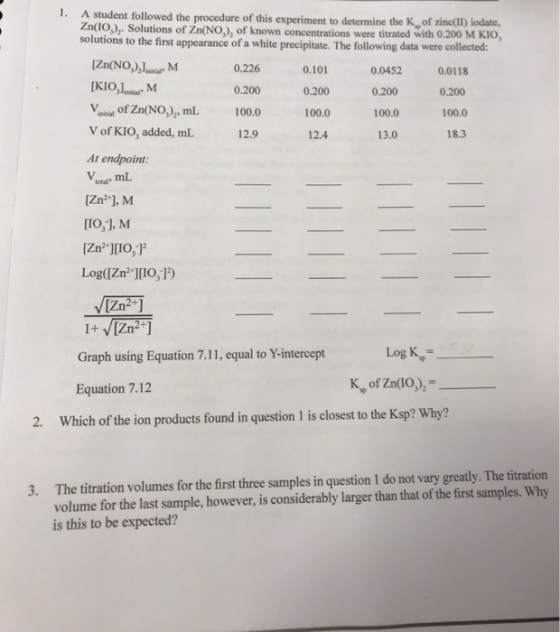
 Section: Date: lodine Pre-Lab Questions 1. A student followed the procedure of this experiment to determine the K of zinc(I) iodate, Zn(IO). Solutions of Zn(NO), of known concentrations were titrated with 0.200 M KIO, solutions to the first appearance of a white precipitate. The following data were collected: Zn(NO)atlM KIose M nof Zn(NO), mL V of KIO, added, mL At endpoint M0.226 0.200 100.0 12.9 0.101 0.200 100.0 12.4 0.0452 0.200 100.0 13.0 0.0118 0.200 100.0 18.3 112. 112.4 113...
TIe-LaboratoTV ASSISITICI 1. A student followed the procedure of this ex KIO, solutions to the first appearance of...
 TIe-LaboratoTV ASSISITICI 1. A student followed the procedure of this ex KIO, solutions to the first appearance of a the procedure of this experiment to determine the solubility product of zinc(IT) 2. Solutions of Zn(NO), of known initial concentrations were titrated with 0.200M ne first appearance of a white precipitate. The following data were collected: constant for zinc(II) iodate. ne table below and, by making the appropriate plot, determine the solubility product (Use additional paper for doing the calculations required...
#2 please. I have attached info for part 1 goal #3 demonstrate the calculations w OIVO...
 #2 please. I have attached info for part 1 goal
#3
demonstrate the calculations
w OIVO SU UGLUUL iz. Demonstrate through mole calculations that iodate was indeed the limiting reactant in the production of triiodide in Part 1 - Goal 3 (titration) of this study. You have three reactants to consider KI, 103, and H. Refer to the titration for Molarities and quantities used for each reactant. Assume that 10 mL of Klau) contains 1 gram of Klin) Goal #3:...
#2 please. I have attached info for part 1 goal
#3
demonstrate the calculations
w OIVO SU UGLUUL iz. Demonstrate through mole calculations that iodate was indeed the limiting reactant in the production of triiodide in Part 1 - Goal 3 (titration) of this study. You have three reactants to consider KI, 103, and H. Refer to the titration for Molarities and quantities used for each reactant. Assume that 10 mL of Klau) contains 1 gram of Klin) Goal #3:...
Experiment 17A. A Solubility Product Constant Procedure Getting Started 1. Obtain a 10 ml pipet, ...
 question#1
Experiment 17A. A Solubility Product Constant Procedure Getting Started 1. Obtain a 10 ml pipet, a 50 mL buret, and 2 pieces of 120 cm filter paper Preparing Saturated Solutions of M10J MIO), is an insoluble divalent iodate salt. The identity of the cation M-is unknown. 1 Prepare MIO,), by adding S0 ml of o.2 M KIO, to 20 mL of 1 Molar M(NO,J, in a 150 mt 2. Stir the mixture vigorously with a stirring rod. A white,...
question#1
Experiment 17A. A Solubility Product Constant Procedure Getting Started 1. Obtain a 10 ml pipet, a 50 mL buret, and 2 pieces of 120 cm filter paper Preparing Saturated Solutions of M10J MIO), is an insoluble divalent iodate salt. The identity of the cation M-is unknown. 1 Prepare MIO,), by adding S0 ml of o.2 M KIO, to 20 mL of 1 Molar M(NO,J, in a 150 mt 2. Stir the mixture vigorously with a stirring rod. A white,...
ANSWER ALL 3 QUESTIONS AND ALL PARTS Question 1 Using the standard reduction potentials on page 127, draw a compl...
 ANSWER ALL 3 QUESTIONS AND ALL PARTS
Question 1 Using the standard reduction potentials on page 127, draw a complete galvanic cell in the space below for Fe Ag a) Clearly label the electrodes, the solutions and the salt bridge. Clearly label which metal is the cathode and anode and a chemical you might use for the salt bridge. b) Give the half-reaction that occurs at the cathode and the half-reaction that occurs at the anode and indicate the direction...
ANSWER ALL 3 QUESTIONS AND ALL PARTS
Question 1 Using the standard reduction potentials on page 127, draw a complete galvanic cell in the space below for Fe Ag a) Clearly label the electrodes, the solutions and the salt bridge. Clearly label which metal is the cathode and anode and a chemical you might use for the salt bridge. b) Give the half-reaction that occurs at the cathode and the half-reaction that occurs at the anode and indicate the direction...
Question 1 Complete this prelab, and give this to your TA before prelab lecture starts. Please...
 Question 1
Complete this prelab, and give this to your TA before prelab lecture starts. Please remember that this prelab is weighted and worth 15% of your lab grade! Total Points 30 1. Consider the following reaction: Starting with 4.00 mL of 0.200 M Fe (anej in a cuvette, 0.10 mL increments of 0.00100 M SCN (wa) will be added. Assume that because [Fe oal(SCN (wl, the [Fe(SCN)'] concentration can be calculated from the limiting reagent, SCN. Calculate [Fe(SCN)2"]. Report...
Question 1
Complete this prelab, and give this to your TA before prelab lecture starts. Please remember that this prelab is weighted and worth 15% of your lab grade! Total Points 30 1. Consider the following reaction: Starting with 4.00 mL of 0.200 M Fe (anej in a cuvette, 0.10 mL increments of 0.00100 M SCN (wa) will be added. Assume that because [Fe oal(SCN (wl, the [Fe(SCN)'] concentration can be calculated from the limiting reagent, SCN. Calculate [Fe(SCN)2"]. Report...
1) What chemical is the titrant in this experiment? What chemical is the analyte in this experiment? Experi...
 1) What chemical is the titrant in this experiment? What
chemical is the analyte in this
experiment?
Experiment #8: Measuring the Vitamin C Content of Emergen-C™ Objectives: • Students will learn how to use a burette. • Students will learn how to use the iodine starch indicator system to monitor oxidation/reduction reactions. Students will learn how to conduct a titration to determine the amount of analyte in an unknown solution. • Students will learn about ascorbic acid's role as a...
1) What chemical is the titrant in this experiment? What
chemical is the analyte in this
experiment?
Experiment #8: Measuring the Vitamin C Content of Emergen-C™ Objectives: • Students will learn how to use a burette. • Students will learn how to use the iodine starch indicator system to monitor oxidation/reduction reactions. Students will learn how to conduct a titration to determine the amount of analyte in an unknown solution. • Students will learn about ascorbic acid's role as a...
Please help with the prelab questions! thank you!!!! Especially 2 and 3! Pre-Lab Questions 1. Calculate...
 Please help with the prelab questions! thank you!!!!
Especially 2 and 3!
Pre-Lab Questions 1. Calculate the theoretical equivalence point (the volume!) in terms of ml NaOH adde each of the titrations. Assume the concentration of acid is 0.81 M and the concentration of base is 0.51 M. 2. Which equation can be used to find the pH of a buffer? Calculate the pH of a buffer containing 0.20 M CH3COOH and 0.20 M CH3COONa. What is the pH after...
Please help with the prelab questions! thank you!!!!
Especially 2 and 3!
Pre-Lab Questions 1. Calculate the theoretical equivalence point (the volume!) in terms of ml NaOH adde each of the titrations. Assume the concentration of acid is 0.81 M and the concentration of base is 0.51 M. 2. Which equation can be used to find the pH of a buffer? Calculate the pH of a buffer containing 0.20 M CH3COOH and 0.20 M CH3COONa. What is the pH after...
Molarity for NaOH = 0.0873 2. In a second titration with the same solution of NaOH as used in Question #1, the student...
 Molarity for NaOH = 0.08732. In a second titration with the same solution of NaOH as used in Question #1, the student weighs out a sample of KHP of 0.359 g. Calculate the volume of the NaOH solution needed to neutralize this sample of KHP. 3. A monoprotic weak acid with the general formula of HA will react with a base, such as NaOH. Write the neutralization equation which describes the reaction. 4. If K, for the weak acid, HA is 1.8...
please help answer question 4, a-f please using the data below from chart 1 objectives from...
 please help answer question 4, a-f please
using the data below from chart 1
objectives from lab, thank you
DATA:CA y 3 Ay No3 Part I: Cell Potential of voltaic cells under standard conditions: cell CU CND2 #27 14.0m Give the half Half cell reaction at Combinations Oxidation Reduction E the anode and with [ion] takes place Theoretical takes place cathode. Write in M here here (V) above the arrow E c (V) if it is oxidation or reduction. |-0.340...
please help answer question 4, a-f please
using the data below from chart 1
objectives from lab, thank you
DATA:CA y 3 Ay No3 Part I: Cell Potential of voltaic cells under standard conditions: cell CU CND2 #27 14.0m Give the half Half cell reaction at Combinations Oxidation Reduction E the anode and with [ion] takes place Theoretical takes place cathode. Write in M here here (V) above the arrow E c (V) if it is oxidation or reduction. |-0.340...
 Section: Date: lodine Pre-Lab Questions 1. A student followed the procedure of this experiment to determine the K of zinc(I) iodate, Zn(IO). Solutions of Zn(NO), of known concentrations were titrated with 0.200 M KIO, solutions to the first appearance of a white precipitate. The following data were collected: Zn(NO)atlM KIose M nof Zn(NO), mL V of KIO, added, mL At endpoint M0.226 0.200 100.0 12.9 0.101 0.200 100.0 12.4 0.0452 0.200 100.0 13.0 0.0118 0.200 100.0 18.3 112. 112.4 113...
 TIe-LaboratoTV ASSISITICI 1. A student followed the procedure of this ex KIO, solutions to the first appearance of a the procedure of this experiment to determine the solubility product of zinc(IT) 2. Solutions of Zn(NO), of known initial concentrations were titrated with 0.200M ne first appearance of a white precipitate. The following data were collected: constant for zinc(II) iodate. ne table below and, by making the appropriate plot, determine the solubility product (Use additional paper for doing the calculations required...
 #2 please. I have attached info for part 1 goal
#3
demonstrate the calculations
w OIVO SU UGLUUL iz. Demonstrate through mole calculations that iodate was indeed the limiting reactant in the production of triiodide in Part 1 - Goal 3 (titration) of this study. You have three reactants to consider KI, 103, and H. Refer to the titration for Molarities and quantities used for each reactant. Assume that 10 mL of Klau) contains 1 gram of Klin) Goal #3:...
#2 please. I have attached info for part 1 goal
#3
demonstrate the calculations
w OIVO SU UGLUUL iz. Demonstrate through mole calculations that iodate was indeed the limiting reactant in the production of triiodide in Part 1 - Goal 3 (titration) of this study. You have three reactants to consider KI, 103, and H. Refer to the titration for Molarities and quantities used for each reactant. Assume that 10 mL of Klau) contains 1 gram of Klin) Goal #3:...
 question#1
Experiment 17A. A Solubility Product Constant Procedure Getting Started 1. Obtain a 10 ml pipet, a 50 mL buret, and 2 pieces of 120 cm filter paper Preparing Saturated Solutions of M10J MIO), is an insoluble divalent iodate salt. The identity of the cation M-is unknown. 1 Prepare MIO,), by adding S0 ml of o.2 M KIO, to 20 mL of 1 Molar M(NO,J, in a 150 mt 2. Stir the mixture vigorously with a stirring rod. A white,...
question#1
Experiment 17A. A Solubility Product Constant Procedure Getting Started 1. Obtain a 10 ml pipet, a 50 mL buret, and 2 pieces of 120 cm filter paper Preparing Saturated Solutions of M10J MIO), is an insoluble divalent iodate salt. The identity of the cation M-is unknown. 1 Prepare MIO,), by adding S0 ml of o.2 M KIO, to 20 mL of 1 Molar M(NO,J, in a 150 mt 2. Stir the mixture vigorously with a stirring rod. A white,...
 ANSWER ALL 3 QUESTIONS AND ALL PARTS
Question 1 Using the standard reduction potentials on page 127, draw a complete galvanic cell in the space below for Fe Ag a) Clearly label the electrodes, the solutions and the salt bridge. Clearly label which metal is the cathode and anode and a chemical you might use for the salt bridge. b) Give the half-reaction that occurs at the cathode and the half-reaction that occurs at the anode and indicate the direction...
ANSWER ALL 3 QUESTIONS AND ALL PARTS
Question 1 Using the standard reduction potentials on page 127, draw a complete galvanic cell in the space below for Fe Ag a) Clearly label the electrodes, the solutions and the salt bridge. Clearly label which metal is the cathode and anode and a chemical you might use for the salt bridge. b) Give the half-reaction that occurs at the cathode and the half-reaction that occurs at the anode and indicate the direction...
 Question 1
Complete this prelab, and give this to your TA before prelab lecture starts. Please remember that this prelab is weighted and worth 15% of your lab grade! Total Points 30 1. Consider the following reaction: Starting with 4.00 mL of 0.200 M Fe (anej in a cuvette, 0.10 mL increments of 0.00100 M SCN (wa) will be added. Assume that because [Fe oal(SCN (wl, the [Fe(SCN)'] concentration can be calculated from the limiting reagent, SCN. Calculate [Fe(SCN)2"]. Report...
Question 1
Complete this prelab, and give this to your TA before prelab lecture starts. Please remember that this prelab is weighted and worth 15% of your lab grade! Total Points 30 1. Consider the following reaction: Starting with 4.00 mL of 0.200 M Fe (anej in a cuvette, 0.10 mL increments of 0.00100 M SCN (wa) will be added. Assume that because [Fe oal(SCN (wl, the [Fe(SCN)'] concentration can be calculated from the limiting reagent, SCN. Calculate [Fe(SCN)2"]. Report...
 1) What chemical is the titrant in this experiment? What
chemical is the analyte in this
experiment?
Experiment #8: Measuring the Vitamin C Content of Emergen-C™ Objectives: • Students will learn how to use a burette. • Students will learn how to use the iodine starch indicator system to monitor oxidation/reduction reactions. Students will learn how to conduct a titration to determine the amount of analyte in an unknown solution. • Students will learn about ascorbic acid's role as a...
1) What chemical is the titrant in this experiment? What
chemical is the analyte in this
experiment?
Experiment #8: Measuring the Vitamin C Content of Emergen-C™ Objectives: • Students will learn how to use a burette. • Students will learn how to use the iodine starch indicator system to monitor oxidation/reduction reactions. Students will learn how to conduct a titration to determine the amount of analyte in an unknown solution. • Students will learn about ascorbic acid's role as a...
 Please help with the prelab questions! thank you!!!!
Especially 2 and 3!
Pre-Lab Questions 1. Calculate the theoretical equivalence point (the volume!) in terms of ml NaOH adde each of the titrations. Assume the concentration of acid is 0.81 M and the concentration of base is 0.51 M. 2. Which equation can be used to find the pH of a buffer? Calculate the pH of a buffer containing 0.20 M CH3COOH and 0.20 M CH3COONa. What is the pH after...
Please help with the prelab questions! thank you!!!!
Especially 2 and 3!
Pre-Lab Questions 1. Calculate the theoretical equivalence point (the volume!) in terms of ml NaOH adde each of the titrations. Assume the concentration of acid is 0.81 M and the concentration of base is 0.51 M. 2. Which equation can be used to find the pH of a buffer? Calculate the pH of a buffer containing 0.20 M CH3COOH and 0.20 M CH3COONa. What is the pH after...
 Molarity for NaOH = 0.08732. In a second titration with the same solution of NaOH as used in Question #1, the student weighs out a sample of KHP of 0.359 g. Calculate the volume of the NaOH solution needed to neutralize this sample of KHP. 3. A monoprotic weak acid with the general formula of HA will react with a base, such as NaOH. Write the neutralization equation which describes the reaction. 4. If K, for the weak acid, HA is 1.8...
 please help answer question 4, a-f please
using the data below from chart 1
objectives from lab, thank you
DATA:CA y 3 Ay No3 Part I: Cell Potential of voltaic cells under standard conditions: cell CU CND2 #27 14.0m Give the half Half cell reaction at Combinations Oxidation Reduction E the anode and with [ion] takes place Theoretical takes place cathode. Write in M here here (V) above the arrow E c (V) if it is oxidation or reduction. |-0.340...
please help answer question 4, a-f please
using the data below from chart 1
objectives from lab, thank you
DATA:CA y 3 Ay No3 Part I: Cell Potential of voltaic cells under standard conditions: cell CU CND2 #27 14.0m Give the half Half cell reaction at Combinations Oxidation Reduction E the anode and with [ion] takes place Theoretical takes place cathode. Write in M here here (V) above the arrow E c (V) if it is oxidation or reduction. |-0.340...
Most questions answered within 3 hours.
-
Where is the error in this code sequence?
String s1 = "Hello";
String s2 = "ello";...
asked 10 months ago -
Financial data for Joel de Paris, Inc., for last year
follow:
Joel de Paris, Inc.
Balance...
asked 10 months ago -
Consider this reaction:
Al2(SO4)3 (aq)+ BaCl3
(aq) Al2Cl6 (aq)- +
3BaSO4(s) . What is the...
asked 10 months ago -
Suppose that Savneet is considering increasing her
recent random sample from 20 car rentals to 40...
asked 10 months ago -
Trucks arrive at an unloading terminal at an average rate of 120
per hour.
Trucks arrive...
asked 10 months ago -
Why are methanol and ethanol completely soluble in water while
octanol is not very little soluble....
asked 10 months ago -
A facilities manager at a university reads in a research report
that the mean amount of...
asked 10 months ago -
When the CuSO4 is rehydrated by adding water to the anhydrous
compound, is this an endothermic...
asked 10 months ago -
A ray of sunlight is passing from diamond into crown glass; the
angle of incidence is...
asked 10 months ago -
A block of mass 0.249 kg is placed on top of a light, vertical
spring of...
asked 10 months ago -
how do the kidneys compensate in the presences of acidosis
a) trigger hyperventilate
b) reserve acid...
asked 10 months ago -
Question 501 pts
The rental rate of capital to the firm increases. Which of the
following...
asked 10 months ago