

Homework Answers
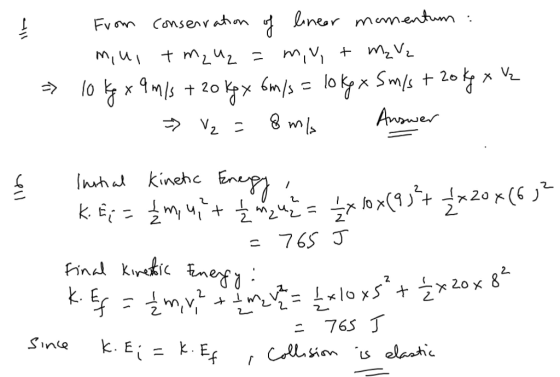
During collision of objects, since there is no external force, the total linear momentum of the system remain conserved.
Further for elastic collision, the total kinetic energy also remain conserved. the solution is based on same principle as below:
Add Answer to:
9.00 m/s (Cright) collides with 1.An object of mass 10.o kg moving with a velocity ofo...
2.An object of mass 10.0 kg moving with a velocity of 9.00 mls collision with another...
 2.An object of mass 10.0 kg moving with a velocity of 9.00 mls collision with another object of mass 20.0kg direction. After the collision the 10.0 kg object moves with a veloci moving at 6.00 m/ s in the opposite ty of 2 osite direction. What is the velocity of the 20.0 kg object after this co mu's in Lo Calaulate the loss of KE nveted to other forms of energy) during the collision in questions 2, What type of...
5. A pile-driver of mass 380.0 kg moving at 20.0 m/s hits a stationary stake of...
 5. A pile-driver of mass 380.0 kg moving at 20.0 m/s hits a stationary stake of mass 20.0 kg. If the two move off together, calculate their common velocity. 6. Show that the collision in questions 1 is elastic; that is find total KE before collision and total KE after collision. If they are equal, then collision is elastic.
A mass of 2.5 kg moving at 5.5 m/s collides with a stationary object of mass...
A mass of 2.5 kg moving at 5.5 m/s collides with a stationary object of mass 4.6 kg. After collision, they move off together. Calculate the final speed in m/s, to 2 sf.
a 2 kg object is moving east 3 m/s. It collides with a 10 kg object...
a 2 kg object is moving east 3 m/s. It collides with a 10 kg object moving west 5 m/s. after the collision, the 2 kg moves west with velocity of 5 m/s. A.) what is the velocity of the 10 kg after the collision? B.) Show that kinetic energy is not considered.
An object with a mass of 9.00 g is moving to the right at 14.0 cm/s...
 An object with a mass of 9.00 g is moving to the right at 14.0 cm/s when it is overtaken by an object with a mass of 25.0 g moving in the same direction with a speed of 20.0 cm/s. If the collision is elastic, determine the speed of each object after the collision in centimeters per second. 25.0 g object cm/s 9.00 g object cm/s
A moving object A of mass 8.7 kg and speed 2.2 m/s collides with a stationary...
A moving object A of mass 8.7 kg and speed 2.2 m/s collides with a stationary object B of mass 9.4 kg. The collision is totally inelastic. Calculate the speed of the combined object after collision.
A 19.5kg object moving in the +x direction at 5.5 m/s collides head on with a...
A 19.5kg object moving in the +x direction at 5.5 m/s collides head on with a 15.9kg object moving in the -x direction at 3.5m/s. Part A Find the final velocity of each mass if the objects stick together. Part B Find the final velocity of each mass if the collision is elastic. Part C Find the final velocity of each mass if the 19.5 kg object is at rest after the collision. Part D Is the result in part...
A 2kg mass moving with a velocity of 7 m/s collides elastically with a 4 kg...
A 2kg mass moving with a velocity of 7 m/s collides elastically with a 4 kg mass moving in the opposite direction at 4 m/s. The 2 kg mass reverses direction after the collision and has a new velocity of 3 m/s. What is the new velocity of the 4 kg mass
A proton (mass 1 u) moving at 9.00 10^(6) m/s collides elastically and head-on with a...
A proton (mass 1 u) moving at 9.00 10^(6) m/s collides elastically and head-on with a second particle moving in the opposite direction at 2.00 10^(6) m/s. After the collision, the proton is moving opposite to its initial direction at 5.40 10^(6) m/s. Find the mass and final velocity of the second particle. [Take the proton's initial velocity to be in the positive direction.]
An object of mass 2.91 kg, moving with an initial velocity of 4.99 î m/s, collides...
An object of mass 2.91 kg, moving with an initial velocity of 4.99 î m/s, collides with and sticks to an object of mass 2.36 kg with an initial velocity of -3.19 ĵ m/s. Find the final velocity of the composite object.
 2.An object of mass 10.0 kg moving with a velocity of 9.00 mls collision with another object of mass 20.0kg direction. After the collision the 10.0 kg object moves with a veloci moving at 6.00 m/ s in the opposite ty of 2 osite direction. What is the velocity of the 20.0 kg object after this co mu's in Lo Calaulate the loss of KE nveted to other forms of energy) during the collision in questions 2, What type of...
 5. A pile-driver of mass 380.0 kg moving at 20.0 m/s hits a stationary stake of mass 20.0 kg. If the two move off together, calculate their common velocity. 6. Show that the collision in questions 1 is elastic; that is find total KE before collision and total KE after collision. If they are equal, then collision is elastic.
 An object with a mass of 9.00 g is moving to the right at 14.0 cm/s when it is overtaken by an object with a mass of 25.0 g moving in the same direction with a speed of 20.0 cm/s. If the collision is elastic, determine the speed of each object after the collision in centimeters per second. 25.0 g object cm/s 9.00 g object cm/s
Most questions answered within 3 hours.
-
Where is the error in this code sequence?
String s1 = "Hello";
String s2 = "ello";...
asked 10 months ago -
Financial data for Joel de Paris, Inc., for last year
follow:
Joel de Paris, Inc.
Balance...
asked 10 months ago -
Consider this reaction:
Al2(SO4)3 (aq)+ BaCl3
(aq) Al2Cl6 (aq)- +
3BaSO4(s) . What is the...
asked 10 months ago -
Suppose that Savneet is considering increasing her
recent random sample from 20 car rentals to 40...
asked 10 months ago -
Trucks arrive at an unloading terminal at an average rate of 120
per hour.
Trucks arrive...
asked 10 months ago -
Why are methanol and ethanol completely soluble in water while
octanol is not very little soluble....
asked 10 months ago -
A facilities manager at a university reads in a research report
that the mean amount of...
asked 10 months ago -
When the CuSO4 is rehydrated by adding water to the anhydrous
compound, is this an endothermic...
asked 10 months ago -
A ray of sunlight is passing from diamond into crown glass; the
angle of incidence is...
asked 10 months ago -
A block of mass 0.249 kg is placed on top of a light, vertical
spring of...
asked 10 months ago -
how do the kidneys compensate in the presences of acidosis
a) trigger hyperventilate
b) reserve acid...
asked 10 months ago -
Question 501 pts
The rental rate of capital to the firm increases. Which of the
following...
asked 10 months ago