
Homework Answers
Answer:
Step 1: Explanation:
Kc is defined as the amounts of products and reactants present at equilibrium in a reversible chemical reaction at a given temperature.
Kp is the equilibrium constant calculated from the partial pressures of a reaction equation. It is used to express the relationship between product pressures and reactant pressures
Relationship between Kp and Kc is
Kp = Kc (RT)Δn where, Δ n = ( moles of gaseous products - moles of gaseous reactants
Step 2: Solution
Given, CaCO3(s)⇌CaO(s)+CO2(g)
Δ n = ( moles of gaseous products - moles of gaseous reactants )
Δ n = (0+1) -(0) = 1 [ because moles of solid is not considered ]
Since we know
Kp = Kc (RT)Δn
then, Kc = Kp / (RT)Δn
if Δ n = 1 then Kc = Kp / (RT) [ where R = gas constant = 8.314 J / mol.K ]
Add Answer to:
O KINETICS AND EQUILIBRIUM Interconverting Kp and Kc Consider the following chemical equilibrium: CaCO,G) = CaO...
SYNBUDYIPUWhQH72382-COM NOVO Nimg2How OKINETICS AND EQUILIBRIUM Interconverting Kp and Kc Consider the following chemical equilibrium: 2H,...
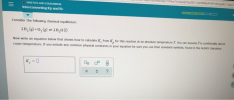 SYNBUDYIPUWhQH72382-COM NOVO Nimg2How OKINETICS AND EQUILIBRIUM Interconverting Kp and Kc Consider the following chemical equilibrium: 2H, ()+0,() = 2H,0(1) Now write an equation below that shows how to calculate K from K for this reaction at an absolute temperature T. You can assume Tis comfortably above room temperature. If you include any common physical constants in your equation be sure you use their standard symbols, found in the ALEKS Calculator K = 0 x 5 ?
Consider the following chemical equilibrium: 2 H,O Now write an equation below that shows how to ...
 Consider the following chemical equilibrium: 2 H,O Now write an equation below that shows how to calculate Kp from Kc for this reaction at an absolute temperature T assume T is comfortably above room temperature. If you include any common physical constants in your equation be sure you use their standard symbols, found in the ALEKS Calculator. dlo
Consider the following chemical equilibrium: 2 H,O Now write an equation below that shows how to calculate Kp from Kc for this...
Consider the following chemical equilibrium: 2 H,O Now write an equation below that shows how to calculate Kp from Kc for this reaction at an absolute temperature T assume T is comfortably above room temperature. If you include any common physical constants in your equation be sure you use their standard symbols, found in the ALEKS Calculator. dlo
Consider the following chemical equilibrium: 2 H,O Now write an equation below that shows how to calculate Kp from Kc for this...
Consider the following chemical equilibrium: H2(g)+F2(g)⇌2HF(g) Now write an equation below that shows how to calculate...
Consider the following chemical equilibrium: H2(g)+F2(g)⇌2HF(g) Now write an equation below that shows how to calculate Kc from Kp for this reaction at an absolute temperature T. You can assume T is comfortably above room temperature. Kc=
= Objective Knowledge Check Consider the following chemical equilibrium: C(s)+2H, (g) =CH, (g) Now write an equatio...
 = Objective Knowledge Check Consider the following chemical equilibrium: C(s)+2H, (g) =CH, (g) Now write an equation below that shows how to calculate K, from K for this reaction at an ab room temperature. If you include any common physical constants in your equation be sure you K = 0 X 6 X
1:Consider the following equilibrium process at 686°C: CO2(g) + H2(g) ⇌ CO(g) + H2O(g) The equilibrium...
1:Consider the following equilibrium process at 686°C: CO2(g) + H2(g) ⇌ CO(g) + H2O(g) The equilibrium concentrations of the reacting species are [CO] = 0.0570 M, [H2] = 0.0420 M, [CO2] = 0.0860 M, and [H2O] = 0.0430 M. (a) Calculate Kc for the reaction at 686°C. (b)If we add CO2 to increase its concentration to 0.440 mol / L, what will the concentrations of all the gases be when equilibrium is reestablished? (c) CO2: H2: CO: H2O: 2:The following...
The equilibrium constant, Kp, for the following reaction is 1.57 at 600 K: CO(g) + Cl2(g)...
The equilibrium constant, Kp, for the following reaction is 1.57 at 600 K: CO(g) + Cl2(g) COCl2(g) Calculate the equilibrium partial pressures of all species when CO and Cl2, each at an intitial partial pressure of 1.70 atm, are introduced into an evacuated vessel at 600 K. PCO = atm PCl2 = atm PCOCl2 = atm B. The equilibrium constant, Kc, for the following reaction is 2.90×10⁻² at 1150 K. 2SO3(g) 2SO2(g) + O2(g) Calculate Kc at this temperature for...
O KINETICS AND EQUILIBRIUM Using the general properties of equilibrium constants At a certain temperature, the...
 O KINETICS AND EQUILIBRIUM Using the general properties of equilibrium constants At a certain temperature, the equilibrium constant K for the following reaction is 0.92: Br (8) + OCI,(g) BIOCI(g) + BrCI(g) Use this information to complete the following table, Suppose a 6.0 L reaction vessel is filled with 1.3 mol of Bry and 1.3 mol of Clz. What can you say about the composition of the mixture in the vessel at equilibrium? There will be very little Br2 and...
Consider the following system at equilibrium where H° = 111 kJ, and Kc = 6.30, at...
Consider the following system at equilibrium where H° = 111 kJ, and Kc = 6.30, at 723 K. 2NH3(g) N2(g) + 3H2(g) When 0.22 moles of N2(g) are added to the equilibrium system at constant temperature: please double check answer to make sure its correct, thank you. The value of Kc _________increases.decreases.remains the same. The value of Qc _________is greater than is equal to is less than Kc. The reaction must ? run in the forward direction to restablish equilibrium. run in...
1) For the following reaction: SO2Cl2(g)<-> SO2(g) + Cl2 (g) Kp=2.91x10^3 at 298K In the reaction...
1) For the following reaction: SO2Cl2(g)<-> SO2(g) + Cl2 (g) Kp=2.91x10^3 at 298K In the reaction at equilibrium, the partial pressure of SO2 is 137 torr and that of CL2 is 285 torr. The partial pressure of SO2Cl2 is [x]torr. 2) For the following reaction:NH4HS(s)<->NH3(g) + H2S (g) Kc=8.5x10^-3 At any given point the reaction mixture has solid NH4HS, NH3 at 0.166M and H2S at 0.166M. a) Is the reaction at equilibrium? b)Will more of the solid form, or will...
Chemical Equilibrium Characteristics Consider the reaction: H20(g)Co(g) = H2(g) Co2(g) Which the following statements a...
 Chemical Equilibrium Characteristics Consider the reaction: H20(g)Co(g) = H2(g) Co2(g) Which the following statements are true and which are false. In general, at a given temperature, the reaction quotient (Q) is a constant. true Amounts of all reactants and products corresponding to an exact equilibrium composition for this reaction are sealed in a vessel. The CO placed in the vessel is labelled with 14C. After an indefinite period false time 14C may be found in both CO and CO2 molecules....
 SYNBUDYIPUWhQH72382-COM NOVO Nimg2How OKINETICS AND EQUILIBRIUM Interconverting Kp and Kc Consider the following chemical equilibrium: 2H, ()+0,() = 2H,0(1) Now write an equation below that shows how to calculate K from K for this reaction at an absolute temperature T. You can assume Tis comfortably above room temperature. If you include any common physical constants in your equation be sure you use their standard symbols, found in the ALEKS Calculator K = 0 x 5 ?
 Consider the following chemical equilibrium: 2 H,O Now write an equation below that shows how to calculate Kp from Kc for this reaction at an absolute temperature T assume T is comfortably above room temperature. If you include any common physical constants in your equation be sure you use their standard symbols, found in the ALEKS Calculator. dlo
Consider the following chemical equilibrium: 2 H,O Now write an equation below that shows how to calculate Kp from Kc for this...
Consider the following chemical equilibrium: 2 H,O Now write an equation below that shows how to calculate Kp from Kc for this reaction at an absolute temperature T assume T is comfortably above room temperature. If you include any common physical constants in your equation be sure you use their standard symbols, found in the ALEKS Calculator. dlo
Consider the following chemical equilibrium: 2 H,O Now write an equation below that shows how to calculate Kp from Kc for this...
 = Objective Knowledge Check Consider the following chemical equilibrium: C(s)+2H, (g) =CH, (g) Now write an equation below that shows how to calculate K, from K for this reaction at an ab room temperature. If you include any common physical constants in your equation be sure you K = 0 X 6 X
 O KINETICS AND EQUILIBRIUM Using the general properties of equilibrium constants At a certain temperature, the equilibrium constant K for the following reaction is 0.92: Br (8) + OCI,(g) BIOCI(g) + BrCI(g) Use this information to complete the following table, Suppose a 6.0 L reaction vessel is filled with 1.3 mol of Bry and 1.3 mol of Clz. What can you say about the composition of the mixture in the vessel at equilibrium? There will be very little Br2 and...
 Chemical Equilibrium Characteristics Consider the reaction: H20(g)Co(g) = H2(g) Co2(g) Which the following statements are true and which are false. In general, at a given temperature, the reaction quotient (Q) is a constant. true Amounts of all reactants and products corresponding to an exact equilibrium composition for this reaction are sealed in a vessel. The CO placed in the vessel is labelled with 14C. After an indefinite period false time 14C may be found in both CO and CO2 molecules....
Most questions answered within 3 hours.
-
Where is the error in this code sequence?
String s1 = "Hello";
String s2 = "ello";...
asked 10 months ago -
Financial data for Joel de Paris, Inc., for last year
follow:
Joel de Paris, Inc.
Balance...
asked 10 months ago -
Consider this reaction:
Al2(SO4)3 (aq)+ BaCl3
(aq) Al2Cl6 (aq)- +
3BaSO4(s) . What is the...
asked 10 months ago -
Suppose that Savneet is considering increasing her
recent random sample from 20 car rentals to 40...
asked 10 months ago -
Trucks arrive at an unloading terminal at an average rate of 120
per hour.
Trucks arrive...
asked 10 months ago -
Why are methanol and ethanol completely soluble in water while
octanol is not very little soluble....
asked 10 months ago -
A facilities manager at a university reads in a research report
that the mean amount of...
asked 10 months ago -
When the CuSO4 is rehydrated by adding water to the anhydrous
compound, is this an endothermic...
asked 10 months ago -
A ray of sunlight is passing from diamond into crown glass; the
angle of incidence is...
asked 10 months ago -
A block of mass 0.249 kg is placed on top of a light, vertical
spring of...
asked 10 months ago -
how do the kidneys compensate in the presences of acidosis
a) trigger hyperventilate
b) reserve acid...
asked 10 months ago -
Question 501 pts
The rental rate of capital to the firm increases. Which of the
following...
asked 10 months ago