
Homework Answers
Add Answer to:
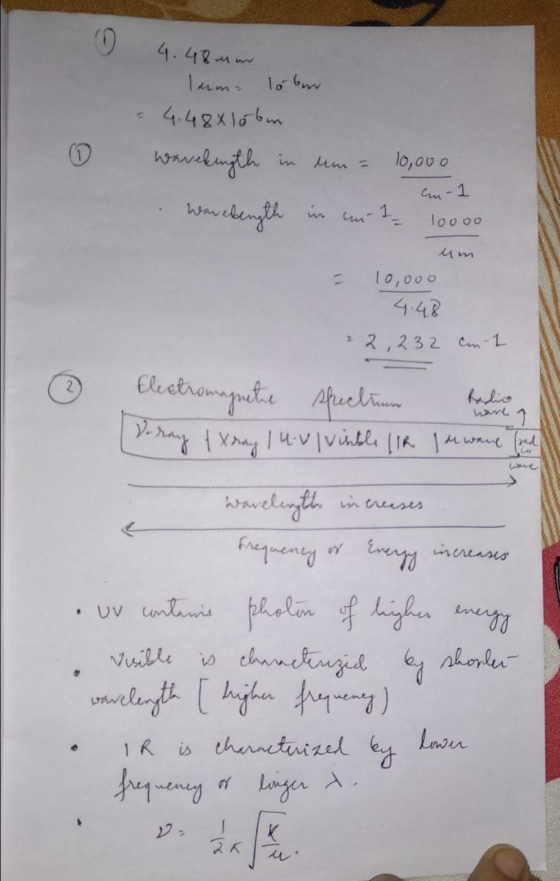
An infrared wavelength of 4.48um is equivalent to a wavenumber of cm-1 Which region of the...
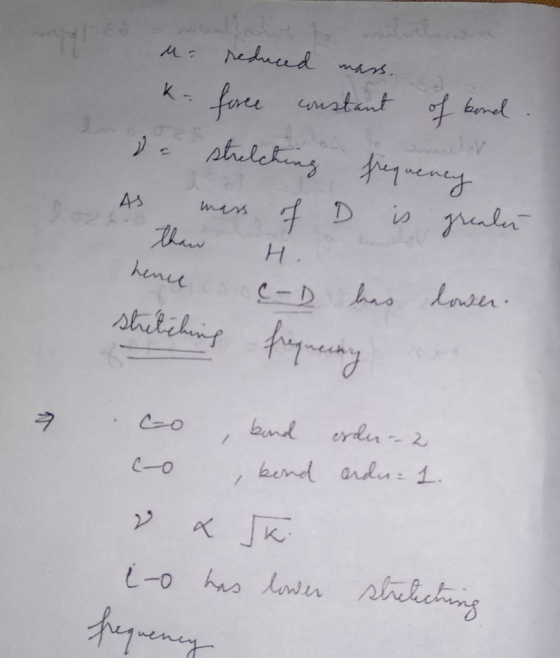
Indicate which of the following statements about the electromagnetic spectrum and IR spectroscopy are true and...
Indicate which of the following statements about the electromagnetic spectrum and IR spectroscopy are true and which are false. In any cases where the statement is false, explain how or why the statement is false. Infrared (IR) light is in the gamma ray part of the electromagnetic spectrum. Electromagnetic radiation is characterized by its mass and force. UV-Vis spectra are normally scanned in the 4000-600 cm-1 region. The fingerprint region on an IR spectrum is the easiest to interpret. Stronger...
2. What part of the electromagnetic spectrum (wavelength range) occupies the infrared region and from it...
2. What part of the electromagnetic spectrum (wavelength range) occupies the infrared region and from it which specific range is used with the organic molecules. ? 3. In general, how do you compare the radiations of IR with UV, X-ray and microwave radiation in terms of energy? Organize in increasing order. 4. What causes exposure or proximity in humans: a) to an IR lamp, b) spending an hour under the sun, c) taking a plate with X-rays or obtaining an...
In addition to the visible peaks seen in the H emission spectrum, there are other transitions...
In addition to the visible peaks seen in the H emission spectrum, there are other transitions occurring that give peaks detected in the ultraviolet (UV) region and in the infrared (IR) region of the electromagnetic spectrum. Compared to the transitions that emit visible light, would transitions in the UV region: (a) have a longer or shorter wavelength than the visible transitions and (b) correspond to greater energy or less energy than visible transitions? Explain your answer.
The electromagnetic spectrum arranged by increasing wavelength is O radio waves, gamma rays, x-rays, visible light,...
 The electromagnetic spectrum arranged by increasing wavelength is O radio waves, gamma rays, x-rays, visible light, infrared, microwave, ultra violet. O x-rays, gamma rays, ultraviolet, visible light, infrared, microwave, radio waves. O infrared, gamma rays, x-rays, ultraviolet, visible light, microwave, radio waves. O gamma rays, x-rays, ultraviolet, visible light, infrared, microwave, radio waves.
help please E. A and C Question 6. Which of the following is currently most often...
 help please
E. A and C Question 6. Which of the following is currently most often used to indicate the location of a signal on an IR spectrum? A. wavelength B. wavenumber C. frequency D. A and B E. all of these Question 7. Warmer objects emit more radiation. A. UV B. Microwave C. IR D. Visible E. x-ray Question 8. Which of the following are units for wavenumber in IR spectroscopy? 8 cm C. J-s cm E. J-s Question...
help please
E. A and C Question 6. Which of the following is currently most often used to indicate the location of a signal on an IR spectrum? A. wavelength B. wavenumber C. frequency D. A and B E. all of these Question 7. Warmer objects emit more radiation. A. UV B. Microwave C. IR D. Visible E. x-ray Question 8. Which of the following are units for wavenumber in IR spectroscopy? 8 cm C. J-s cm E. J-s Question...
Be sure to answer all parts. (a) What is the wavelength (in nm) of radiation that...
Be sure to answer all parts. (a) What is the wavelength (in nm) of radiation that has an energy content of 3.55 × 10³ kJ/mol? __× 10__ nm (b) In which region of the electromagnetic spectrum is this radiation found? gamma ray visible radio wave microwave X-ray ultraviolet infrared
Which one of the following has the highest frequency?
 Example 1: The electromagnetic spectrum of light is often arranged in terms of frequency. Which one of the following has the highest frequency? a. Visible light b. Microwaves c. infrared light d. Gamma rays e. radio waves f. X-rays g. Ultraviolet light Example 2: The electromagnetic spectrum of light is often arranged in terms of wavelength. Which one of the following has the longest wavelength? a. Visible light b. Microwaves c. infrared light d. Gamma rays e. radio waves f. X-rays g. Ultraviolet light Example 3: Which one of the following has the fastest speed? a. Visible...
The diagram shows the electromagnetic spectrum.
 1.The diagram shows the electromagnetic spectrum. Identify the types of electromagnetic radiation (EMR) with the following characteristics. (a) highest frequency radio waves microwaves infrared visible ultraviolet X rays gamma rays (b) highest energy radio waves microwaves infrared visible ultraviolet X rays gamma rays (c) longest wavelength radio waves microwaves infrared visible ultraviolet X rays gamma rays2. Calculate the energy (in joules) of a photon with a wavelength of 2.93x10 nm.
7. To eject electrons from the surface of sodium requires photons with a wavelength less than...
 7. To eject electrons from the surface of sodium requires photons with a wavelength less than or equal to 535 nm. A. Determine the minimum frequency of light that can eject electrons from [3 points] sodium's surface (in Hz). B. Determine the binding energy of an electron at the surface of sodium (in Joules). [3 points) C. To what region of the electromagnetic spectrum does 535 nm correspond? [2 points) a) near-infrared region b) green part of the visible spectrum...
Calculate the wavelength of the electromagentic waves with the given frequencies, and determine the type of...
Calculate the wavelength of the electromagentic waves with the given frequencies, and determine the type of electromagnetic radiation for each combination. frequency: 3.00×10¹³ Hz wavelength: ??? m type: a. infrared b. gamma ray c. visible d. ultraviolet frequency: 4.14×10¹⁵ Hz wavelength: ??? m type: a. infrared b. gamma ray c. visible d. ultraviolet frequency: 7.00×10¹⁴ Hz wavelength: ??? m type: a. infrared b. gamma ray c. visible d. ultraviolet
 The electromagnetic spectrum arranged by increasing wavelength is O radio waves, gamma rays, x-rays, visible light, infrared, microwave, ultra violet. O x-rays, gamma rays, ultraviolet, visible light, infrared, microwave, radio waves. O infrared, gamma rays, x-rays, ultraviolet, visible light, microwave, radio waves. O gamma rays, x-rays, ultraviolet, visible light, infrared, microwave, radio waves.
 help please
E. A and C Question 6. Which of the following is currently most often used to indicate the location of a signal on an IR spectrum? A. wavelength B. wavenumber C. frequency D. A and B E. all of these Question 7. Warmer objects emit more radiation. A. UV B. Microwave C. IR D. Visible E. x-ray Question 8. Which of the following are units for wavenumber in IR spectroscopy? 8 cm C. J-s cm E. J-s Question...
help please
E. A and C Question 6. Which of the following is currently most often used to indicate the location of a signal on an IR spectrum? A. wavelength B. wavenumber C. frequency D. A and B E. all of these Question 7. Warmer objects emit more radiation. A. UV B. Microwave C. IR D. Visible E. x-ray Question 8. Which of the following are units for wavenumber in IR spectroscopy? 8 cm C. J-s cm E. J-s Question...
 7. To eject electrons from the surface of sodium requires photons with a wavelength less than or equal to 535 nm. A. Determine the minimum frequency of light that can eject electrons from [3 points] sodium's surface (in Hz). B. Determine the binding energy of an electron at the surface of sodium (in Joules). [3 points) C. To what region of the electromagnetic spectrum does 535 nm correspond? [2 points) a) near-infrared region b) green part of the visible spectrum...
Most questions answered within 3 hours.
-
Where is the error in this code sequence?
String s1 = "Hello";
String s2 = "ello";...
asked 11 months ago -
Financial data for Joel de Paris, Inc., for last year
follow:
Joel de Paris, Inc.
Balance...
asked 11 months ago -
Consider this reaction:
Al2(SO4)3 (aq)+ BaCl3
(aq) Al2Cl6 (aq)- +
3BaSO4(s) . What is the...
asked 11 months ago -
Suppose that Savneet is considering increasing her
recent random sample from 20 car rentals to 40...
asked 11 months ago -
Trucks arrive at an unloading terminal at an average rate of 120
per hour.
Trucks arrive...
asked 11 months ago -
Why are methanol and ethanol completely soluble in water while
octanol is not very little soluble....
asked 11 months ago -
A facilities manager at a university reads in a research report
that the mean amount of...
asked 11 months ago -
When the CuSO4 is rehydrated by adding water to the anhydrous
compound, is this an endothermic...
asked 11 months ago -
A ray of sunlight is passing from diamond into crown glass; the
angle of incidence is...
asked 11 months ago -
A block of mass 0.249 kg is placed on top of a light, vertical
spring of...
asked 11 months ago -
how do the kidneys compensate in the presences of acidosis
a) trigger hyperventilate
b) reserve acid...
asked 11 months ago -
Question 501 pts
The rental rate of capital to the firm increases. Which of the
following...
asked 11 months ago