You purchased 100 shares of stock for $10 dollars per share. After holding the stock for...
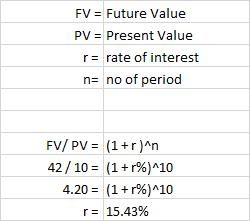
You purchased 100 shares of stock for $10 dollars per share. After holding the stock for 10 years and not receiving any dividends you sell the stock for $42 per share. what is the effective annual rate of return on this investment?
Homework Answers
Ans 15.43%
Effective annual rate of return on this investment = 15.43%
Add Answer to:
You purchased 100 shares of stock for $10 dollars per share.
After holding the stock for...
Question 9 (1 point) You purchased 100 shares of stock for $5 per share. After holding...
 Question 9 (1 point) You purchased 100 shares of stock for $5 per share. After holding the stock for 8 years and not receiving any dividends, you sell the stock for $42 per share. What are the holding period and annual return on this investment? 185%, 14.42% 920%, 41.63% 740%, 30.48% 625%, 27.66%
1. You purchased 1000 shares of stock for $25 a share. After holding the stock for...
1. You purchased 1000 shares of stock for $25 a share. After holding the stock for 6 years and not receiving any dividends, you sell the stock for $42 per share. What are the holding period and annual return on this investment? a) 9.2% ; 1.63% b) 18% ; 2.87% c) 68% ; 9.03% d) 62% ; 7.66%
You just purchased 100 shares of company CXC’s stock at 45 dollars per share for long...
You just purchased 100 shares of company CXC’s stock at 45 dollars per share for long term investment. The most recent dividend per share is $1.50 per share. We also know the dividend growth rate is expected to be 8% per year. What is your expected annual percentage return of this investment? (Please round up your answers to two decimals and write in percentage points without the sign. e.g. If your answer is 12.859%, type 12.86 without the percentage sign)
A stock sells for $10 per share. You purchase 100 shares for $10 a share (i.e.,...
A stock sells for $10 per share. You purchase 100 shares for $10 a share (i.e., for $1,000), and after a year the price rises to $17.50. What will be the percentage return on your investment if you bought the stock on margin and the margin requirement was (a) 25 percent, (b) 50 percent, and (c) 75 percent? (Ignore commissions, dividends, and interest expense.) Repeat Problem 1 to determine the percentage return on your investment but in this case suppose...
Fred purchased 100 shares of Ekto Corporation common stock for $30.3 per share on June 1,...
Fred purchased 100 shares of Ekto Corporation common stock for $30.3 per share on June 1, 2001 and then sold it exactly 11 years later for $43.91 per share. What was Fred's geometric mean average annual return on this investment? 4.08% 2.82% 3.43% 2.48% 1 points QUESTION 6 Fred purchased 100 shares of Ekto Corporation common stock for $31.99 per share on June 1, 2001 and then sold it exactly 3 years later for $43.53 per share. What was...
1. A stock sells for $10 per share. You purchase 100 shares for $10 a share...
1. A stock sells for $10 per share. You purchase 100 shares for $10 a share (i.e., for $1,000), and after a year the price rises to $17.50. What will be the percentage return on your investment if you bought the stock on margin and the margin requirement was (a) 25 percent, (b) 50 percent, and (c) 75 percent? (Ignore commissions, dividends, and interest expense.) Please show how to solve in Excel Step-by-Step.
23 You bought 100 shares of a stock at S52 per share. After 240 days, you...
 23 You bought 100 shares of a stock at S52 per share. After 240 days, you decide to sell the stock. By this time, the stock had gone up and was now worth $58.50 per share. You are dealing with a brokerage firm that charges a commission of $49 plus 0.8% of transaction amounts between $2,500 and $9.999. Determine the annual rate of interest you've earned on this investment
Fred purchased 100 shares of Ekto Corporation common stock for $30.3 per share on June 1,...
Fred purchased 100 shares of Ekto Corporation common stock for $30.3 per share on June 1, 2001 and then sold it exactly 11 years later for $43.91 per share. What was Fred's geometric mean average annual return on this investment? 4.08% 2.82% 3.43% 2.48% 1 points QUESTION 6 Fred purchased 100 shares of Ekto Corporation common stock for $31.99 per share on June 1, 2001 and then sold it exactly 3 years later for $43.53 per share. What was...
You purchased 100 shares of stock for a share price of $16.47. You sold the stock...
You purchased 100 shares of stock for a share price of $16.47. You sold the stock two years later for a share price of $19.33. You also received total dividend payments of $0.72 per share. What was your total return on your investment?
You purchased 100 shares of stock for a share price of $16.84. You sold the stock...
You purchased 100 shares of stock for a share price of $16.84. You sold the stock two years later for a share price of $18.78. You also received total dividend payments of $0.77 per share. What was your total return on your investment?
 Question 9 (1 point) You purchased 100 shares of stock for $5 per share. After holding the stock for 8 years and not receiving any dividends, you sell the stock for $42 per share. What are the holding period and annual return on this investment? 185%, 14.42% 920%, 41.63% 740%, 30.48% 625%, 27.66%
 23 You bought 100 shares of a stock at S52 per share. After 240 days, you decide to sell the stock. By this time, the stock had gone up and was now worth $58.50 per share. You are dealing with a brokerage firm that charges a commission of $49 plus 0.8% of transaction amounts between $2,500 and $9.999. Determine the annual rate of interest you've earned on this investment
Most questions answered within 3 hours.
-
Where is the error in this code sequence?
String s1 = "Hello";
String s2 = "ello";...
asked 11 months ago -
Financial data for Joel de Paris, Inc., for last year
follow:
Joel de Paris, Inc.
Balance...
asked 11 months ago -
Consider this reaction:
Al2(SO4)3 (aq)+ BaCl3
(aq) Al2Cl6 (aq)- +
3BaSO4(s) . What is the...
asked 11 months ago -
Suppose that Savneet is considering increasing her
recent random sample from 20 car rentals to 40...
asked 11 months ago -
Trucks arrive at an unloading terminal at an average rate of 120
per hour.
Trucks arrive...
asked 11 months ago -
Why are methanol and ethanol completely soluble in water while
octanol is not very little soluble....
asked 11 months ago -
A facilities manager at a university reads in a research report
that the mean amount of...
asked 11 months ago -
When the CuSO4 is rehydrated by adding water to the anhydrous
compound, is this an endothermic...
asked 11 months ago -
A ray of sunlight is passing from diamond into crown glass; the
angle of incidence is...
asked 11 months ago -
A block of mass 0.249 kg is placed on top of a light, vertical
spring of...
asked 11 months ago -
how do the kidneys compensate in the presences of acidosis
a) trigger hyperventilate
b) reserve acid...
asked 11 months ago -
Question 501 pts
The rental rate of capital to the firm increases. Which of the
following...
asked 11 months ago