8. For the reaction r = k [I2] ^ 2 [KMnO4] ^ 3 we can establish...
8. For the reaction r = k [I2] ^ 2 [KMnO4] ^ 3 we can establish that:
a.the reaction is second order with respect to iodine
b. the reaction is fifth order
c. the reaction is third order with respect to KMnO4
d. all of the above
Homework Answers
![© Given 7 = K[In]*[kmne.] Rate with respect to [I]]= 2 (secondes) Rate with Respect to [kmno,]= 3( Third order Total order=2+](http://img.homeworklib.com/questions/b1a29df0-77ca-11ea-a160-098705125a3f.png?x-oss-process=image/resize,w_560)
Consider the following reaction: H2 + I2 ➞ 2HI They react by a second-order process, first...
Consider the following reaction: H2 + I2 ➞ 2HI They react by a second-order process, first order with respect to each reactant with k = 0.63 L/(mol*sec). a) What is the initial reaction rate when we add 0.50 g H2 and 0.20 g I2 to a 800. mL vessel? b) How does the reaction rate change (by what factor/amount) when we add 0.10 g I2 to the above mixture?
1. A reaction is second order in[A] and second-order in [B]: Rate,=K[A]^2[B]^2. what are the units...
1. A reaction is second order in[A] and second-order in [B]: Rate,=K[A]^2[B]^2. what are the units of k for this reaction? If the concentration of air decreases by a factor of 2 and the concentration of b increases by a factor of 5 what happens to the rate? 2. for the forward reaction 2NO+Cl2=>2NOCl. determine the rate(m/s)for experiment #4 given [NO]°(M)=0.40M and [Cl2]°z(M)=0?20M. Rate? 3.The following data were collected over time for the forward reaction 2NO2=>2NO+O2 ( 1/[NO2]=100 at 0...
d) Calculate K, for the following reaction at 25 C H2lg) + I2 (g)< 2HI (8)...
 d) Calculate K, for the following reaction at 25 C H2lg) + I2 (g)< 2HI (8) G 2.60 ki/mol 2 2 D-
Can I get an explanation as to why for these two? 1. [2 marks] Which of...
 Can I get an explanation as to why for
these two?
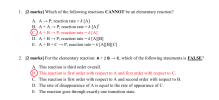
1. [2 marks] Which of the following reactions CANNOT be an elementary reaction? A. A → P; reaction rate = k [A] B. A + A → P; reaction rate = k [A]2 (C.) A+B → P; reaction rate = k [A] D. A+B → P; reaction rate = k [A][B] E. A +B+C → P; reaction rate = k [A][B][C] 2. [2 marks] For the elementary reaction: A...
Can I get an explanation as to why for
these two?
1. [2 marks] Which of the following reactions CANNOT be an elementary reaction? A. A → P; reaction rate = k [A] B. A + A → P; reaction rate = k [A]2 (C.) A+B → P; reaction rate = k [A] D. A+B → P; reaction rate = k [A][B] E. A +B+C → P; reaction rate = k [A][B][C] 2. [2 marks] For the elementary reaction: A...
The following reaction can be used to produce CL2 in the laboratory. 2 KMnO4 + 8...
The following reaction can be used to produce CL2 in the laboratory. 2 KMnO4 + 8 H2SO4 + 10 KCl = 2 MnSO4 + 5 Cl2 + 8 H2O + 6 K2SO4 A.) How many moles of KMnO4 are requird to generate 1 mol of Cl2? B.) How many grams of KMnO4 are required to generate 1 gram of Cl2?
The gas phase reaction of hydrogen with iodine H2 + I2 ---------->2 HI is first order...
The gas phase reaction of hydrogen with iodine H2 + I2 ---------->2 HI is first order in H2 and first order in I2. Complete the rate law for this reaction in the box below. Use the form k[A]m[B]n... , where '1' is understood for m, n ... (don't enter 1) and concentrations taken to the zero power do not appear. Rate=__________ In an experiment to determine the rate law, the rate of the reaction was determined to be 5.37×10⁻²² Ms-1...
5 I- + IO3− + 6 H+→ 3 I2+ 3 H2O. For the reaction above, the...
5 I- + IO3− + 6 H+→ 3 I2+ 3 H2O. For the reaction above, the rate of disappearance of iodide ion is 5.0 × 10^−3 M s−1 . The rate of formation of iodine is (A) 1.0 × 10⁻²M s−1 (B) 1.0 × 10⁻³M s−1 (C) 3.0 × 10⁻³M s−1 (D) 5.0 × 10⁻³M s−1 Please explain!!
The reaction H2(g) + I2(g) → 2 HI (g) is first order in both hydrogen and iodine. It is therefore referred to as second order overall. Its rate constant for the formation of HI (g) at 400 ◦C is 2.34 ×...
The reaction H2(g) + I2(g) → 2 HI (g) is first order in both hydrogen and iodine. It is therefore referred to as second order overall. Its rate constant for the formation of HI (g) at 400 ◦C is 2.34 × 10⁻² · lit · mol−1 · sec−1 and its activation energy is 150 KJ/mol. Use the rate law to estimate how long it takes to form 0.1 mole of HI(g) if I start by putting 2 moles of H2...
Answer the questions given the following reaction and cell potentials. 3 I2(s) + 2 Fe(s) →...
Answer the questions given the following reaction and cell potentials. 3 I2(s) + 2 Fe(s) → 2 Fe3+(aq) + 6 I⁻(aq) E°iron = -0.036 V and E°iodine = 0.5355 V (blank 1) Calculate the standard cell potential for the reaction. (blank 2) Is this process spontaneous? (yes or no) (blank 3) How many electrons are transferred during the redox reaction? (blank 4) Calculate the equilibrium constant K.
the following statements relate to the reaction for the formation of HI: H2(g) + I2(g)--> 2HI(g)...
the following statements relate to the reaction for the formation of HI: H2(g) + I2(g)--> 2HI(g) Rate= k[H2][I2] Determine which of the following statements is true. (a) The reaction must occur in a single step (b) This is a second-order reaction overall (c) If the concentrations of both reactants are doubled, the rate will double (d) Raising the temperature lowers the activation energy for this reaction
 d) Calculate K, for the following reaction at 25 C H2lg) + I2 (g)< 2HI (8) G 2.60 ki/mol 2 2 D-
 Can I get an explanation as to why for
these two?
1. [2 marks] Which of the following reactions CANNOT be an elementary reaction? A. A → P; reaction rate = k [A] B. A + A → P; reaction rate = k [A]2 (C.) A+B → P; reaction rate = k [A] D. A+B → P; reaction rate = k [A][B] E. A +B+C → P; reaction rate = k [A][B][C] 2. [2 marks] For the elementary reaction: A...
Can I get an explanation as to why for
these two?
1. [2 marks] Which of the following reactions CANNOT be an elementary reaction? A. A → P; reaction rate = k [A] B. A + A → P; reaction rate = k [A]2 (C.) A+B → P; reaction rate = k [A] D. A+B → P; reaction rate = k [A][B] E. A +B+C → P; reaction rate = k [A][B][C] 2. [2 marks] For the elementary reaction: A...
Most questions answered within 3 hours.
-
Where is the error in this code sequence?
String s1 = "Hello";
String s2 = "ello";...
asked 11 months ago -
Financial data for Joel de Paris, Inc., for last year
follow:
Joel de Paris, Inc.
Balance...
asked 11 months ago -
Consider this reaction:
Al2(SO4)3 (aq)+ BaCl3
(aq) Al2Cl6 (aq)- +
3BaSO4(s) . What is the...
asked 11 months ago -
Suppose that Savneet is considering increasing her
recent random sample from 20 car rentals to 40...
asked 11 months ago -
Trucks arrive at an unloading terminal at an average rate of 120
per hour.
Trucks arrive...
asked 11 months ago -
Why are methanol and ethanol completely soluble in water while
octanol is not very little soluble....
asked 11 months ago -
A facilities manager at a university reads in a research report
that the mean amount of...
asked 11 months ago -
When the CuSO4 is rehydrated by adding water to the anhydrous
compound, is this an endothermic...
asked 11 months ago -
A ray of sunlight is passing from diamond into crown glass; the
angle of incidence is...
asked 11 months ago -
A block of mass 0.249 kg is placed on top of a light, vertical
spring of...
asked 11 months ago -
how do the kidneys compensate in the presences of acidosis
a) trigger hyperventilate
b) reserve acid...
asked 11 months ago -
Question 501 pts
The rental rate of capital to the firm increases. Which of the
following...
asked 11 months ago