
Homework Answers
In Cournout competiton, two players compete with each other on the amount of output they produce at the same time.
We know, Q=Qm+Qk
So, P=8-Qm-Qk
Profit of McDonald is (8-Qm-Qk)*Qm-Qm^2
By deriving and equalizing to 0, we get 8-2Qm-Qk-2Qm=0 So, Qk+4Qm=8
Profit of KFC is (8-Qm-Qk)*Qk-Qk^2/2
By deriving and equalizing to 0, we get 8-2Qk-Qm-Qk=0 So, 3Qk+Qm=8
3(8-4Qm)+Qm=8
16=11Qm
Qm=16/11(Ans)
Qk=8-64/11=24/11(Ans)
Add Answer to:
Suppose the market of fried chicken is dominated by two oligopolists: Macdonald and KFC. The inverse...
3. Bertrand Competition Suppose the market of fried chicken is dominated by five oligopolists: Ma...
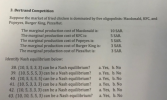 3. Bertrand Competition Suppose the market of fried chicken is dominated by five oligopolists: Macdonald, KFC, and Popeyes, Burger King, PizzaHut. The marginal production cost of Macdonald is: The marginal production cost of KFC is: The marginal production cost of Popeyes is: The marginal production cost of Burger King is: The marginal production cost of PizzaHut is: 10 SAR. 5 SAR 5 SAR 3SAR 3 SAR Identify Nash equilibrium below: 38. (10, 5, 5, 3, 3) can be a Nash...
Suppose a market has two firms that sell identical products. These firms face an inverse market...
Suppose a market has two firms that sell identical products. These firms face an inverse market demand function of P=120 – Q. Firm 1 has a constant MC=20. Firm 2’s marginal cost is MC=30. Find the Cournot equilibrium price, quantities, and profits for each firm. If these firms were able to perfectly collude, what would be the monopoly equilibrium?
2. The numbers of countries where Kentucky Fried Chicken (KFC) and Pizza Hut operate are shown...
 2. The numbers of countries where Kentucky Fried Chicken (KFC) and Pizza Hut operate are shown in the ollowing table for various years. Number of Countries Pizza Hut 91 Year 3 2013 42014 5 2015 6 2016 72017 KFC 118 120 125 128 92 95 103 131 106 Source: Yum Brands Let K(t) and P(t) be the numbers of countries where KFC and Pizza Hut operate, respectively, both at years since 2010 a. Find equations of K and P b....
Consider a market with a demand curve given (in inverse form) by P(Q) = 80 – 0.25Q
Part 1 Consider a market with a demand curve given (in inverse form) by P(Q) = 80 – 0.25Q, where Q is total market output and P is the price of the good. Two firms compete in this market by simultaneously choosing quantities q1 and q2 (where q1 + q2 = Q). This is an example of Choose one: A. Stackelberg competition. B. Cournot competition. C. Bertrand competition. D. perfect competition.Part 2 Now suppose the cost of production is constant at $50.00 per unit (and is the same...
Consider two symmetric Cournot duopolists who face inverse market demand of p = 140−Q. Suppose that...
Consider two symmetric Cournot duopolists who face inverse market demand of p = 140−Q. Suppose that they each have long-run cost functions Ci(qi) = 20qi for i = 1, 2. (a) Draw a graph containing the demand and marginal cost curves. (b) What are the efficient quantity and price, QC and pC? How much total surplus is generated at this quantity and price? (c) What are the monopoly quantity and price, QM and pM ? How much profit would a...
2*. Consider a market with two firms where the inverse demand function is given by p...
2*. Consider a market with two firms where the inverse demand function is given by p = 28 - 2q and where q = q1 + q2. Each firm has the total cost function c(qi) = 4qi, where i = {1,2}. a) Compare price level, quantities and profits in this market calculating the Cournot equilibrium and the Stackelberg equilibrium. Draw a graph with best response functions and illustrate the Cournot and Stackelberg solutions in that graph. b) Compare your solutions...
2*. Consider a market with two firms where the inverse demand function is given by p...
2*. Consider a market with two firms where the inverse demand function is given by p = 28 - 2q and where q = q1 + q2. Each firm has the total cost function c(qi) = 4qi, where i = {1,2}. a) Compare price level, quantities and profits in this market calculating the Cournot equilibrium and the Stackelberg equilibrium. Draw a graph with best response functions and illustrate the Cournot and Stackelberg solutions in that graph. b) Compare your solutions...
2*. Consider a market with two firms where the inverse demand function is given by p...
2*. Consider a market with two firms where the inverse demand function is given by p = 28 - 2q and where q = q1 + q2. Each firm has the total cost function c(qi) = 4qi, where i = {1,2}. a) Compare price level, quantities and profits in this market calculating the Cournot equilibrium and the Stackelberg equilibrium. Draw a graph with best response functions and illustrate the Cournot and Stackelberg solutions in that graph. b) Compare your solutions...
3. The market illustrated below has inverse demand p(Q) = 130 - 3Q and industry-wide marginal...
 3. The market illustrated below has inverse demand p(Q) = 130 - 3Q and industry-wide marginal cost MCQ) = 10 + 2Q. If production is competitive, this is the market (inverse) supply curve. If production is consolidated under a monopolist, this is the monopolist's MC curve. a. Suppose there is a monopolist. Explain how marginal revenue for a monopolist is different than for a firm under perfect competition. Then derive the profit-maximizing market outcome (including the monopoly price and quantity...
this is a 2 part question The market for disinfectant is dominated by 2 firms, Lysol...
 this is a 2 part question
The market for disinfectant is dominated by 2 firms, Lysol and Clorox. The marginal cost (MC) for providing disinfectant is $1 (average cost is also $1), and the consumer form their demand for disinfectant via the following inverse demand equation P=5-Q:. The corresponding marginal revenue curve is: P=5- 2Q a. If Lysol and Clorox decide to collude, what quantities will be sold in the market and what price will consumers pay for this quantity...
this is a 2 part question
The market for disinfectant is dominated by 2 firms, Lysol and Clorox. The marginal cost (MC) for providing disinfectant is $1 (average cost is also $1), and the consumer form their demand for disinfectant via the following inverse demand equation P=5-Q:. The corresponding marginal revenue curve is: P=5- 2Q a. If Lysol and Clorox decide to collude, what quantities will be sold in the market and what price will consumers pay for this quantity...
 3. Bertrand Competition Suppose the market of fried chicken is dominated by five oligopolists: Macdonald, KFC, and Popeyes, Burger King, PizzaHut. The marginal production cost of Macdonald is: The marginal production cost of KFC is: The marginal production cost of Popeyes is: The marginal production cost of Burger King is: The marginal production cost of PizzaHut is: 10 SAR. 5 SAR 5 SAR 3SAR 3 SAR Identify Nash equilibrium below: 38. (10, 5, 5, 3, 3) can be a Nash...
 2. The numbers of countries where Kentucky Fried Chicken (KFC) and Pizza Hut operate are shown in the ollowing table for various years. Number of Countries Pizza Hut 91 Year 3 2013 42014 5 2015 6 2016 72017 KFC 118 120 125 128 92 95 103 131 106 Source: Yum Brands Let K(t) and P(t) be the numbers of countries where KFC and Pizza Hut operate, respectively, both at years since 2010 a. Find equations of K and P b....
 3. The market illustrated below has inverse demand p(Q) = 130 - 3Q and industry-wide marginal cost MCQ) = 10 + 2Q. If production is competitive, this is the market (inverse) supply curve. If production is consolidated under a monopolist, this is the monopolist's MC curve. a. Suppose there is a monopolist. Explain how marginal revenue for a monopolist is different than for a firm under perfect competition. Then derive the profit-maximizing market outcome (including the monopoly price and quantity...
 this is a 2 part question
The market for disinfectant is dominated by 2 firms, Lysol and Clorox. The marginal cost (MC) for providing disinfectant is $1 (average cost is also $1), and the consumer form their demand for disinfectant via the following inverse demand equation P=5-Q:. The corresponding marginal revenue curve is: P=5- 2Q a. If Lysol and Clorox decide to collude, what quantities will be sold in the market and what price will consumers pay for this quantity...
this is a 2 part question
The market for disinfectant is dominated by 2 firms, Lysol and Clorox. The marginal cost (MC) for providing disinfectant is $1 (average cost is also $1), and the consumer form their demand for disinfectant via the following inverse demand equation P=5-Q:. The corresponding marginal revenue curve is: P=5- 2Q a. If Lysol and Clorox decide to collude, what quantities will be sold in the market and what price will consumers pay for this quantity...
Most questions answered within 3 hours.
-
Where is the error in this code sequence?
String s1 = "Hello";
String s2 = "ello";...
asked 11 months ago -
Financial data for Joel de Paris, Inc., for last year
follow:
Joel de Paris, Inc.
Balance...
asked 11 months ago -
Consider this reaction:
Al2(SO4)3 (aq)+ BaCl3
(aq) Al2Cl6 (aq)- +
3BaSO4(s) . What is the...
asked 11 months ago -
Suppose that Savneet is considering increasing her
recent random sample from 20 car rentals to 40...
asked 11 months ago -
Trucks arrive at an unloading terminal at an average rate of 120
per hour.
Trucks arrive...
asked 11 months ago -
Why are methanol and ethanol completely soluble in water while
octanol is not very little soluble....
asked 11 months ago -
A facilities manager at a university reads in a research report
that the mean amount of...
asked 11 months ago -
When the CuSO4 is rehydrated by adding water to the anhydrous
compound, is this an endothermic...
asked 11 months ago -
A ray of sunlight is passing from diamond into crown glass; the
angle of incidence is...
asked 11 months ago -
A block of mass 0.249 kg is placed on top of a light, vertical
spring of...
asked 11 months ago -
how do the kidneys compensate in the presences of acidosis
a) trigger hyperventilate
b) reserve acid...
asked 11 months ago -
Question 501 pts
The rental rate of capital to the firm increases. Which of the
following...
asked 11 months ago