Using the nmr spec provided can you find the structures of the compounds?
Also the reagents. 


Homework Answers
The reagent A is (CH3)2CHCH2Br/NaH
The structure of B is (CH3)3C-C C-CH2-CH(CH3)2
The reagent E is hydrogenation (Birch reduction), followed by hydrobromination, i.e. i) Li/NH3, ii) HBr
The structure of molecule F can be drawn as follows.
(CH3)3C-CH(Br)-CH2-CH(CH3)2
Add Answer to:
Using the nmr spec provided can you find the structures of the compounds?
Determine the compound using the Mass Spec, IR, C NMR, and H NMR. H Nmr splitting...
 Determine the compound using the Mass Spec, IR, C NMR, and H
NMR.
H Nmr splitting pattern from left to right: singlet, triplet,
septet (7), singlet, doublet
Compound 1 Mass Spec: Mpeak : 162 IR: 100 - TRANSMETTANCEI21 DO 4000 2000 2000 1500 1500 - 1000 13C NMR: Broadband in provided below. DEPT data is in the provided table. 200.180.160.140 120 100.80 '60.40.20 PPM DEPT -135 positive DEPT-90 positive -------------- PPM 191 149 138 137 135 128 126 | 34...
Determine the compound using the Mass Spec, IR, C NMR, and H
NMR.
H Nmr splitting pattern from left to right: singlet, triplet,
septet (7), singlet, doublet
Compound 1 Mass Spec: Mpeak : 162 IR: 100 - TRANSMETTANCEI21 DO 4000 2000 2000 1500 1500 - 1000 13C NMR: Broadband in provided below. DEPT data is in the provided table. 200.180.160.140 120 100.80 '60.40.20 PPM DEPT -135 positive DEPT-90 positive -------------- PPM 191 149 138 137 135 128 126 | 34...
Based on the H NMR data provided, deduce the structures of each of the compounds below,...
Based on the H NMR data provided, deduce the structures of each of the compounds below, where the molecular formula is C5H12O 5 (singlet, 1H), 3.4 (pentet, 1H), 1.5 (pentet, 4H), 0.9 (tripet, 6H)
Can someone please interpret the IR Spectrum, Mass Spec, and NMR data to help me find...
 Can someone please interpret the IR Spectrum, Mass Spec, and
NMR data to help me find the unknown compound and its
structure?
Can someone please interpret the IR Spectrum, Mass Spec, and
NMR data to help me find the unknown compound and its
structure?
Deduce the structure of the mystery compound using the attached Mass Spec, IR Spec, H-NMR, and...
 Deduce the structure of the mystery compound using the attached
Mass Spec, IR Spec, H-NMR, and C-NMR
Mass Spectrum 100 41 80 60 28 115 69 40 121 87 123 20 M(194) M+2(96) 1 149 151 0 0 40 120 160 200
Deduce the structure of the mystery compound using the attached
Mass Spec, IR Spec, H-NMR, and C-NMR
Mass Spectrum 100 41 80 60 28 115 69 40 121 87 123 20 M(194) M+2(96) 1 149 151 0 0 40 120 160 200
What would the structure look like using the mass spec with a parent peak of 162, IR, C-NMR and H-NMR? TRETTENCEI...
 What would the structure look like using the mass spec with a
parent peak of 162, IR, C-NMR and H-NMR?
TRETTENCEI Singlet doublet Singlet triplet muitplet PPM halides 13C NMR: Broadband in provided below. DEPT data is in the provided table. 200 180 160 140 120 100 PPM 80 60 40 20 0 DEPT-135 positive DEPT-90 positive PPM 191 149 138 137 135 128 126 positive positive positive positive positive positive positive positive positive positive
What would the structure look like using the mass spec with a
parent peak of 162, IR, C-NMR and H-NMR?
TRETTENCEI Singlet doublet Singlet triplet muitplet PPM halides 13C NMR: Broadband in provided below. DEPT data is in the provided table. 200 180 160 140 120 100 PPM 80 60 40 20 0 DEPT-135 positive DEPT-90 positive PPM 191 149 138 137 135 128 126 positive positive positive positive positive positive positive positive positive positive
Please help me understand how to obtain the structures of the compounds for the NMR spectra...
 Please help me understand how to obtain the structures
of the compounds for the NMR spectra
The NMR spectra are shown for two isomeric compounds with formula C_10H_12O_2. Their infrared spectra show strong bands near 1735cm^-1. Make no attempt to interpret the aromatic proton area between 7.0 and 7.5 ppm except to determine the number of protons attached to the aromatic ring. Draw the structures of the compounds.
Please help me understand how to obtain the structures
of the compounds for the NMR spectra
The NMR spectra are shown for two isomeric compounds with formula C_10H_12O_2. Their infrared spectra show strong bands near 1735cm^-1. Make no attempt to interpret the aromatic proton area between 7.0 and 7.5 ppm except to determine the number of protons attached to the aromatic ring. Draw the structures of the compounds.
(C) Using only 1H NMR, how can you differentiate between the following structures 0 ~ А...
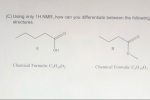 (C) Using only 1H NMR, how can you differentiate between the following structures 0 ~ А OH B Chemical Formula: C5H1002 Chemical Formula: C3H1002
Please help identify the organic compound using mass spec, ir spec, CNMR, and HNMR. From looking...
 Please help identify the
organic compound using mass spec, ir spec, CNMR, and HNMR.
From looking at the mass spec, I believe the molar mass of the
uknown organic compound to be 122 g/mol
From looking at CNMR, I believe there are at least 5 carbons for
each of the 5 peaks. I recall from class that there can be more due
to symmetry, but am not certain how to tell.
Above are all of the graphs given to me...
Please help identify the
organic compound using mass spec, ir spec, CNMR, and HNMR.
From looking at the mass spec, I believe the molar mass of the
uknown organic compound to be 122 g/mol
From looking at CNMR, I believe there are at least 5 carbons for
each of the 5 peaks. I recall from class that there can be more due
to symmetry, but am not certain how to tell.
Above are all of the graphs given to me...
Determine the structure of Compound 2 using the Mass Spec, IR, C NMR, H NMR, and...
 Determine the structure of Compound 2 using the Mass Spec, IR, C
NMR, H NMR, and Dept Experiments.
Splitting patterns are as follows from left to right: triplet, 5
peaks (unsure of name), septet (7), 4 peaks (unsure of name),
doublet
Compound 2 Mass Spec MT:M/2 = 164 Relative Intensity 25 50 75 125 150 100 m/z IR LO0 D 4000 3000 2000 1500 1000 500 HAVENUMBERI-i H NMR: ditto as compound 1 6 2 2 4 1 2 PPM...
Determine the structure of Compound 2 using the Mass Spec, IR, C
NMR, H NMR, and Dept Experiments.
Splitting patterns are as follows from left to right: triplet, 5
peaks (unsure of name), septet (7), 4 peaks (unsure of name),
doublet
Compound 2 Mass Spec MT:M/2 = 164 Relative Intensity 25 50 75 125 150 100 m/z IR LO0 D 4000 3000 2000 1500 1000 500 HAVENUMBERI-i H NMR: ditto as compound 1 6 2 2 4 1 2 PPM...
QUESTION 7 A chloroform solution containing aspirin and phenacetin (structures shown below) is provided to you...
 QUESTION 7 A chloroform solution containing aspirin and phenacetin (structures shown below) is provided to you in lab. Which of the following reagents would you need to separate these two compounds using extraction? gola 0 Hzc o Aspirin Phenacetin Saturated aqueous solution of Naci. An aqueous solution of KOH. An aqueous solution of HCI. Acetic acid.
 Determine the compound using the Mass Spec, IR, C NMR, and H
NMR.
H Nmr splitting pattern from left to right: singlet, triplet,
septet (7), singlet, doublet
Compound 1 Mass Spec: Mpeak : 162 IR: 100 - TRANSMETTANCEI21 DO 4000 2000 2000 1500 1500 - 1000 13C NMR: Broadband in provided below. DEPT data is in the provided table. 200.180.160.140 120 100.80 '60.40.20 PPM DEPT -135 positive DEPT-90 positive -------------- PPM 191 149 138 137 135 128 126 | 34...
Determine the compound using the Mass Spec, IR, C NMR, and H
NMR.
H Nmr splitting pattern from left to right: singlet, triplet,
septet (7), singlet, doublet
Compound 1 Mass Spec: Mpeak : 162 IR: 100 - TRANSMETTANCEI21 DO 4000 2000 2000 1500 1500 - 1000 13C NMR: Broadband in provided below. DEPT data is in the provided table. 200.180.160.140 120 100.80 '60.40.20 PPM DEPT -135 positive DEPT-90 positive -------------- PPM 191 149 138 137 135 128 126 | 34...
 Can someone please interpret the IR Spectrum, Mass Spec, and
NMR data to help me find the unknown compound and its
structure?
Can someone please interpret the IR Spectrum, Mass Spec, and
NMR data to help me find the unknown compound and its
structure?
 Deduce the structure of the mystery compound using the attached
Mass Spec, IR Spec, H-NMR, and C-NMR
Mass Spectrum 100 41 80 60 28 115 69 40 121 87 123 20 M(194) M+2(96) 1 149 151 0 0 40 120 160 200
Deduce the structure of the mystery compound using the attached
Mass Spec, IR Spec, H-NMR, and C-NMR
Mass Spectrum 100 41 80 60 28 115 69 40 121 87 123 20 M(194) M+2(96) 1 149 151 0 0 40 120 160 200
 What would the structure look like using the mass spec with a
parent peak of 162, IR, C-NMR and H-NMR?
TRETTENCEI Singlet doublet Singlet triplet muitplet PPM halides 13C NMR: Broadband in provided below. DEPT data is in the provided table. 200 180 160 140 120 100 PPM 80 60 40 20 0 DEPT-135 positive DEPT-90 positive PPM 191 149 138 137 135 128 126 positive positive positive positive positive positive positive positive positive positive
What would the structure look like using the mass spec with a
parent peak of 162, IR, C-NMR and H-NMR?
TRETTENCEI Singlet doublet Singlet triplet muitplet PPM halides 13C NMR: Broadband in provided below. DEPT data is in the provided table. 200 180 160 140 120 100 PPM 80 60 40 20 0 DEPT-135 positive DEPT-90 positive PPM 191 149 138 137 135 128 126 positive positive positive positive positive positive positive positive positive positive
 Please help me understand how to obtain the structures
of the compounds for the NMR spectra
The NMR spectra are shown for two isomeric compounds with formula C_10H_12O_2. Their infrared spectra show strong bands near 1735cm^-1. Make no attempt to interpret the aromatic proton area between 7.0 and 7.5 ppm except to determine the number of protons attached to the aromatic ring. Draw the structures of the compounds.
Please help me understand how to obtain the structures
of the compounds for the NMR spectra
The NMR spectra are shown for two isomeric compounds with formula C_10H_12O_2. Their infrared spectra show strong bands near 1735cm^-1. Make no attempt to interpret the aromatic proton area between 7.0 and 7.5 ppm except to determine the number of protons attached to the aromatic ring. Draw the structures of the compounds.
 (C) Using only 1H NMR, how can you differentiate between the following structures 0 ~ А OH B Chemical Formula: C5H1002 Chemical Formula: C3H1002
 Please help identify the
organic compound using mass spec, ir spec, CNMR, and HNMR.
From looking at the mass spec, I believe the molar mass of the
uknown organic compound to be 122 g/mol
From looking at CNMR, I believe there are at least 5 carbons for
each of the 5 peaks. I recall from class that there can be more due
to symmetry, but am not certain how to tell.
Above are all of the graphs given to me...
Please help identify the
organic compound using mass spec, ir spec, CNMR, and HNMR.
From looking at the mass spec, I believe the molar mass of the
uknown organic compound to be 122 g/mol
From looking at CNMR, I believe there are at least 5 carbons for
each of the 5 peaks. I recall from class that there can be more due
to symmetry, but am not certain how to tell.
Above are all of the graphs given to me...
 Determine the structure of Compound 2 using the Mass Spec, IR, C
NMR, H NMR, and Dept Experiments.
Splitting patterns are as follows from left to right: triplet, 5
peaks (unsure of name), septet (7), 4 peaks (unsure of name),
doublet
Compound 2 Mass Spec MT:M/2 = 164 Relative Intensity 25 50 75 125 150 100 m/z IR LO0 D 4000 3000 2000 1500 1000 500 HAVENUMBERI-i H NMR: ditto as compound 1 6 2 2 4 1 2 PPM...
Determine the structure of Compound 2 using the Mass Spec, IR, C
NMR, H NMR, and Dept Experiments.
Splitting patterns are as follows from left to right: triplet, 5
peaks (unsure of name), septet (7), 4 peaks (unsure of name),
doublet
Compound 2 Mass Spec MT:M/2 = 164 Relative Intensity 25 50 75 125 150 100 m/z IR LO0 D 4000 3000 2000 1500 1000 500 HAVENUMBERI-i H NMR: ditto as compound 1 6 2 2 4 1 2 PPM...
 QUESTION 7 A chloroform solution containing aspirin and phenacetin (structures shown below) is provided to you in lab. Which of the following reagents would you need to separate these two compounds using extraction? gola 0 Hzc o Aspirin Phenacetin Saturated aqueous solution of Naci. An aqueous solution of KOH. An aqueous solution of HCI. Acetic acid.
Most questions answered within 3 hours.
-
Where is the error in this code sequence?
String s1 = "Hello";
String s2 = "ello";...
asked 11 months ago -
Financial data for Joel de Paris, Inc., for last year
follow:
Joel de Paris, Inc.
Balance...
asked 11 months ago -
Consider this reaction:
Al2(SO4)3 (aq)+ BaCl3
(aq) Al2Cl6 (aq)- +
3BaSO4(s) . What is the...
asked 11 months ago -
Suppose that Savneet is considering increasing her
recent random sample from 20 car rentals to 40...
asked 11 months ago -
Trucks arrive at an unloading terminal at an average rate of 120
per hour.
Trucks arrive...
asked 11 months ago -
Why are methanol and ethanol completely soluble in water while
octanol is not very little soluble....
asked 11 months ago -
A facilities manager at a university reads in a research report
that the mean amount of...
asked 11 months ago -
When the CuSO4 is rehydrated by adding water to the anhydrous
compound, is this an endothermic...
asked 11 months ago -
A ray of sunlight is passing from diamond into crown glass; the
angle of incidence is...
asked 11 months ago -
A block of mass 0.249 kg is placed on top of a light, vertical
spring of...
asked 11 months ago -
how do the kidneys compensate in the presences of acidosis
a) trigger hyperventilate
b) reserve acid...
asked 11 months ago -
Question 501 pts
The rental rate of capital to the firm increases. Which of the
following...
asked 11 months ago