
Homework Answers
Add Answer to:
Luli lemperature was 100°C. muito e Assume the reac- 3. Calculate the value for AG (at...
UILO HIVIH your calculated Ko.. Assume the reac- tion temperature was 100°C. 3. Calculate the value for AG° (at 2...
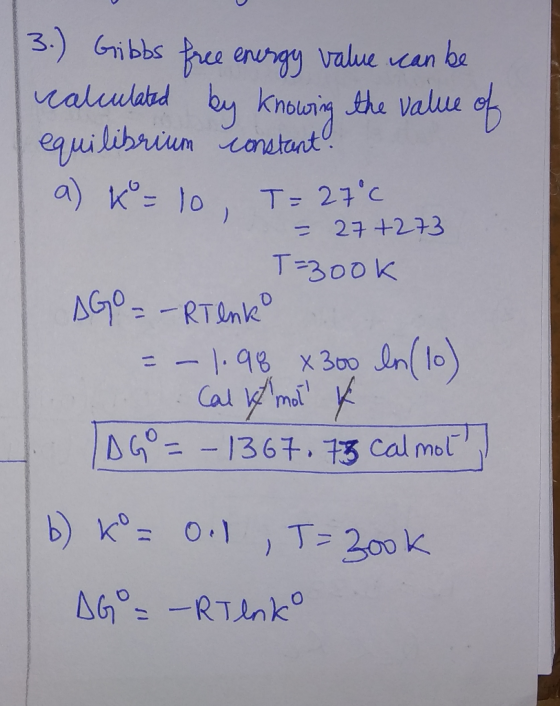
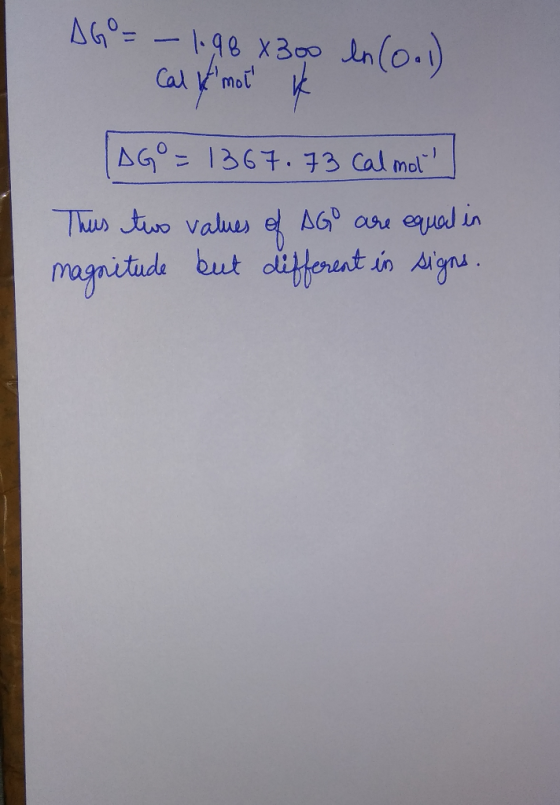
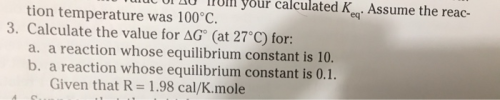 UILO HIVIH your calculated Ko.. Assume the reac- tion temperature was 100°C. 3. Calculate the value for AG° (at 27°C) for: a. a reaction whose equilibrium constant is 10. b. a reaction whose equilibrium constant is 0.1. Given that R= 1.98 cal/K.mole
Using the reduction potentials given, calculate the equilibrium constant, K, at 20 degrees C for the reaction Using the reduction potentials given, calculate the equilibrium constant, K, at 25°C for...
 Using the reduction potentials given, calculate the equilibrium
constant, K, at 20 degrees C for the reaction
Using the reduction potentials given, calculate the equilibrium constant, K, at 25°C for the reaction, 33 3+ Ag (aa) t Fe(a)Ag) Fe (aq) +0.77 V +0.80 V A Ag+(aq) + e- ← a. 1.66 b. 6.4 c. 3.2 d. 6.1 x 10⁻⁴ e. 1.6 x 10⁴ Rank the following compounds according to increasing solubility in water. K” is a less than sign) 34...
Using the reduction potentials given, calculate the equilibrium
constant, K, at 20 degrees C for the reaction
Using the reduction potentials given, calculate the equilibrium constant, K, at 25°C for the reaction, 33 3+ Ag (aa) t Fe(a)Ag) Fe (aq) +0.77 V +0.80 V A Ag+(aq) + e- ← a. 1.66 b. 6.4 c. 3.2 d. 6.1 x 10⁻⁴ e. 1.6 x 10⁴ Rank the following compounds according to increasing solubility in water. K” is a less than sign) 34...
(9) A spontaneous process has the change of free energy (a) AG > 0 (b) AG <0 (c) AG = 0 (d) AH >0 and AS &...
 (9) A spontaneous process has the change of free energy (a) AG > 0 (b) AG <0 (c) AG = 0 (d) AH >0 and AS <0 (10) A chemical reaction has AH = 10 kJ, AS = 50 J/K at temperature T = 300 K, the reaction AG = (a) 5000 (b)-5000 (c) 10000 (d) 50 (11) For reaction : Ag (s) + 1/2 Cl2 (g) = Agt (aq) + CI+ (aq), the standard free energy of formation: AGE"...
(a) Calculate ?G for the reaction: 2H,000 H()+OH (ag) at 25 C given the following initial...
 (a) Calculate ?G for the reaction: 2H,000 H()+OH (ag) at 25 C given the following initial concentrations. HO] 1.0x 10⁻¹² M and (OH]- 20 x10* M (b) Predict the direction in which the reaction will proceed spontaneously to establish equilibrium. 10. The AG° for the reaction: N,(g)+3H,(g)0 2NH,(g) is 33.3 kJ/mol at 25°C. What is the value of Kp?
39. Given: E +0.46 V Eo- +0.34 V Cu(s) + 2 Ag+ → 2 Ag (s) + Cu2. Cu2+ + H2 (g) → Cu (s) + 2 H' Find the standar...
 39. Given: E +0.46 V Eo- +0.34 V Cu(s) + 2 Ag+ → 2 Ag (s) + Cu2. Cu2+ + H2 (g) → Cu (s) + 2 H' Find the standard potential for the cell reaction for 2 Ag + H2 (g)-2 Ag+2H +0.80 V b. a. +0.40 V +0.12 V d. c. -0.12 v none of these e. 40. Given: Fe (s) + 2 Ag' (aq) Fe (ag)+ 2 Ag (s) with E ell -1.24 V What is the...
Calculate the free energy AG at 25°C for the nonstandard conditions at point where the reaction...
 Calculate the free energy AG at 25°C for the nonstandard conditions at point where the reaction quotient Q is 2.75 x 10 Express your answer numerically in kilojoules. View Available Hint(s) % ALC O ? AG - CO Nitrosyl chloride formation Chlorine gas. Cl(s), reacts with nitric oxide, NO(), to form nitrosyl chloride, NOCI(g), via the reaction Cl(s) + 2NO(g) + 2NOCI() The thermodynamic data for the reactants and products in the reaction are given in the following table: Substance...
QUESTION 19 Calculate AG, in kJ, for the following reaction: 2 HNO, (lia) + NO (g)...
 QUESTION 19 Calculate AG, in kJ, for the following reaction: 2 HNO, (lia) + NO (g) - 3 NO, (g) + H2O (lia) Substance AG (kJ) HNO3 () - 79.71 NO (9) 86.57 51.30 NO2 (9) H20 (0) -237.18 QUESTION 20 Calculate the equilibrium constant for the reaction from the previous question at O "C. ENTER A NUMBER WITH FOUR SIG FIGS. K=e-4CRT R = 8.314 J/K mol
Z. Consider the following data: E(Ag O/Ag- +1.36 V; EAg g")-+1.98 V; E(Ag/Ag)-+0.80 V; E (Ag.S/AgH2S)--0.69...
 Z. Consider the following data: E(Ag O/Ag- +1.36 V; EAg g")-+1.98 V; E(Ag/Ag)-+0.80 V; E (Ag.S/AgH2S)--0.69 v (a) Which of the five species (Ag S, Ag:O, Ag g,Ag) is the strongest oxidizer and which one should be the easiest to oxidize? (b) The standard hydrogen electrode is connected with an electrode made of silver and containing Ag ions in water as shown below: Ag Which of the electrodes is the cathode and which is the anode? Which way the electrons...
(9) A spontaneous process has the change of free energy (a) AG>0 (c) AG = 0...
 (9) A spontaneous process has the change of free energy (a) AG>0 (c) AG = 0 (b) AG <O (d) AH>0 and AS <O (10) A chemical reaction has AH = 10 kJ. AS = 50 J/K at temperature T = 300 K. the reaction AG = J. (a) 5000 (b) -5000 (c) 10000 (d) 50 (11) For reaction: Ag (s) + 2 Cl2 (g) Ag° (aq) +CI (aq), the standard free energy of formation: AGf° (Ag*) = 77.1 kJ/mol,...
Please show steps For the following half-reaction, 0.017 V Ag(S203)23eAg+2 S2032- Calculate the value of the...
 Please show steps
For the following half-reaction, 0.017 V Ag(S203)23eAg+2 S2032- Calculate the value of the equilibrium constant at 25°C for the following reaction. (Hint: Find a half-reaction that can be added to the one above to give the required reaction.) Ag+(aq) 2 S2032-(aq) Ag(S203)23-
Please show steps
For the following half-reaction, 0.017 V Ag(S203)23eAg+2 S2032- Calculate the value of the equilibrium constant at 25°C for the following reaction. (Hint: Find a half-reaction that can be added to the one above to give the required reaction.) Ag+(aq) 2 S2032-(aq) Ag(S203)23-
 UILO HIVIH your calculated Ko.. Assume the reac- tion temperature was 100°C. 3. Calculate the value for AG° (at 27°C) for: a. a reaction whose equilibrium constant is 10. b. a reaction whose equilibrium constant is 0.1. Given that R= 1.98 cal/K.mole
 Using the reduction potentials given, calculate the equilibrium
constant, K, at 20 degrees C for the reaction
Using the reduction potentials given, calculate the equilibrium constant, K, at 25°C for the reaction, 33 3+ Ag (aa) t Fe(a)Ag) Fe (aq) +0.77 V +0.80 V A Ag+(aq) + e- ← a. 1.66 b. 6.4 c. 3.2 d. 6.1 x 10⁻⁴ e. 1.6 x 10⁴ Rank the following compounds according to increasing solubility in water. K” is a less than sign) 34...
Using the reduction potentials given, calculate the equilibrium
constant, K, at 20 degrees C for the reaction
Using the reduction potentials given, calculate the equilibrium constant, K, at 25°C for the reaction, 33 3+ Ag (aa) t Fe(a)Ag) Fe (aq) +0.77 V +0.80 V A Ag+(aq) + e- ← a. 1.66 b. 6.4 c. 3.2 d. 6.1 x 10⁻⁴ e. 1.6 x 10⁴ Rank the following compounds according to increasing solubility in water. K” is a less than sign) 34...
 (9) A spontaneous process has the change of free energy (a) AG > 0 (b) AG <0 (c) AG = 0 (d) AH >0 and AS <0 (10) A chemical reaction has AH = 10 kJ, AS = 50 J/K at temperature T = 300 K, the reaction AG = (a) 5000 (b)-5000 (c) 10000 (d) 50 (11) For reaction : Ag (s) + 1/2 Cl2 (g) = Agt (aq) + CI+ (aq), the standard free energy of formation: AGE"...
 (a) Calculate ?G for the reaction: 2H,000 H()+OH (ag) at 25 C given the following initial concentrations. HO] 1.0x 10⁻¹² M and (OH]- 20 x10* M (b) Predict the direction in which the reaction will proceed spontaneously to establish equilibrium. 10. The AG° for the reaction: N,(g)+3H,(g)0 2NH,(g) is 33.3 kJ/mol at 25°C. What is the value of Kp?
 39. Given: E +0.46 V Eo- +0.34 V Cu(s) + 2 Ag+ → 2 Ag (s) + Cu2. Cu2+ + H2 (g) → Cu (s) + 2 H' Find the standard potential for the cell reaction for 2 Ag + H2 (g)-2 Ag+2H +0.80 V b. a. +0.40 V +0.12 V d. c. -0.12 v none of these e. 40. Given: Fe (s) + 2 Ag' (aq) Fe (ag)+ 2 Ag (s) with E ell -1.24 V What is the...
 Calculate the free energy AG at 25°C for the nonstandard conditions at point where the reaction quotient Q is 2.75 x 10 Express your answer numerically in kilojoules. View Available Hint(s) % ALC O ? AG - CO Nitrosyl chloride formation Chlorine gas. Cl(s), reacts with nitric oxide, NO(), to form nitrosyl chloride, NOCI(g), via the reaction Cl(s) + 2NO(g) + 2NOCI() The thermodynamic data for the reactants and products in the reaction are given in the following table: Substance...
 QUESTION 19 Calculate AG, in kJ, for the following reaction: 2 HNO, (lia) + NO (g) - 3 NO, (g) + H2O (lia) Substance AG (kJ) HNO3 () - 79.71 NO (9) 86.57 51.30 NO2 (9) H20 (0) -237.18 QUESTION 20 Calculate the equilibrium constant for the reaction from the previous question at O "C. ENTER A NUMBER WITH FOUR SIG FIGS. K=e-4CRT R = 8.314 J/K mol
 Z. Consider the following data: E(Ag O/Ag- +1.36 V; EAg g")-+1.98 V; E(Ag/Ag)-+0.80 V; E (Ag.S/AgH2S)--0.69 v (a) Which of the five species (Ag S, Ag:O, Ag g,Ag) is the strongest oxidizer and which one should be the easiest to oxidize? (b) The standard hydrogen electrode is connected with an electrode made of silver and containing Ag ions in water as shown below: Ag Which of the electrodes is the cathode and which is the anode? Which way the electrons...
 (9) A spontaneous process has the change of free energy (a) AG>0 (c) AG = 0 (b) AG <O (d) AH>0 and AS <O (10) A chemical reaction has AH = 10 kJ. AS = 50 J/K at temperature T = 300 K. the reaction AG = J. (a) 5000 (b) -5000 (c) 10000 (d) 50 (11) For reaction: Ag (s) + 2 Cl2 (g) Ag° (aq) +CI (aq), the standard free energy of formation: AGf° (Ag*) = 77.1 kJ/mol,...
 Please show steps
For the following half-reaction, 0.017 V Ag(S203)23eAg+2 S2032- Calculate the value of the equilibrium constant at 25°C for the following reaction. (Hint: Find a half-reaction that can be added to the one above to give the required reaction.) Ag+(aq) 2 S2032-(aq) Ag(S203)23-
Please show steps
For the following half-reaction, 0.017 V Ag(S203)23eAg+2 S2032- Calculate the value of the equilibrium constant at 25°C for the following reaction. (Hint: Find a half-reaction that can be added to the one above to give the required reaction.) Ag+(aq) 2 S2032-(aq) Ag(S203)23-
Most questions answered within 3 hours.
-
Where is the error in this code sequence?
String s1 = "Hello";
String s2 = "ello";...
asked 10 months ago -
Financial data for Joel de Paris, Inc., for last year
follow:
Joel de Paris, Inc.
Balance...
asked 10 months ago -
Consider this reaction:
Al2(SO4)3 (aq)+ BaCl3
(aq) Al2Cl6 (aq)- +
3BaSO4(s) . What is the...
asked 10 months ago -
Suppose that Savneet is considering increasing her
recent random sample from 20 car rentals to 40...
asked 10 months ago -
Trucks arrive at an unloading terminal at an average rate of 120
per hour.
Trucks arrive...
asked 10 months ago -
Why are methanol and ethanol completely soluble in water while
octanol is not very little soluble....
asked 10 months ago -
A facilities manager at a university reads in a research report
that the mean amount of...
asked 10 months ago -
When the CuSO4 is rehydrated by adding water to the anhydrous
compound, is this an endothermic...
asked 10 months ago -
A ray of sunlight is passing from diamond into crown glass; the
angle of incidence is...
asked 10 months ago -
A block of mass 0.249 kg is placed on top of a light, vertical
spring of...
asked 10 months ago -
how do the kidneys compensate in the presences of acidosis
a) trigger hyperventilate
b) reserve acid...
asked 10 months ago -
Question 501 pts
The rental rate of capital to the firm increases. Which of the
following...
asked 10 months ago