


Homework Answers
Solution 1
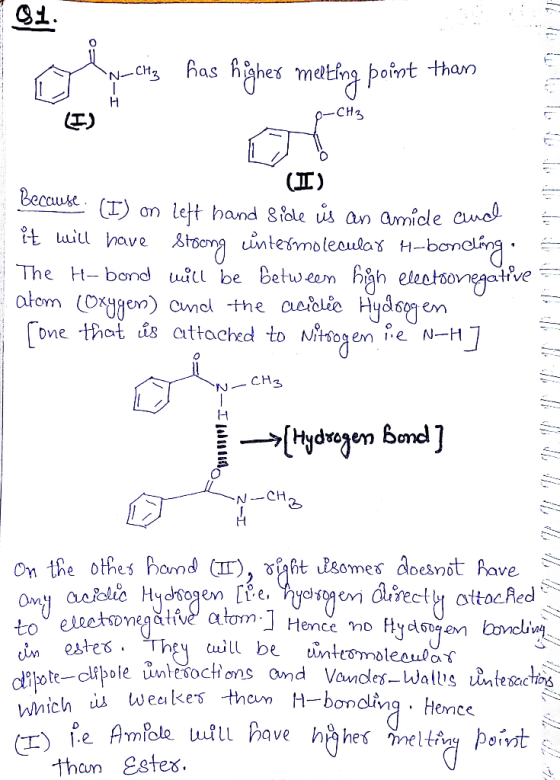
Add Answer to:
Do all work on this paper. 1. The compound below on the left has a much...
nob 2. Strong acids always protonate amide oxygens and never protonate amide nitrogens. Provide two reasons that...
 nob 2. Strong acids always protonate amide oxygens and never protonate amide nitrogens. Provide two reasons that explain this fact (4 points). 6. Propose multi step synthetic routes from the given organic molecule to the indicated product. You can use any organic solvent and any of the following organic chemicals CH,-, CH,CH,-Br and inorganic chemicals: co, KCN, Mg, Li, Cul, Zn, Sn, HCI, H,O, H,SO, DIBALH, LIAIH, NaBH, Cro, H, and Pd catalyst, PBr, and SOCI,. (24 points, 6 each)....
4. Draw a circle around the compound that reacts most rapidly with KOH in water solvent,...
 4. Draw a circle around the compound that reacts most rapidly with KOH in water solvent, and draw a rectangle around the compound that reacts most slowly (Ph=phenylCH) in each horizontal row (6 points). There 5. Write the products of the following reactions. If there is no reaction write NR. (26 points, 2 each). 1. SOCI, 2.CH,CH,OH 1. SOCI, 2. (CH,CH, CHL PhầCH OCH CH,OH, catalytie HC Phách, C OOLCH CH, NH, catalytic HCI
1. COMB 2. wwerd 6. Propose multi step synthetic routes from the given organic molecule to the indicated product. Y...
 1. COMB 2. wwerd 6. Propose multi step synthetic routes from the given organic molecule to the indicated product. You can use any organic solvent and any of the following organic chemicals CHI, CH.CH -Brand inorganic chemicals: CO., KCN, Mr. Li, Cul, Zn, Sn, HCI,H,O, H.SO, DIBALH, LIAIH, NaBH., Cro., H, and Pd catalyst, PBr, and SOCI. (24 points, 6 each). OOH CH Of 04
C-O-CH.CH. PhầCH, 1. LAIH, 2. water, HCI -OCH CH . LAOR), where tertiary buty Ph-CHE POSTED...
 C-O-CH.CH. PhầCH, 1. LAIH, 2. water, HCI -OCH CH . LAOR), where tertiary buty Ph-CHE POSTED -OCH, CH, 1. DIBALH 2. water, HCI 1. DIBAL H 2. water, HCI excess Hz, metal catalyst excess KOH, water, heat excess KOH, water, heat 1. LAIH 2. water, HC
1. LIAIH -OCHCH 2. water, HC CH 1. LIAKOR),H where R tertiary butyl aerny is n....
 1. LIAIH -OCHCH 2. water, HC CH 1. LIAKOR),H where R tertiary butyl aerny is n. doino y u of uban oCH 2. water, HCl Ph-CH eCH CHO uqo co lo bb . AL 1. DIBAL H O-CHCH Ph-CH 2. water, HC 1. DIBAL H 2. water, HC Ph-CH HO excess H2, metal catalyst Ph-CH excess KOH, water, heat Ph-CH excess KOH, water, heat 1. LiAl 2 water, HC
ANSWER ALL QUESTIONS AND ALL PARTS FULLY! 1. Provide the reagent needed to convert 2-pentanol to...
 ANSWER ALL QUESTIONS AND ALL PARTS FULLY!
1. Provide the reagent needed to convert 2-pentanol to 2-bromopentane (3 points). 2. Provide the reagent needed to complete the reaction below (1 point) De - Di 3. Give the products for the following reactions (6 points). нс он HCI HC on here a. OH O mot 1. NaH 2. CH CH CH(CH3)CH2CI 1, CHICAS COLGA SOCI Pyridine HBr 4. For each molecule, give the electrophile and the nucleophile that formed the compound...
ANSWER ALL QUESTIONS AND ALL PARTS FULLY!
1. Provide the reagent needed to convert 2-pentanol to 2-bromopentane (3 points). 2. Provide the reagent needed to complete the reaction below (1 point) De - Di 3. Give the products for the following reactions (6 points). нс он HCI HC on here a. OH O mot 1. NaH 2. CH CH CH(CH3)CH2CI 1, CHICAS COLGA SOCI Pyridine HBr 4. For each molecule, give the electrophile and the nucleophile that formed the compound...
clearer images For questions 1 - 5. predict the major organic products for the following transformations....
 clearer images
For questions 1 - 5. predict the major organic products for the following transformations. Clearly indicate formal charges and stereochemistry if applicable. The use of a squiggly bond is not permitted; all stereoisomers should be clearly indicated for full credit. OH 1. a) Croy, H,SO,,H,O (Jones reagent) b) workup 2. a) HCI (cat.), CH, OH b) workup Q2 1. a) Croy, pyridine, HCl, solvent (PCC) b) workup 2. a) HCI (cat.), CH, OH b) workup a) NaOH, solvent,...
clearer images
For questions 1 - 5. predict the major organic products for the following transformations. Clearly indicate formal charges and stereochemistry if applicable. The use of a squiggly bond is not permitted; all stereoisomers should be clearly indicated for full credit. OH 1. a) Croy, H,SO,,H,O (Jones reagent) b) workup 2. a) HCI (cat.), CH, OH b) workup Q2 1. a) Croy, pyridine, HCl, solvent (PCC) b) workup 2. a) HCI (cat.), CH, OH b) workup a) NaOH, solvent,...
pppppplllleeeaaassseee help 1. a. Compound 1 reacts with A under acid conditions to form an imine. What could Z be in this reaction? b. Compound 2 reacts with A (same A as previous reaction) unde...
 pppppplllleeeaaassseee help
1. a. Compound 1 reacts with A under acid conditions to form an imine. What could Z be in this reaction? b. Compound 2 reacts with A (same A as previous reaction) under acid conditions to form an amide. What is Z in this reaction? Draw the structure of A Use curved arrows to show how Compound 2 forms the amide. c. Both reactions involve a leaving group. What is the leaving group in each reaction? O A...
pppppplllleeeaaassseee help
1. a. Compound 1 reacts with A under acid conditions to form an imine. What could Z be in this reaction? b. Compound 2 reacts with A (same A as previous reaction) under acid conditions to form an amide. What is Z in this reaction? Draw the structure of A Use curved arrows to show how Compound 2 forms the amide. c. Both reactions involve a leaving group. What is the leaving group in each reaction? O A...
1.Provide the major organic product of the reaction below. 2.Provide the major organic product of the...
 1.Provide the major organic product of the reaction below.
2.Provide the major organic product of the reaction shown
below.
3.Provide the major organic product of the reaction shown
below.
4.Predict the necessary starting material for the reaction
below. Give the IUPAC name.
5.
Part A
Draw the carbonyl compound needed for this synthesis.
6.Predict the product formed when
CH3-CH2-C≡C:–Na+
undergoes a reaction with the compound shown below followed by an
aqueous workup..
Interactive 3D display mode
7. When 2,2-dibromo-1-phenylpropane is...
1.Provide the major organic product of the reaction below.
2.Provide the major organic product of the reaction shown
below.
3.Provide the major organic product of the reaction shown
below.
4.Predict the necessary starting material for the reaction
below. Give the IUPAC name.
5.
Part A
Draw the carbonyl compound needed for this synthesis.
6.Predict the product formed when
CH3-CH2-C≡C:–Na+
undergoes a reaction with the compound shown below followed by an
aqueous workup..
Interactive 3D display mode
7. When 2,2-dibromo-1-phenylpropane is...
2 1 attempts left Check my work Which of the following amines can be used to resolve a racemic mi...
 Please answer all questions.
The answer to question #2 is incorrect.
2 1 attempts left Check my work Which of the following amines can be used to resolve a racemic mixture of amino acids? Select all that apply. 0.5 points NH2 HIH eBook Ho Print NH2 References Be sure to answer all parts. The structure of the amino acid sequence Gly-His-Leu is shown below. Select the letters that correspond to the N-terminal(s), the C-terminal(s), and amide bond(s). (CH3)2CHCH2 0.5 points...
Please answer all questions.
The answer to question #2 is incorrect.
2 1 attempts left Check my work Which of the following amines can be used to resolve a racemic mixture of amino acids? Select all that apply. 0.5 points NH2 HIH eBook Ho Print NH2 References Be sure to answer all parts. The structure of the amino acid sequence Gly-His-Leu is shown below. Select the letters that correspond to the N-terminal(s), the C-terminal(s), and amide bond(s). (CH3)2CHCH2 0.5 points...
 nob 2. Strong acids always protonate amide oxygens and never protonate amide nitrogens. Provide two reasons that explain this fact (4 points). 6. Propose multi step synthetic routes from the given organic molecule to the indicated product. You can use any organic solvent and any of the following organic chemicals CH,-, CH,CH,-Br and inorganic chemicals: co, KCN, Mg, Li, Cul, Zn, Sn, HCI, H,O, H,SO, DIBALH, LIAIH, NaBH, Cro, H, and Pd catalyst, PBr, and SOCI,. (24 points, 6 each)....
 4. Draw a circle around the compound that reacts most rapidly with KOH in water solvent, and draw a rectangle around the compound that reacts most slowly (Ph=phenylCH) in each horizontal row (6 points). There 5. Write the products of the following reactions. If there is no reaction write NR. (26 points, 2 each). 1. SOCI, 2.CH,CH,OH 1. SOCI, 2. (CH,CH, CHL PhầCH OCH CH,OH, catalytie HC Phách, C OOLCH CH, NH, catalytic HCI
 1. COMB 2. wwerd 6. Propose multi step synthetic routes from the given organic molecule to the indicated product. You can use any organic solvent and any of the following organic chemicals CHI, CH.CH -Brand inorganic chemicals: CO., KCN, Mr. Li, Cul, Zn, Sn, HCI,H,O, H.SO, DIBALH, LIAIH, NaBH., Cro., H, and Pd catalyst, PBr, and SOCI. (24 points, 6 each). OOH CH Of 04
 C-O-CH.CH. PhầCH, 1. LAIH, 2. water, HCI -OCH CH . LAOR), where tertiary buty Ph-CHE POSTED -OCH, CH, 1. DIBALH 2. water, HCI 1. DIBAL H 2. water, HCI excess Hz, metal catalyst excess KOH, water, heat excess KOH, water, heat 1. LAIH 2. water, HC
 1. LIAIH -OCHCH 2. water, HC CH 1. LIAKOR),H where R tertiary butyl aerny is n. doino y u of uban oCH 2. water, HCl Ph-CH eCH CHO uqo co lo bb . AL 1. DIBAL H O-CHCH Ph-CH 2. water, HC 1. DIBAL H 2. water, HC Ph-CH HO excess H2, metal catalyst Ph-CH excess KOH, water, heat Ph-CH excess KOH, water, heat 1. LiAl 2 water, HC
 ANSWER ALL QUESTIONS AND ALL PARTS FULLY!
1. Provide the reagent needed to convert 2-pentanol to 2-bromopentane (3 points). 2. Provide the reagent needed to complete the reaction below (1 point) De - Di 3. Give the products for the following reactions (6 points). нс он HCI HC on here a. OH O mot 1. NaH 2. CH CH CH(CH3)CH2CI 1, CHICAS COLGA SOCI Pyridine HBr 4. For each molecule, give the electrophile and the nucleophile that formed the compound...
ANSWER ALL QUESTIONS AND ALL PARTS FULLY!
1. Provide the reagent needed to convert 2-pentanol to 2-bromopentane (3 points). 2. Provide the reagent needed to complete the reaction below (1 point) De - Di 3. Give the products for the following reactions (6 points). нс он HCI HC on here a. OH O mot 1. NaH 2. CH CH CH(CH3)CH2CI 1, CHICAS COLGA SOCI Pyridine HBr 4. For each molecule, give the electrophile and the nucleophile that formed the compound...
 clearer images
For questions 1 - 5. predict the major organic products for the following transformations. Clearly indicate formal charges and stereochemistry if applicable. The use of a squiggly bond is not permitted; all stereoisomers should be clearly indicated for full credit. OH 1. a) Croy, H,SO,,H,O (Jones reagent) b) workup 2. a) HCI (cat.), CH, OH b) workup Q2 1. a) Croy, pyridine, HCl, solvent (PCC) b) workup 2. a) HCI (cat.), CH, OH b) workup a) NaOH, solvent,...
clearer images
For questions 1 - 5. predict the major organic products for the following transformations. Clearly indicate formal charges and stereochemistry if applicable. The use of a squiggly bond is not permitted; all stereoisomers should be clearly indicated for full credit. OH 1. a) Croy, H,SO,,H,O (Jones reagent) b) workup 2. a) HCI (cat.), CH, OH b) workup Q2 1. a) Croy, pyridine, HCl, solvent (PCC) b) workup 2. a) HCI (cat.), CH, OH b) workup a) NaOH, solvent,...
 pppppplllleeeaaassseee help
1. a. Compound 1 reacts with A under acid conditions to form an imine. What could Z be in this reaction? b. Compound 2 reacts with A (same A as previous reaction) under acid conditions to form an amide. What is Z in this reaction? Draw the structure of A Use curved arrows to show how Compound 2 forms the amide. c. Both reactions involve a leaving group. What is the leaving group in each reaction? O A...
pppppplllleeeaaassseee help
1. a. Compound 1 reacts with A under acid conditions to form an imine. What could Z be in this reaction? b. Compound 2 reacts with A (same A as previous reaction) under acid conditions to form an amide. What is Z in this reaction? Draw the structure of A Use curved arrows to show how Compound 2 forms the amide. c. Both reactions involve a leaving group. What is the leaving group in each reaction? O A...
 1.Provide the major organic product of the reaction below.
2.Provide the major organic product of the reaction shown
below.
3.Provide the major organic product of the reaction shown
below.
4.Predict the necessary starting material for the reaction
below. Give the IUPAC name.
5.
Part A
Draw the carbonyl compound needed for this synthesis.
6.Predict the product formed when
CH3-CH2-C≡C:–Na+
undergoes a reaction with the compound shown below followed by an
aqueous workup..
Interactive 3D display mode
7. When 2,2-dibromo-1-phenylpropane is...
1.Provide the major organic product of the reaction below.
2.Provide the major organic product of the reaction shown
below.
3.Provide the major organic product of the reaction shown
below.
4.Predict the necessary starting material for the reaction
below. Give the IUPAC name.
5.
Part A
Draw the carbonyl compound needed for this synthesis.
6.Predict the product formed when
CH3-CH2-C≡C:–Na+
undergoes a reaction with the compound shown below followed by an
aqueous workup..
Interactive 3D display mode
7. When 2,2-dibromo-1-phenylpropane is...
 Please answer all questions.
The answer to question #2 is incorrect.
2 1 attempts left Check my work Which of the following amines can be used to resolve a racemic mixture of amino acids? Select all that apply. 0.5 points NH2 HIH eBook Ho Print NH2 References Be sure to answer all parts. The structure of the amino acid sequence Gly-His-Leu is shown below. Select the letters that correspond to the N-terminal(s), the C-terminal(s), and amide bond(s). (CH3)2CHCH2 0.5 points...
Please answer all questions.
The answer to question #2 is incorrect.
2 1 attempts left Check my work Which of the following amines can be used to resolve a racemic mixture of amino acids? Select all that apply. 0.5 points NH2 HIH eBook Ho Print NH2 References Be sure to answer all parts. The structure of the amino acid sequence Gly-His-Leu is shown below. Select the letters that correspond to the N-terminal(s), the C-terminal(s), and amide bond(s). (CH3)2CHCH2 0.5 points...
Most questions answered within 3 hours.
-
Where is the error in this code sequence?
String s1 = "Hello";
String s2 = "ello";...
asked 10 months ago -
Financial data for Joel de Paris, Inc., for last year
follow:
Joel de Paris, Inc.
Balance...
asked 10 months ago -
Consider this reaction:
Al2(SO4)3 (aq)+ BaCl3
(aq) Al2Cl6 (aq)- +
3BaSO4(s) . What is the...
asked 10 months ago -
Suppose that Savneet is considering increasing her
recent random sample from 20 car rentals to 40...
asked 10 months ago -
Trucks arrive at an unloading terminal at an average rate of 120
per hour.
Trucks arrive...
asked 10 months ago -
Why are methanol and ethanol completely soluble in water while
octanol is not very little soluble....
asked 10 months ago -
A facilities manager at a university reads in a research report
that the mean amount of...
asked 10 months ago -
When the CuSO4 is rehydrated by adding water to the anhydrous
compound, is this an endothermic...
asked 10 months ago -
A ray of sunlight is passing from diamond into crown glass; the
angle of incidence is...
asked 10 months ago -
A block of mass 0.249 kg is placed on top of a light, vertical
spring of...
asked 10 months ago -
how do the kidneys compensate in the presences of acidosis
a) trigger hyperventilate
b) reserve acid...
asked 10 months ago -
Question 501 pts
The rental rate of capital to the firm increases. Which of the
following...
asked 10 months ago