
Homework Answers

Add Answer to:
13, Electron flow in an electrolytic cell is always from to A. anode to cathode B....
Draw a diagram of the electrolytic cell from Part 1. Identify the cathode, anode, directions in...
 Draw a diagram of the electrolytic cell from Part 1. Identify
the cathode, anode, directions in which the electrons, and ions
move. Show how the nickel atoms migrate from the anode and how they
deposit on the cathode. Show the power source and then identify the
positive and negative terminals of the power source. Identify the
positive and negative electrodes. Identify and write the oxidation
and reduction half reactions and write the mass of each electrode
at the start and...
Draw a diagram of the electrolytic cell from Part 1. Identify
the cathode, anode, directions in which the electrons, and ions
move. Show how the nickel atoms migrate from the anode and how they
deposit on the cathode. Show the power source and then identify the
positive and negative terminals of the power source. Identify the
positive and negative electrodes. Identify and write the oxidation
and reduction half reactions and write the mass of each electrode
at the start and...
Identify the components of the electrolytic electrochemical cell below, placing the anode on the left and...
 Identify the components of the electrolytic electrochemical cell below, placing the anode on the left and the cathode on the right. Use the terms salt bridge, zinc nitrate solution, copper nitrate solution, copper electrode, and zinc electrode. Also, label the electrodes as + and - A C E Direction of electron flow (circle one): A to B B to A or Direction of cation flow through salt bridge: E C to D D to C or Label the electrodes on...
Identify the components of the electrolytic electrochemical cell below, placing the anode on the left and...
 Identify the components of the electrolytic electrochemical cell below, placing the anode on the left and the cathode on the right. Use the terms salt bridge, zinc nitrate solution, copper nitrate solution, copper electrode, and zinc electrode. Also, label the electrodes as + and - A С E Direction of electron flow (circle one): A to B B to A or Direction of cation flow through salt bridge: C to D D to C or Label the electrodes on the...
One difference between an electrolytic cell and a galvanic (voltaic) cell is the galvanic cell reaction...
One difference between an electrolytic cell and a galvanic (voltaic) cell is the galvanic cell reaction is spontaneous and the electrolytic cell reaction is not spontaneous. galvanic cells last longer than electrolytic cells.` electrolytic cells produce more power than galvanic cells. electrolytic cells always require inert electrodes .electrons flow from the anode to the cathode in a galvanic cell and in the opposite direction in a voltaic cell.
Determine whether each statement describes an anode or a cathode in a voltaic cell. Where the...
 Determine whether each statement describes an anode or a cathode in a voltaic cell.
Where the reduction occurs Choose...
The positive terminal Choose...
Where electrons flow from Choose...
Where the oxidation occurs Choose...
Where electrons flow to Choose...
The negative terminal Choose...
Determine whether each statement describes an anode or a cathode in a voltaic cell.
Where the reduction occurs Choose...
The positive terminal Choose...
Where electrons flow from Choose...
Where the oxidation occurs Choose...
Where electrons flow to Choose...
The negative terminal Choose...
13. In an electrolytic cell the electrode at which the electrons enter the solution is called...
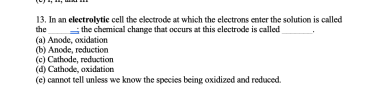 13. In an electrolytic cell the electrode at which the electrons enter the solution is called the the chemical change that occurs at this electrode is called (a) Anode, oxidation (b) Anode, reduction (c) Cathode, reduction (d) Cathode, oxidation (e) cannot tell unless we know the species being oxidized and reduced.
13. What reaction occurs at the anode during the electrolysis of molten silver chloride? A. AgCl(1)...
 13. What reaction occurs at the anode during the electrolysis of molten silver chloride? A. AgCl(1) ► Ag" (l) + CE(1) B. Ag (l) +e → Ag(1) C. Ag() ► Ag () + D. 2CH(1) Cl2(g) + 2e E. Cl2(g) + 2e → 201(1) 14. One of the differences between a voltaic cell and an electrolytic cell (where electrolysis occurs) is that in an electrolytic cell: A. electrical energy is supplied from an outside energy source to drive a nonspontaneous...
206. Please label the cathode, anode, salt bridge, and the direction of the electron flow Zn...
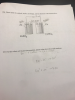 206. Please label the cathode, anode, salt bridge, and the direction of the electron flow Zn Cu CuSO4 ZnSO4 207. For the voltaic cell in previous question, please write down the 2 half reactions Cutey
Which of the following is true for a galvanic cell 1. The electron flow is from...
 Which of the following is true for a galvanic cell 1. The electron flow is from the negative electrode to the positive electrode 2. The electron flow is from the anode to the cathode. 3. The electron flow is from the oxidising agent to the reducing agent through an external circuit. 1 only O 2 only O 3 only . 1 and 2 only 1, 2, and 3
Part A Consider a voltaic cell that is set up as follows: Anode contains an Zn(s) electrode and 1M Zn2+(aq) Cathode cont...
Part A Consider a voltaic cell that is set up as follows: Anode contains an Zn(s) electrode and 1M Zn2+(aq) Cathode contains a Pt(s) electrode and 1M MnO4–(aq),Mn2+(aq), and H+(aq) Which of the following statements match the cathode? Select all that apply. Group of answer choices The electrode increases in mass Oxidation occurs at this half-cell Electrons enter the half-cell The electrode is inactive Cations from the salt-bridge move to this half-cell The electrode is negative Part B Which of...
 Draw a diagram of the electrolytic cell from Part 1. Identify
the cathode, anode, directions in which the electrons, and ions
move. Show how the nickel atoms migrate from the anode and how they
deposit on the cathode. Show the power source and then identify the
positive and negative terminals of the power source. Identify the
positive and negative electrodes. Identify and write the oxidation
and reduction half reactions and write the mass of each electrode
at the start and...
Draw a diagram of the electrolytic cell from Part 1. Identify
the cathode, anode, directions in which the electrons, and ions
move. Show how the nickel atoms migrate from the anode and how they
deposit on the cathode. Show the power source and then identify the
positive and negative terminals of the power source. Identify the
positive and negative electrodes. Identify and write the oxidation
and reduction half reactions and write the mass of each electrode
at the start and...
 Identify the components of the electrolytic electrochemical cell below, placing the anode on the left and the cathode on the right. Use the terms salt bridge, zinc nitrate solution, copper nitrate solution, copper electrode, and zinc electrode. Also, label the electrodes as + and - A C E Direction of electron flow (circle one): A to B B to A or Direction of cation flow through salt bridge: E C to D D to C or Label the electrodes on...
 Identify the components of the electrolytic electrochemical cell below, placing the anode on the left and the cathode on the right. Use the terms salt bridge, zinc nitrate solution, copper nitrate solution, copper electrode, and zinc electrode. Also, label the electrodes as + and - A С E Direction of electron flow (circle one): A to B B to A or Direction of cation flow through salt bridge: C to D D to C or Label the electrodes on the...
 Determine whether each statement describes an anode or a cathode in a voltaic cell.
Where the reduction occurs Choose...
The positive terminal Choose...
Where electrons flow from Choose...
Where the oxidation occurs Choose...
Where electrons flow to Choose...
The negative terminal Choose...
Determine whether each statement describes an anode or a cathode in a voltaic cell.
Where the reduction occurs Choose...
The positive terminal Choose...
Where electrons flow from Choose...
Where the oxidation occurs Choose...
Where electrons flow to Choose...
The negative terminal Choose...
 13. In an electrolytic cell the electrode at which the electrons enter the solution is called the the chemical change that occurs at this electrode is called (a) Anode, oxidation (b) Anode, reduction (c) Cathode, reduction (d) Cathode, oxidation (e) cannot tell unless we know the species being oxidized and reduced.
 13. What reaction occurs at the anode during the electrolysis of molten silver chloride? A. AgCl(1) ► Ag" (l) + CE(1) B. Ag (l) +e → Ag(1) C. Ag() ► Ag () + D. 2CH(1) Cl2(g) + 2e E. Cl2(g) + 2e → 201(1) 14. One of the differences between a voltaic cell and an electrolytic cell (where electrolysis occurs) is that in an electrolytic cell: A. electrical energy is supplied from an outside energy source to drive a nonspontaneous...
 206. Please label the cathode, anode, salt bridge, and the direction of the electron flow Zn Cu CuSO4 ZnSO4 207. For the voltaic cell in previous question, please write down the 2 half reactions Cutey
 Which of the following is true for a galvanic cell 1. The electron flow is from the negative electrode to the positive electrode 2. The electron flow is from the anode to the cathode. 3. The electron flow is from the oxidising agent to the reducing agent through an external circuit. 1 only O 2 only O 3 only . 1 and 2 only 1, 2, and 3
Most questions answered within 3 hours.
-
Where is the error in this code sequence?
String s1 = "Hello";
String s2 = "ello";...
asked 10 months ago -
Financial data for Joel de Paris, Inc., for last year
follow:
Joel de Paris, Inc.
Balance...
asked 10 months ago -
Consider this reaction:
Al2(SO4)3 (aq)+ BaCl3
(aq) Al2Cl6 (aq)- +
3BaSO4(s) . What is the...
asked 10 months ago -
Suppose that Savneet is considering increasing her
recent random sample from 20 car rentals to 40...
asked 10 months ago -
Trucks arrive at an unloading terminal at an average rate of 120
per hour.
Trucks arrive...
asked 10 months ago -
Why are methanol and ethanol completely soluble in water while
octanol is not very little soluble....
asked 10 months ago -
A facilities manager at a university reads in a research report
that the mean amount of...
asked 10 months ago -
When the CuSO4 is rehydrated by adding water to the anhydrous
compound, is this an endothermic...
asked 10 months ago -
A ray of sunlight is passing from diamond into crown glass; the
angle of incidence is...
asked 10 months ago -
A block of mass 0.249 kg is placed on top of a light, vertical
spring of...
asked 10 months ago -
how do the kidneys compensate in the presences of acidosis
a) trigger hyperventilate
b) reserve acid...
asked 10 months ago -
Question 501 pts
The rental rate of capital to the firm increases. Which of the
following...
asked 10 months ago