
Homework Answers
Add Answer to:
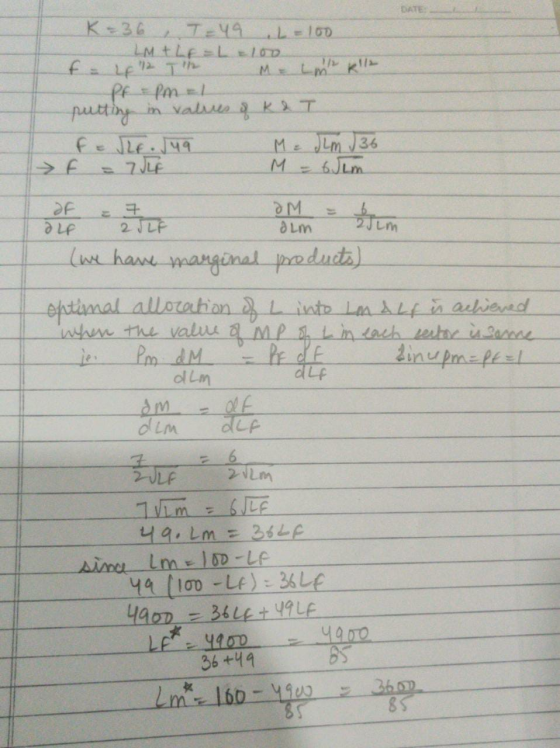
7. An economy produces two goods, food (F) and manufacturing (M). Food is produced by the...
Consider an economy that can produce two goods, manufactures and food. Manufactures are produced using capital...
 Consider an economy that can produce two goods, manufactures and
food. Manufactures are produced using capital and labor. Food is
produced using land and labor. The total supply of labor is 20
units. Given the supply of capital and land, the marginal products
of labors are as follows:
Suppose that the price of manufactures is 2 and the price of
food is 1.
A.Determine graphically and algebraically the wage rate and the
allocation of labor between the two sectors
B.Calculate,...
Consider an economy that can produce two goods, manufactures and
food. Manufactures are produced using capital and labor. Food is
produced using land and labor. The total supply of labor is 20
units. Given the supply of capital and land, the marginal products
of labors are as follows:
Suppose that the price of manufactures is 2 and the price of
food is 1.
A.Determine graphically and algebraically the wage rate and the
allocation of labor between the two sectors
B.Calculate,...
B2. (20 marks) Consider a small-open economy, "Home", that produces two goods: forest product (F) and manufacturing...
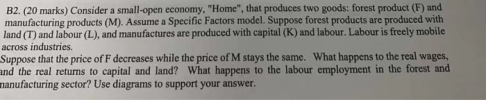 B2. (20 marks) Consider a small-open economy, "Home", that produces two goods: forest product (F) and manufacturing products (M). Assume a Specific Factors model. Suppose forest products are produced with land (T) and labour (L), and manufactures are produced with capital (K) and labour. Labour is freely mobile across industries. Suppose that the price of F decreases while the price of M stays the same. What happens to the real wages, and the real returns to capital and land? What...
1. Suppose there are two goods, Machines (M) and Food (F), and three factors of production...
 1. Suppose there are two goods, Machines (M) and Food (F), and three factors of production Labor (L), Capital (K), and Land (T). The production functions are as follows: QM = AKÜLT, Qp = April where Qm is the quantity produced of MQF is the quantity produced of F, L M is the amount of labor that is employed in sector M, and LF denotes labor employed in sector F. There is a total of L units of labor, and...
1. (40 marks) Sylvania is a small open economy producing two products, X and Y, using...
 1. (40 marks) Sylvania is a small open economy producing two products, X and Y, using two factors of production, capital and labour, under constant returns to scale. Capital is sector-specific, while labour is freely mobile between production sectors. Let Qx and Qy be the output quantities, Kx and Ky the capital endowments specific to the two sectors, and Lx and Ly the labour allocations to the two sectors subject to the constraint im- posed by the total endowment, namely...
Question 4 with LinearAlgebra) Consider an economy consisting of 3 sectors: M (manufacturing), E (energy) and...
 Question 4 with LinearAlgebra) Consider an economy consisting of 3 sectors: M (manufacturing), E (energy) and T (transposrtation'). The following is known about the required inputs in each of these sectors from the outputs of different sectors for production of yearly outputs xI, x2 and x3 in the sectors M, E and T, respectively )M requires a fraction o 0.5 fraction of the output of E, and 0.2 fraction of T (ii) E requires b fraction of itself, 0.3 fraction...
1 (Specific Factor Model, Chapter 3) In the simple" version of the specific factor model, there...
1. (Specific Factor Model, Chapter 3) In the "simple" version of the specific factor model, there are two sectors (goods), one factor (labor) that is perfectly mobile between the two sectors, and one fixed - or specific - factor in each sector. To be concrete, suppose the two goods are food and clothing, the specific factor in food is "land" - represented by "T", and the specific factor in clothing is "capital", represented by "K'. The production functions for each...
Consider an economy where two types of goods are produced: final goods, denoted Yt, and new ideas, denoted At
Consider an economy where two types of goods are produced: final goods, denoted Yt, and new ideas, denoted At. The total workforce is constant and denoted L, and a share, λ, of all workers are researchers, producing new ideas. All other workers are employed in production under the following linear technology:Yt = AtLY,where LY is the number of workers employed in production of the final good. Production of new ideas is governed by∆At+1 =ψAtLA,where ψ is a productivity parameter and LA is the...
1. Country Z has an economy that produces two goods: Food (A) and Housing (B). These...
 1. Country Z has an economy that produces two goods: Food (A) and Housing (B). These goods require the use of two resources. A unit of Food requires the use of 2 units of labor and 4 units to capital while one unit of housing requires the use of three (3) units of labor and five (5) units of capital. Country Z only has 150 units of labor and 200 units of capital available. Dl BL A. Use the above...
Heckscher-Ohlin model Country A produces cellphone (C) and food (F) with capital and labor. Both sectors...
Heckscher-Ohlin model Country A produces cellphone (C) and food (F) with capital and labor. Both sectors are perfect competitive. Capital (K) and labor (L) are not substitutable with each other. Thus, unit capital requirement and unit labor requirement are fixed. ??? = 3, ??? = 1, ??? = 2, ??? = 4, where ??? is the number of units of K-capital required to produce and unit of C-cellphone. a. Which sector is relatively capital intensive? Which sector is relatively labor...
Consider a small open economy (e.g. the Netherlands) producing two goods, clothing and food. The clothing...
Consider a small open economy (e.g. the Netherlands) producing two goods, clothing and food. The clothing industry uses capital (K) and labor (LC) as inputs, while the food industry uses land (La) and labor (LF ) as factors of production. The production technologies for the two industries are given by QC = K ¼ LC 3/4 ; QF = La1/2L F 1/2 . Also, the country is endowed with 216 units of capital, 360 units of labor, and 9 units...
 Consider an economy that can produce two goods, manufactures and
food. Manufactures are produced using capital and labor. Food is
produced using land and labor. The total supply of labor is 20
units. Given the supply of capital and land, the marginal products
of labors are as follows:
Suppose that the price of manufactures is 2 and the price of
food is 1.
A.Determine graphically and algebraically the wage rate and the
allocation of labor between the two sectors
B.Calculate,...
Consider an economy that can produce two goods, manufactures and
food. Manufactures are produced using capital and labor. Food is
produced using land and labor. The total supply of labor is 20
units. Given the supply of capital and land, the marginal products
of labors are as follows:
Suppose that the price of manufactures is 2 and the price of
food is 1.
A.Determine graphically and algebraically the wage rate and the
allocation of labor between the two sectors
B.Calculate,...
 B2. (20 marks) Consider a small-open economy, "Home", that produces two goods: forest product (F) and manufacturing products (M). Assume a Specific Factors model. Suppose forest products are produced with land (T) and labour (L), and manufactures are produced with capital (K) and labour. Labour is freely mobile across industries. Suppose that the price of F decreases while the price of M stays the same. What happens to the real wages, and the real returns to capital and land? What...
 1. Suppose there are two goods, Machines (M) and Food (F), and three factors of production Labor (L), Capital (K), and Land (T). The production functions are as follows: QM = AKÜLT, Qp = April where Qm is the quantity produced of MQF is the quantity produced of F, L M is the amount of labor that is employed in sector M, and LF denotes labor employed in sector F. There is a total of L units of labor, and...
 1. (40 marks) Sylvania is a small open economy producing two products, X and Y, using two factors of production, capital and labour, under constant returns to scale. Capital is sector-specific, while labour is freely mobile between production sectors. Let Qx and Qy be the output quantities, Kx and Ky the capital endowments specific to the two sectors, and Lx and Ly the labour allocations to the two sectors subject to the constraint im- posed by the total endowment, namely...
 Question 4 with LinearAlgebra) Consider an economy consisting of 3 sectors: M (manufacturing), E (energy) and T (transposrtation'). The following is known about the required inputs in each of these sectors from the outputs of different sectors for production of yearly outputs xI, x2 and x3 in the sectors M, E and T, respectively )M requires a fraction o 0.5 fraction of the output of E, and 0.2 fraction of T (ii) E requires b fraction of itself, 0.3 fraction...
 1. Country Z has an economy that produces two goods: Food (A) and Housing (B). These goods require the use of two resources. A unit of Food requires the use of 2 units of labor and 4 units to capital while one unit of housing requires the use of three (3) units of labor and five (5) units of capital. Country Z only has 150 units of labor and 200 units of capital available. Dl BL A. Use the above...
Most questions answered within 3 hours.
-
Where is the error in this code sequence?
String s1 = "Hello";
String s2 = "ello";...
asked 11 months ago -
Financial data for Joel de Paris, Inc., for last year
follow:
Joel de Paris, Inc.
Balance...
asked 11 months ago -
Consider this reaction:
Al2(SO4)3 (aq)+ BaCl3
(aq) Al2Cl6 (aq)- +
3BaSO4(s) . What is the...
asked 11 months ago -
Suppose that Savneet is considering increasing her
recent random sample from 20 car rentals to 40...
asked 11 months ago -
Trucks arrive at an unloading terminal at an average rate of 120
per hour.
Trucks arrive...
asked 11 months ago -
Why are methanol and ethanol completely soluble in water while
octanol is not very little soluble....
asked 11 months ago -
A facilities manager at a university reads in a research report
that the mean amount of...
asked 11 months ago -
When the CuSO4 is rehydrated by adding water to the anhydrous
compound, is this an endothermic...
asked 11 months ago -
A ray of sunlight is passing from diamond into crown glass; the
angle of incidence is...
asked 11 months ago -
A block of mass 0.249 kg is placed on top of a light, vertical
spring of...
asked 11 months ago -
how do the kidneys compensate in the presences of acidosis
a) trigger hyperventilate
b) reserve acid...
asked 11 months ago -
Question 501 pts
The rental rate of capital to the firm increases. Which of the
following...
asked 11 months ago