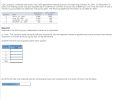
Cub Company, a calendar-year entity, had 3,100 geothermal
heating pumps in its beginning inventory for 20X1. On December 31,
20X0, the heating pumps had been adjusted down to $860 per unit
from an actual cost of $980 per unit. It was the lower of cost or
market. Cub purchased no additional units during 20X1. The
following additional information is provided for 20X1:
| Quarter | Date | Inventory (units) |
Unit Market Value |
|||||
| 1 | March 31, 20X1 | 1,770 | $ | 845 | ||||
| 2 | June 30, 20X1 | 1,440 | 890 | |||||
| 3 | September 30, 20X1 | 1,320 | 800 | |||||
| 4 | December 31, 20X1 | 920 | 830 | |||||
Required:
Respond to the following two independent scenarios as
requested.
a. Case 1: The company does not have sufficient experience
with the seasonal market for geothermal pumps and assumes that any
reductions in market value during the year will be permanent.
(1) Determine the cost of goods sold for each quarter.

Homework Answers


Add Answer to:
Cub Company, a calendar-year entity, had 3,100 geothermal
heating pumps in its beginning inventory for 20X1....
Please help with this. Cub Company, a calendar-year entity, had 3,000 geothermal heating pumps in its...
 Please help with this.
Cub Company, a calendar-year entity, had 3,000 geothermal heating pumps in its beginning inventory for 20X1. On December 31, 20XO, the heating pumps had been adjusted down to $870 per unit from an actual cost of $960 per unit. It was the lower of cost or market. Cub purchased no additional units during 20X1. The following additional information is provided for 20X1: Quarter Date March 31, 20x1 June 30, 2exi September 30, 2exi December 31, 20x1...
Please help with this.
Cub Company, a calendar-year entity, had 3,000 geothermal heating pumps in its beginning inventory for 20X1. On December 31, 20XO, the heating pumps had been adjusted down to $870 per unit from an actual cost of $960 per unit. It was the lower of cost or market. Cub purchased no additional units during 20X1. The following additional information is provided for 20X1: Quarter Date March 31, 20x1 June 30, 2exi September 30, 2exi December 31, 20x1...
At the end of the second quarter of 20X1, Malta Corporation assembled the following information: The...
 At the end of the second quarter of 20X1, Malta Corporation
assembled the following information:
The first quarter resulted in a $106,000 loss before taxes.
During the second quarter, sales were $1,216,000; purchases were
$666,000; and operating expenses were $336,000.
Cost of goods sold is determined using the FIFO method. The
inventory at the end of the first quarter was reduced by $20,000 to
a lower-of-cost-or-market figure of $94,000. During the second
quarter, replacement costs recovered, and by the end...
At the end of the second quarter of 20X1, Malta Corporation
assembled the following information:
The first quarter resulted in a $106,000 loss before taxes.
During the second quarter, sales were $1,216,000; purchases were
$666,000; and operating expenses were $336,000.
Cost of goods sold is determined using the FIFO method. The
inventory at the end of the first quarter was reduced by $20,000 to
a lower-of-cost-or-market figure of $94,000. During the second
quarter, replacement costs recovered, and by the end...
Alquist Company uses the retail method to estimate its ending inventory. Selected information about its year 2018 operations is as follows: January 1, 2018, beginning inventory had a cost of $130,000...
Alquist Company uses the retail method to estimate its ending inventory. Selected information about its year 2018 operations is as follows: January 1, 2018, beginning inventory had a cost of $130,000 and a retail value of $180,000. Purchases during 2018 cost $2,027,000 with an original retail value of $3,080,000. Freight costs were $13,000 for incoming merchandise. Net additional markups were $240,000 and net markdowns were $320,000. Based on prior experience, shrinkage due to shoplifting was estimated to be $18,000 of...
At the end of the second quarter of 20X1, Malta Corporation assembled the following information: 1....
 At the end of the second quarter of 20X1, Malta Corporation assembled the following information: 1. The first quarter resulted in a $130,000 loss before taxes. During the second quarter, sales were $1.240,000: purchases were $690.000: and operating expenses were $360,000. 2. Cost of goods sold is determined using the FIFO method. The inventory at the end of the first quarter was reduced by $44.000 to a lower-of-cost-or-market figure of $118.000. During the second quarter, replacement costs recovered, and by...
Accounting HELP!!!! ============================================================================================== ABC Company had the following inventory balances for Year 2: Beginning Balance Ending...
Accounting HELP!!!! ============================================================================================== ABC Company had the following inventory balances for Year 2: Beginning Balance Ending Balance Raw Materials $470 $160 Work In Process $420 $310 Finished Goods $450 $1150 During Year 2, ABC Company had the following transactions related to inventory: Purchased $220 of raw materials Incurred direct labor costs of $180 Allocated manufacturing overhead costs of $90 Sold inventory to customers for $700 that cost $210 to make What was ABC Company's Total Manufacturing Cost during Year 2?
4 A company had the following inventories during the year. Jan 1: Beginning Inventory 100 units...
 4 A company had the following inventories during the year. Jan 1: Beginning Inventory 100 units at $ 20 March: Purchase 500 units at $25 April: Purchase 1,000 units at $35 April 30: Sold 800 units at $70 May: Purchase 500 units at $40 June 30: Sold 1,000 units at $70 Perpetual FIFO Total Unit Amount Income Statement Total Purchase Perpetual LIFO Weighted Average Total Unit Amount Unit Amount Total Revenue = Unit Sold x Retail Price Total Cost of...
Pacific Company starts the year with a beginning inventory of 4,400 units at $7 per unit....
 Pacific Company starts the year with a beginning inventory of 4,400 units at $7 per unit. The company purchases 6,400 units at $6 each in February and 3,400 units at $8 each in March. Pacific sells 1,650 units during this quarter. Pacific has a perpetual inventory system and uses the FIFO inventory costing method. What is the cost of goods sold for the quarter? Multiple Choice $11,550 $9,900 $12,375 $13,200 Alphabet Company, which uses the periodic inventory method, purchases different...
RE: Week 3
1) During the first quarter of its fiscal year, Tangerine Enterprises experiences a temporary liquidation of 1000 units in its LIFO base owing to seasonal fluctuations. The LIFO unit cost is $12, and the estimated replacement cost of the inventory is $20 per unit. Identify the entry in the first interim period to account for the temporary liquidation.Dr. Cost of Goods Sold for $20,000; Cr Inventory for $12,000; Cr excess of replacement cost over LIFO cost of inventory liquidated for...
Cortez Company sells chairs that are used at computer stations. Its beginning inventory of chairs was...
 Cortez Company sells chairs that are used at computer stations. Its beginning inventory of chairs was 120 units at $110 per unit. During the year, Cortez made two batch purchases of this chair. The first was a 226-unit purchase at $125 per unit; the second was a 264-unit purchase at $132 per unit. During the period, it sold 372 chairs. Required Determine the amount of product costs that would be allocated to cost of goods sold and ending inventory, assuming...
4 A company had the following inventories during the year. Jan 1: Beginning Inventory 100 units...
 4 A company had the following inventories during the year. Jan 1: Beginning Inventory 100 units at $ 20 March: Purchase 500 units at $25 April: Purchase 1,000 units at $35 April 30: Sold 800 units at $70 May: Purchase 500 units at $40 June 30: Sold 1,000 units at $70 Perpetual FIFO Total Unit Amount Income Statement Total Purchase Perpetual LIFO Weighted Average Total Unit Amount Unit Amount Total Revenue = Unit Sold x Retail Price Total Cost of...
 Please help with this.
Cub Company, a calendar-year entity, had 3,000 geothermal heating pumps in its beginning inventory for 20X1. On December 31, 20XO, the heating pumps had been adjusted down to $870 per unit from an actual cost of $960 per unit. It was the lower of cost or market. Cub purchased no additional units during 20X1. The following additional information is provided for 20X1: Quarter Date March 31, 20x1 June 30, 2exi September 30, 2exi December 31, 20x1...
Please help with this.
Cub Company, a calendar-year entity, had 3,000 geothermal heating pumps in its beginning inventory for 20X1. On December 31, 20XO, the heating pumps had been adjusted down to $870 per unit from an actual cost of $960 per unit. It was the lower of cost or market. Cub purchased no additional units during 20X1. The following additional information is provided for 20X1: Quarter Date March 31, 20x1 June 30, 2exi September 30, 2exi December 31, 20x1...
 At the end of the second quarter of 20X1, Malta Corporation
assembled the following information:
The first quarter resulted in a $106,000 loss before taxes.
During the second quarter, sales were $1,216,000; purchases were
$666,000; and operating expenses were $336,000.
Cost of goods sold is determined using the FIFO method. The
inventory at the end of the first quarter was reduced by $20,000 to
a lower-of-cost-or-market figure of $94,000. During the second
quarter, replacement costs recovered, and by the end...
At the end of the second quarter of 20X1, Malta Corporation
assembled the following information:
The first quarter resulted in a $106,000 loss before taxes.
During the second quarter, sales were $1,216,000; purchases were
$666,000; and operating expenses were $336,000.
Cost of goods sold is determined using the FIFO method. The
inventory at the end of the first quarter was reduced by $20,000 to
a lower-of-cost-or-market figure of $94,000. During the second
quarter, replacement costs recovered, and by the end...
 At the end of the second quarter of 20X1, Malta Corporation assembled the following information: 1. The first quarter resulted in a $130,000 loss before taxes. During the second quarter, sales were $1.240,000: purchases were $690.000: and operating expenses were $360,000. 2. Cost of goods sold is determined using the FIFO method. The inventory at the end of the first quarter was reduced by $44.000 to a lower-of-cost-or-market figure of $118.000. During the second quarter, replacement costs recovered, and by...
 4 A company had the following inventories during the year. Jan 1: Beginning Inventory 100 units at $ 20 March: Purchase 500 units at $25 April: Purchase 1,000 units at $35 April 30: Sold 800 units at $70 May: Purchase 500 units at $40 June 30: Sold 1,000 units at $70 Perpetual FIFO Total Unit Amount Income Statement Total Purchase Perpetual LIFO Weighted Average Total Unit Amount Unit Amount Total Revenue = Unit Sold x Retail Price Total Cost of...
 Pacific Company starts the year with a beginning inventory of 4,400 units at $7 per unit. The company purchases 6,400 units at $6 each in February and 3,400 units at $8 each in March. Pacific sells 1,650 units during this quarter. Pacific has a perpetual inventory system and uses the FIFO inventory costing method. What is the cost of goods sold for the quarter? Multiple Choice $11,550 $9,900 $12,375 $13,200 Alphabet Company, which uses the periodic inventory method, purchases different...
 Cortez Company sells chairs that are used at computer stations. Its beginning inventory of chairs was 120 units at $110 per unit. During the year, Cortez made two batch purchases of this chair. The first was a 226-unit purchase at $125 per unit; the second was a 264-unit purchase at $132 per unit. During the period, it sold 372 chairs. Required Determine the amount of product costs that would be allocated to cost of goods sold and ending inventory, assuming...
 4 A company had the following inventories during the year. Jan 1: Beginning Inventory 100 units at $ 20 March: Purchase 500 units at $25 April: Purchase 1,000 units at $35 April 30: Sold 800 units at $70 May: Purchase 500 units at $40 June 30: Sold 1,000 units at $70 Perpetual FIFO Total Unit Amount Income Statement Total Purchase Perpetual LIFO Weighted Average Total Unit Amount Unit Amount Total Revenue = Unit Sold x Retail Price Total Cost of...
Most questions answered within 3 hours.
-
Where is the error in this code sequence?
String s1 = "Hello";
String s2 = "ello";...
asked 10 months ago -
Financial data for Joel de Paris, Inc., for last year
follow:
Joel de Paris, Inc.
Balance...
asked 10 months ago -
Consider this reaction:
Al2(SO4)3 (aq)+ BaCl3
(aq) Al2Cl6 (aq)- +
3BaSO4(s) . What is the...
asked 10 months ago -
Suppose that Savneet is considering increasing her
recent random sample from 20 car rentals to 40...
asked 10 months ago -
Trucks arrive at an unloading terminal at an average rate of 120
per hour.
Trucks arrive...
asked 10 months ago -
Why are methanol and ethanol completely soluble in water while
octanol is not very little soluble....
asked 10 months ago -
A facilities manager at a university reads in a research report
that the mean amount of...
asked 10 months ago -
When the CuSO4 is rehydrated by adding water to the anhydrous
compound, is this an endothermic...
asked 10 months ago -
A ray of sunlight is passing from diamond into crown glass; the
angle of incidence is...
asked 10 months ago -
A block of mass 0.249 kg is placed on top of a light, vertical
spring of...
asked 10 months ago -
how do the kidneys compensate in the presences of acidosis
a) trigger hyperventilate
b) reserve acid...
asked 10 months ago -
Question 501 pts
The rental rate of capital to the firm increases. Which of the
following...
asked 10 months ago