
Homework Answers
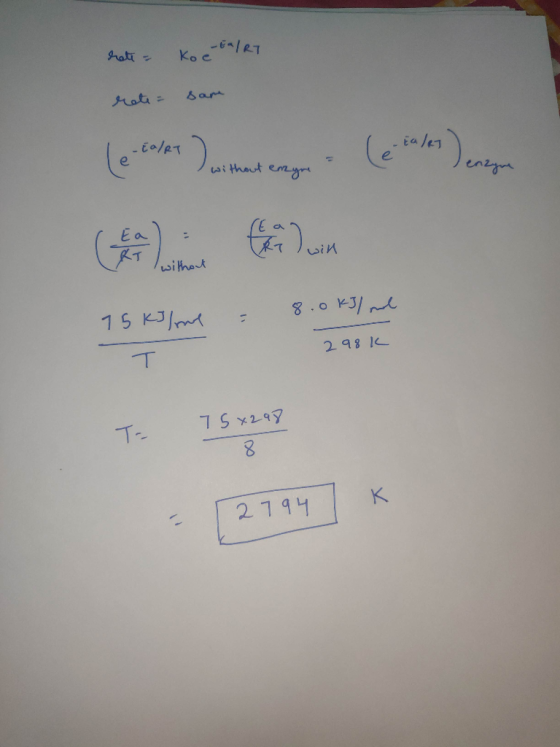
Add Answer to:
Hydrogen peroxide decomposes spontaneously to yield water and oxygen gas according to the following reaction equation...
Hydrogen peroxide decomposes spontaneously to yield water and oxygen gas according to the reaction equation 2H2O2(aq)⟶2H2O(l)+O2(g)2H2O2(aq)⟶2H2O(l)+O2(g)...
Hydrogen peroxide decomposes spontaneously to yield water and oxygen gas according to the reaction equation 2H2O2(aq)⟶2H2O(l)+O2(g)2H2O2(aq)⟶2H2O(l)+O2(g) The activation energy for this reaction is 75 kJ⋅mol−1.75 kJ⋅mol−1. In the presence of a metal catalyst, the activation energy is lowered to 49 kJ⋅mol−1.49 kJ⋅mol−1. At what temperature would the non‑catalyzed reaction need to be run to have a rate equal to that of the metal‑catalyzed reaction at 25 ∘C? T= K
please show all steps opic 16 Homework C2 omework Due on May 18, 2019 Question 10: A Challenge C2 T16HW Question 10 Homework.Unanswered Fill in the Blanks Hydrogen peroxide (Ha0p) is a pale blue...
 please show all steps
opic 16 Homework C2 omework Due on May 18, 2019 Question 10: A Challenge C2 T16HW Question 10 Homework.Unanswered Fill in the Blanks Hydrogen peroxide (Ha0p) is a pale blue, clear liquid that is used as an oxidizing agent,a bleaching agent and an antiseptic When forms water and oxygen gas according to the following chemical equation H0(aq) H20)+02(9) f the activation energy for this reaction is 75 kJ/mol at 25 deg C, and the enzyme catalase...
please show all steps
opic 16 Homework C2 omework Due on May 18, 2019 Question 10: A Challenge C2 T16HW Question 10 Homework.Unanswered Fill in the Blanks Hydrogen peroxide (Ha0p) is a pale blue, clear liquid that is used as an oxidizing agent,a bleaching agent and an antiseptic When forms water and oxygen gas according to the following chemical equation H0(aq) H20)+02(9) f the activation energy for this reaction is 75 kJ/mol at 25 deg C, and the enzyme catalase...
A popular chemical demonstration is the “magic genie” procedure, in which hydrogen peroxide decomposes to water...
A popular chemical demonstration is the “magic genie” procedure, in which hydrogen peroxide decomposes to water and oxygen gas with the aid of a catalyst. The activation energy of this (uncatalyzed) reaction is 70.0 kJ/mol. When the catalyst is added, the activation energy (at 20.ºC) is 42.0 kJ/mol. Theoretically, to what temperature (ºC) would one have to heat the hydrogen peroxide solution so that the rate of the uncatalyzed reaction is equal to the rate of the catalyzed reaction at...
4. [Chang, 10.27) The activation energy for the decomposition of hydrogen peroxide: 2H2O2 (aq) → 2H200...
 4. [Chang, 10.27) The activation energy for the decomposition of hydrogen peroxide: 2H2O2 (aq) → 2H200 + O2(g) is 42 kl.mol-1, whereas when the reaction is catalyzed by the enzyme catalase, it is 7.0 kJ. mol-1. Calculate the temperature that would cause the nonenzymatic catalysis to proceed as rapidly as the enzyme-catalyzed decomposition at 20°C. Assume the pre-exponential factor to be the same in both cases.
Part A Hydrogen peroxide decomposes to water and oxygen at constant pressure by the following reaction....
 Part A Hydrogen peroxide decomposes to water and oxygen at constant pressure by the following reaction. 2 H2O2() + 2 H2O(1) + O2() AH =-196 kJ Calculate the value of (kJ) in this exothermic reaction when 3.00 g of hydrogen peroxide decomposes at constant pressure? -1.73 x 10⁴ kJ -0.0289 kJ -8.65 kJ -17.3 kJ 1.92 kJ Submit Reguest Answer
5) Hydrogen peroxide decomposes to water and oxygen at constant pressure by the following reaction: 2...
5) Hydrogen peroxide decomposes to water and oxygen at constant pressure by the following reaction: 2 H2O2(l) ? 2 H2O(l) + O2(g)c,.H = -196 kJ Calculate the value of q (kJ) in this exothermic reaction when 5.40 g of hydrogen peroxide decomposes at constant pressure? A) -3.11 x 10⁴ kJ B) 1.07 kJ C) -15.6 kJ D) -31.1 kJ E) -0.0161 kJ
An aqueous solution of hydrogen peroxide (H2O2) decomposes to oxygen gas and liquid water. If the...
An aqueous solution of hydrogen peroxide (H2O2) decomposes to oxygen gas and liquid water. If the rate of disappearance is -4.06 M/s, what is the rate of formation of Oxygen gas for this reaction?
Hydrogen peroxide (H2O2) decomposes to produce water and oxygen according to the following reaction: 2 H2O2...
Hydrogen peroxide (H2O2) decomposes to produce water and oxygen according to the following reaction: 2 H2O2 (l) -----------> 2 H2O (l) + O2 (g) Which relationship regarding the quantities of reactants and products associated with this reaction is NOT correct? Group of answer choices 2 molecules of H2O2 -----------------> 2 molecules of H2O + 1 molecule of O2 2 mol of H2O2 ----------------->2 mol of H2O + 1 mol of O2 68.0 g of H2O2 -----------------> 36.0 g of H2O...
Hydrogen peroxide (H202) decomposes according to the equation H2020) — H20(1) +202/9). Calculate Kp for this...
 Hydrogen peroxide (H202) decomposes according to the equation H2020) — H20(1) +202/9). Calculate Kp for this reaction at 25°C. (AH* = -98.2 kJ/mol, ASⓇ = 701 J/K mol) Multiple Choice 20.9 86% 104 3.46 1017 O 13-10-21 75 x 1020
26. Hydrogen peroxide decomposes into water and oxygen in a first-order process. H2O2(aq) → H2O(l) +...
 26. Hydrogen peroxide decomposes into water and oxygen in a first-order process. H2O2(aq) → H2O(l) + 1/2 O2(g) 26. Hydrogen peroxide decomposes into water and oxygen in a first-order process. H2O2(aq) → H2O(2) + 1/2O2(g) At 20.0 °C, the half-life for the reaction is 3.05 x 10⁴ seconds. If the initial concentration of hydrogen peroxide is 0.52 M, what is the concentration after 8.00 days?
 please show all steps
opic 16 Homework C2 omework Due on May 18, 2019 Question 10: A Challenge C2 T16HW Question 10 Homework.Unanswered Fill in the Blanks Hydrogen peroxide (Ha0p) is a pale blue, clear liquid that is used as an oxidizing agent,a bleaching agent and an antiseptic When forms water and oxygen gas according to the following chemical equation H0(aq) H20)+02(9) f the activation energy for this reaction is 75 kJ/mol at 25 deg C, and the enzyme catalase...
please show all steps
opic 16 Homework C2 omework Due on May 18, 2019 Question 10: A Challenge C2 T16HW Question 10 Homework.Unanswered Fill in the Blanks Hydrogen peroxide (Ha0p) is a pale blue, clear liquid that is used as an oxidizing agent,a bleaching agent and an antiseptic When forms water and oxygen gas according to the following chemical equation H0(aq) H20)+02(9) f the activation energy for this reaction is 75 kJ/mol at 25 deg C, and the enzyme catalase...
 4. [Chang, 10.27) The activation energy for the decomposition of hydrogen peroxide: 2H2O2 (aq) → 2H200 + O2(g) is 42 kl.mol-1, whereas when the reaction is catalyzed by the enzyme catalase, it is 7.0 kJ. mol-1. Calculate the temperature that would cause the nonenzymatic catalysis to proceed as rapidly as the enzyme-catalyzed decomposition at 20°C. Assume the pre-exponential factor to be the same in both cases.
 Part A Hydrogen peroxide decomposes to water and oxygen at constant pressure by the following reaction. 2 H2O2() + 2 H2O(1) + O2() AH =-196 kJ Calculate the value of (kJ) in this exothermic reaction when 3.00 g of hydrogen peroxide decomposes at constant pressure? -1.73 x 10⁴ kJ -0.0289 kJ -8.65 kJ -17.3 kJ 1.92 kJ Submit Reguest Answer
 Hydrogen peroxide (H202) decomposes according to the equation H2020) — H20(1) +202/9). Calculate Kp for this reaction at 25°C. (AH* = -98.2 kJ/mol, ASⓇ = 701 J/K mol) Multiple Choice 20.9 86% 104 3.46 1017 O 13-10-21 75 x 1020
 26. Hydrogen peroxide decomposes into water and oxygen in a first-order process. H2O2(aq) → H2O(l) + 1/2 O2(g) 26. Hydrogen peroxide decomposes into water and oxygen in a first-order process. H2O2(aq) → H2O(2) + 1/2O2(g) At 20.0 °C, the half-life for the reaction is 3.05 x 10⁴ seconds. If the initial concentration of hydrogen peroxide is 0.52 M, what is the concentration after 8.00 days?
Most questions answered within 3 hours.
-
Where is the error in this code sequence?
String s1 = "Hello";
String s2 = "ello";...
asked 11 months ago -
Financial data for Joel de Paris, Inc., for last year
follow:
Joel de Paris, Inc.
Balance...
asked 11 months ago -
Consider this reaction:
Al2(SO4)3 (aq)+ BaCl3
(aq) Al2Cl6 (aq)- +
3BaSO4(s) . What is the...
asked 11 months ago -
Suppose that Savneet is considering increasing her
recent random sample from 20 car rentals to 40...
asked 11 months ago -
Trucks arrive at an unloading terminal at an average rate of 120
per hour.
Trucks arrive...
asked 11 months ago -
Why are methanol and ethanol completely soluble in water while
octanol is not very little soluble....
asked 11 months ago -
A facilities manager at a university reads in a research report
that the mean amount of...
asked 11 months ago -
When the CuSO4 is rehydrated by adding water to the anhydrous
compound, is this an endothermic...
asked 11 months ago -
A ray of sunlight is passing from diamond into crown glass; the
angle of incidence is...
asked 11 months ago -
A block of mass 0.249 kg is placed on top of a light, vertical
spring of...
asked 11 months ago -
how do the kidneys compensate in the presences of acidosis
a) trigger hyperventilate
b) reserve acid...
asked 11 months ago -
Question 501 pts
The rental rate of capital to the firm increases. Which of the
following...
asked 11 months ago