Choose one major mineral and describe its function, where it can be found , and the...
Choose one major mineral and describe its function, where it can be found , and the results of a deficiency or toxicity.
Homework Answers
ANSWER.
* Calcium.
Calcium is an important mineral required for the normal functioning
of the body.
* Functions of calcium.
* Normal growth and development of bones and teeth.
* Calcium helps during the process of coagulation of blood.
*Calcium is required for the permiability of capillary walls.
* It is required for contraction and relaxation of heart and muscles
in the body.
* It reduce LDL cholesterol level in the body.
* Calcium required for activation of enzymes like lipase,adenosine
triphosphate etc.
* Sources of calcium.
* Milk and milk products.
* Meat and egg products.
* Fish.
* Legumes.
* Cereals.
* Deficiency of calcium.
* Calcium deficiency result in Osteoporosis.(Bones become
brittle).
* Toxicity.
* Excessive level of calcium in the blood leads to hypercalcemia.
which result in weakness of bone and muscle pain.
Add Answer to:
Choose one major mineral and describe its function, where it can
be found , and the...
the goal is for you to use the lecture slides and notes to fill-in the 20...
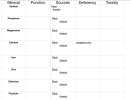 the goal is for you to use the lecture slides and notes to fill-in
the 20 points Minerals table:
Each Mineral (8) will be worth up to 2 pts to complete, except
Calcium and Iron which will be worth a little more. Coppers will
not be included, even though the slides is attached to the end of
the lecture.
- Function:
What is the one or two major functions of the mineral?
(0.5 pt)
- Sources: What are three plant...
the goal is for you to use the lecture slides and notes to fill-in
the 20 points Minerals table:
Each Mineral (8) will be worth up to 2 pts to complete, except
Calcium and Iron which will be worth a little more. Coppers will
not be included, even though the slides is attached to the end of
the lecture.
- Function:
What is the one or two major functions of the mineral?
(0.5 pt)
- Sources: What are three plant...
result in zero points. 41. Describe the six classes of nutrients. In the descrintion of each...
 result in zero points. 41. Describe the six classes of nutrients. In the descrintion of each class of nutrients include the following: Their major function in the body Their deficiency or toxicity A food source Six Classes of Nutrients Food Source Toxicity Deficiency Function Description
NAME:- LAB QUIZ- IRON NUTRITION SCI106 1. Is iron a major mineral or a trace mineral?...
 NAME:- LAB QUIZ- IRON NUTRITION SCI106 1. Is iron a major mineral or a trace mineral? 2. Name the 5 nutrients that are added to all refined grain products during the enriching process: 3. Name 3 good food sources of iron. (PLEASE BE SPECIFIC.) deuo om osude What disease is associated with iron deficiency? Name 2 common symptoms of this disease. 6. Iron in excessive amounts in the diet may be toxic. Iron toxicity may increase the risk of disease....
Choose one and tell us about it and describe where EBP fits in. What is its...
Choose one and tell us about it and describe where EBP fits in. What is its purpose? What are the organization's mission, vision, goals, and how is EBP included in these? Where does EBP show up? For example, how is EBP included in the organization's mission and vision? How does EBP fit into the organization's goals? 150 words. The Joint Commission (formerly JCAHO)
1) Define "gem". Choose a gem quality mineral. What is your favorite gem? Why? What is...
1) Define "gem". Choose a gem quality mineral. What is your favorite gem? Why? What is the origin of this mineral and why is it valuable? What is the difference between a gem quality mineral and a precious or semi-precious stone? Make sure you give examples of each. 2) Describe how diamonds form. In what geologic environment do they form? What are "blood diamonds"? Are diamonds really that valuable? Are there gems that are more valuable than diamonds? Are there...
Describe the advantages of bone versus cartilage in terms of the major bone mineral, hydroxyapatite over...
Describe the advantages of bone versus cartilage in terms of the major bone mineral, hydroxyapatite over calcite regarding high metabolism producing acid waste?
describe the primary difference between consequentialist and non-consequentialist approaches to ethics. Choose one of the major...
describe the primary difference between consequentialist and non-consequentialist approaches to ethics. Choose one of the major theories associated with consequentialism: what objections might be made to this theory? Choose one of the major theories associated with non-consequentialism: what objections might be made to this theory?
Homeostasis is a major, choose on of the organ system and describe how homeostasis is demonstrated...
Homeostasis is a major, choose on of the organ system and describe how homeostasis is demonstrated in that system. Describe any cells, receptors, organ structure, or hormones you can think of that may be involved?
S. What is articular cartilage? What is it made ol? What is its function 6. Why...
 S. What is articular cartilage? What is it made ol? What is its function 6. Why is cartilare hard to heal? 7 What is periarum? What is it composed off (Name the two layers and their components). What is for the fertions of criosteum Describe the blood supply of the periosteum 8. What are Sharpey s t rictures are found in around the diaphysis? What is are their function(sy? 9. Describe the diaphysis. What strictures 10. What is the most...
9. Describe the diaphysis. What structu e what structures are found in around the diaphysis? What...
 9. Describe the diaphysis. What structu e what structures are found in around the diaphysis? What isare their function sy 10. What is the most abundant mineral salt in ECM of bone 11. What are the two main mineral salts that combine to create bone matrix 12. What forms hydroxyapatite crysta atite crystals? What other substances (minerals) do the mineral salts combine with to lead to calcification? and 13. It is the combination of which gives bone its characteristics. Hardness...
 the goal is for you to use the lecture slides and notes to fill-in
the 20 points Minerals table:
Each Mineral (8) will be worth up to 2 pts to complete, except
Calcium and Iron which will be worth a little more. Coppers will
not be included, even though the slides is attached to the end of
the lecture.
- Function:
What is the one or two major functions of the mineral?
(0.5 pt)
- Sources: What are three plant...
the goal is for you to use the lecture slides and notes to fill-in
the 20 points Minerals table:
Each Mineral (8) will be worth up to 2 pts to complete, except
Calcium and Iron which will be worth a little more. Coppers will
not be included, even though the slides is attached to the end of
the lecture.
- Function:
What is the one or two major functions of the mineral?
(0.5 pt)
- Sources: What are three plant...
 result in zero points. 41. Describe the six classes of nutrients. In the descrintion of each class of nutrients include the following: Their major function in the body Their deficiency or toxicity A food source Six Classes of Nutrients Food Source Toxicity Deficiency Function Description
 NAME:- LAB QUIZ- IRON NUTRITION SCI106 1. Is iron a major mineral or a trace mineral? 2. Name the 5 nutrients that are added to all refined grain products during the enriching process: 3. Name 3 good food sources of iron. (PLEASE BE SPECIFIC.) deuo om osude What disease is associated with iron deficiency? Name 2 common symptoms of this disease. 6. Iron in excessive amounts in the diet may be toxic. Iron toxicity may increase the risk of disease....
 S. What is articular cartilage? What is it made ol? What is its function 6. Why is cartilare hard to heal? 7 What is periarum? What is it composed off (Name the two layers and their components). What is for the fertions of criosteum Describe the blood supply of the periosteum 8. What are Sharpey s t rictures are found in around the diaphysis? What is are their function(sy? 9. Describe the diaphysis. What strictures 10. What is the most...
 9. Describe the diaphysis. What structu e what structures are found in around the diaphysis? What isare their function sy 10. What is the most abundant mineral salt in ECM of bone 11. What are the two main mineral salts that combine to create bone matrix 12. What forms hydroxyapatite crysta atite crystals? What other substances (minerals) do the mineral salts combine with to lead to calcification? and 13. It is the combination of which gives bone its characteristics. Hardness...
Most questions answered within 3 hours.
-
Where is the error in this code sequence?
String s1 = "Hello";
String s2 = "ello";...
asked 11 months ago -
Financial data for Joel de Paris, Inc., for last year
follow:
Joel de Paris, Inc.
Balance...
asked 11 months ago -
Consider this reaction:
Al2(SO4)3 (aq)+ BaCl3
(aq) Al2Cl6 (aq)- +
3BaSO4(s) . What is the...
asked 11 months ago -
Suppose that Savneet is considering increasing her
recent random sample from 20 car rentals to 40...
asked 11 months ago -
Trucks arrive at an unloading terminal at an average rate of 120
per hour.
Trucks arrive...
asked 11 months ago -
Why are methanol and ethanol completely soluble in water while
octanol is not very little soluble....
asked 11 months ago -
A facilities manager at a university reads in a research report
that the mean amount of...
asked 11 months ago -
When the CuSO4 is rehydrated by adding water to the anhydrous
compound, is this an endothermic...
asked 11 months ago -
A ray of sunlight is passing from diamond into crown glass; the
angle of incidence is...
asked 11 months ago -
A block of mass 0.249 kg is placed on top of a light, vertical
spring of...
asked 11 months ago -
how do the kidneys compensate in the presences of acidosis
a) trigger hyperventilate
b) reserve acid...
asked 11 months ago -
Question 501 pts
The rental rate of capital to the firm increases. Which of the
following...
asked 11 months ago