
Homework Answers
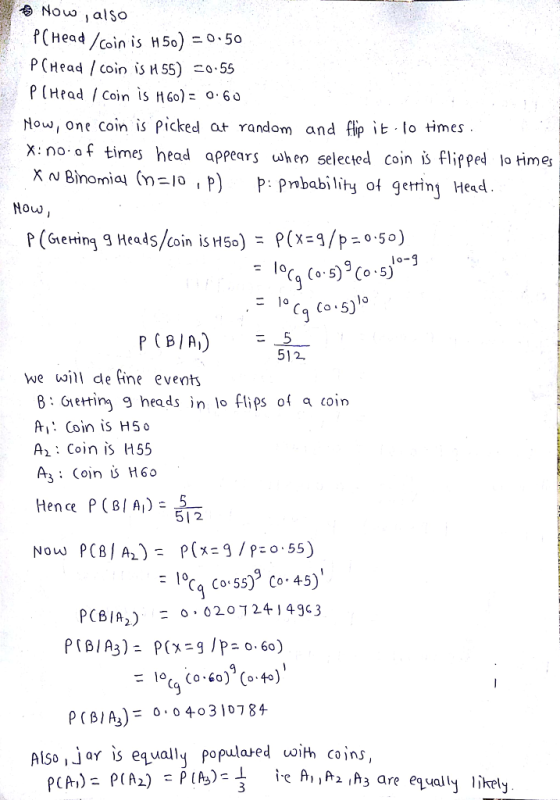
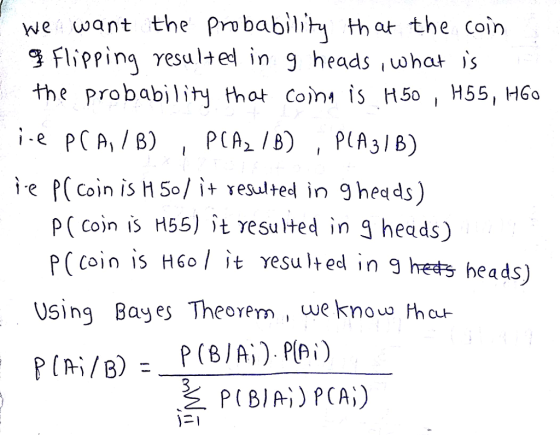
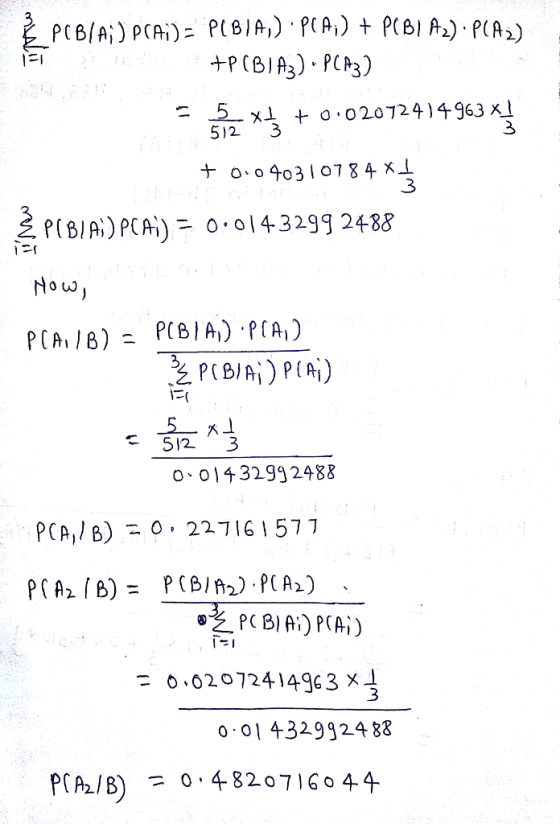
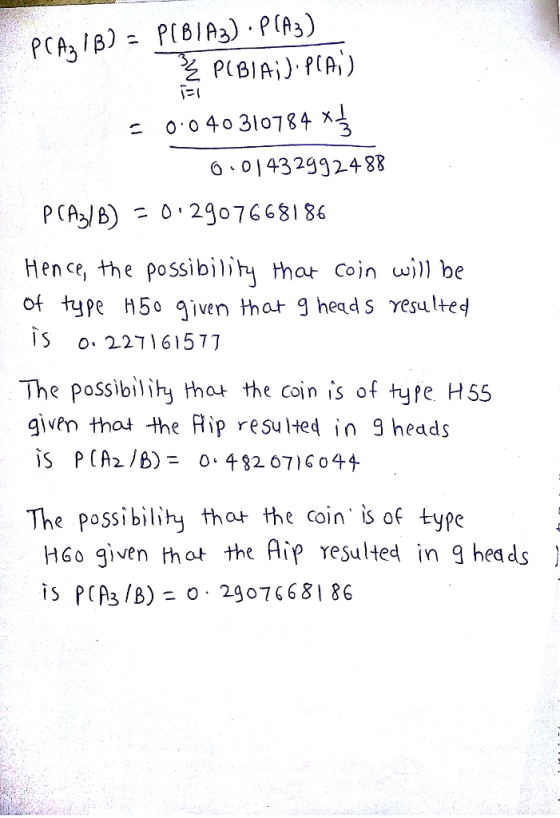
Here the concept of bayes theorem will be used.
A jar is equally populated with coins of type H50, H55, and H60.
This means P(getting coin H50)=
P(getting coin H55)=
P(getting coin H60)=
Also one needs to know the pdf of binomail distribution.
If X~Binomial(n, p)
where n=total number of trials
p=probability of success
then
P(X=r) =
r=0,1,2,....n
= 0 otherwise
Add Answer to:
H60 (with probabilities of coming up heads 0.5, 0.55, and 0.6 respectively). You take one coin...
There are three coins. They have chances 0.4, 0.6 and 0.8 respectively of showing heads. One...
There are three coins. They have chances 0.4, 0.6 and 0.8 respectively of showing heads. One of these three coins is chosen at random and flipped. (a) What is the chance that the coin chosen is the coin with probability equal to .4 of showing heads and a head shows up after the flip? (b) What is the chance that the coin, when flipped, shows a head? (c) Given that the coin, when flipped, shows a head, what is the...
1. You have three different coins where the probabilities of getting heads are 0.5, 0.7, and...
 1. You have three different coins where the probabilities of getting heads are 0.5, 0.7, and 0.2 respectively You plan to flip each coin and count the total number of heads. You're curious what the probability of getting exactly two heads is. [1 point a. Explain why you cannot use the Binomial model for this situation. [3 points] b. Show that the probability of getting exactly two heads is 0.38. Define any events you want to use in words. c....
A special novelty coin has a probability of 0.89 of coming up heads. In 12 tosses...
A special novelty coin has a probability of 0.89 of coming up heads. In 12 tosses of this coin: a) What is the probability the coin comes up heads exactly 10 times? Round your response to at least 3 decimal places. b) What is the probability the coin comes up heads more than 10 times? Round your response to at least 3 decimal places.
Suppose you have two coins. One coin is fair and other is a coin with heads...
Suppose you have two coins. One coin is fair and other is a coin with heads on both sides. Now you choose a coin at random and flip the coin. If the coin lands head, what is the probability that it was the fair coin?
C Spinning a coin, unlike tossing it, may not give heads and tails equal probabilities. I...
 C Spinning a coin, unlike tossing it, may not give heads and tails equal probabilities. I spun a penny 150 times and got 67 heads. We wish to find how significant is this evidence against equal probabilities, a. What is the sample proportion of heads? Round to 3 decimal places. b. Heads do not make up half of the sample. Is this sample evidence that the probabilities of heads and tails are different? Take p to be the probability of...
Suppose C1;C2;C3 are three didifferent biased coins, whose probability of heads equals 0.4, 0.5, and 0.2...
Suppose C1;C2;C3 are three didifferent biased coins, whose probability of heads equals 0.4, 0.5, and 0.2 respectively. Suppose coins are placed together in a box and you randomly picked a coin from the box. Flip the coin 10 times. Let A denote the event you randomly chose coin C1. Let B denote the event that you got exactly 4 heads out of the 10 coin flips. Compute the following probabilities: P(A∩B) P(B) P(A|B)
Mysterioso the Magician is walking down the street with a box containing 25 identical looking coins: 24 are fair coins (which flip heads with probability 0.5 and tails with probability 0.5) and one i...
 Mysterioso the Magician is walking down the street with a box containing 25 identical looking coins: 24 are fair coins (which flip heads with probability 0.5 and tails with probability 0.5) and one is a trick coin which alwavs flips heads. Renata the Fox skillfully robs Mysterioso of one of the coins in his box (chosen uniformly at random). She decides she will flip the coin k times to test if it is the trick coin. (a) What is the...
2. Mysterioso the Magician is walking down the street with a box containing 25 identical looking coins: 24 are fair coins (which flip heads with probabilty 0.5 and tails with probability 0.5) and one...
 2. Mysterioso the Magician is walking down the street with a box containing 25 identical looking coins: 24 are fair coins (which flip heads with probabilty 0.5 and tails with probability 0.5) and one is a trick coin which always flips heads. Renata the Fox skillfully robs Mysterioso of one of the coins in his box (chosen uniformly at random). She decides she will flip the coin k times to test if it is the trick coin (a) What is...
Do the following in MATLAB: trials = 100; flip = rand(trials,1); heads = (flip >= 0.5);...
Do the following in MATLAB: trials = 100; flip = rand(trials,1); heads = (flip >= 0.5); percentheads = sum(heads)/trials a.We can use a random number generator to estimate probabilities that might otherwise be difficult to evaluate. Consider the probability of obtaining four heads on four flips. Generate four separate random experiments of 0s and 1s representing N trials each. (You can do this by generating an Nx4 random array rather than an Nx1 array as in #1.) Now look at...
Suppose you have an unfair coin that is weighted so that heads comes up only 30...
Suppose you have an unfair coin that is weighted so that heads comes up only 30 percent of the time. If you flip the coin 4 times, what is the probability that you obtain at least 3 heads in the 4 flips?
 1. You have three different coins where the probabilities of getting heads are 0.5, 0.7, and 0.2 respectively You plan to flip each coin and count the total number of heads. You're curious what the probability of getting exactly two heads is. [1 point a. Explain why you cannot use the Binomial model for this situation. [3 points] b. Show that the probability of getting exactly two heads is 0.38. Define any events you want to use in words. c....
 C Spinning a coin, unlike tossing it, may not give heads and tails equal probabilities. I spun a penny 150 times and got 67 heads. We wish to find how significant is this evidence against equal probabilities, a. What is the sample proportion of heads? Round to 3 decimal places. b. Heads do not make up half of the sample. Is this sample evidence that the probabilities of heads and tails are different? Take p to be the probability of...
 Mysterioso the Magician is walking down the street with a box containing 25 identical looking coins: 24 are fair coins (which flip heads with probability 0.5 and tails with probability 0.5) and one is a trick coin which alwavs flips heads. Renata the Fox skillfully robs Mysterioso of one of the coins in his box (chosen uniformly at random). She decides she will flip the coin k times to test if it is the trick coin. (a) What is the...
 2. Mysterioso the Magician is walking down the street with a box containing 25 identical looking coins: 24 are fair coins (which flip heads with probabilty 0.5 and tails with probability 0.5) and one is a trick coin which always flips heads. Renata the Fox skillfully robs Mysterioso of one of the coins in his box (chosen uniformly at random). She decides she will flip the coin k times to test if it is the trick coin (a) What is...
Most questions answered within 3 hours.
-
Where is the error in this code sequence?
String s1 = "Hello";
String s2 = "ello";...
asked 11 months ago -
Financial data for Joel de Paris, Inc., for last year
follow:
Joel de Paris, Inc.
Balance...
asked 11 months ago -
Consider this reaction:
Al2(SO4)3 (aq)+ BaCl3
(aq) Al2Cl6 (aq)- +
3BaSO4(s) . What is the...
asked 11 months ago -
Suppose that Savneet is considering increasing her
recent random sample from 20 car rentals to 40...
asked 11 months ago -
Trucks arrive at an unloading terminal at an average rate of 120
per hour.
Trucks arrive...
asked 11 months ago -
Why are methanol and ethanol completely soluble in water while
octanol is not very little soluble....
asked 11 months ago -
A facilities manager at a university reads in a research report
that the mean amount of...
asked 11 months ago -
When the CuSO4 is rehydrated by adding water to the anhydrous
compound, is this an endothermic...
asked 11 months ago -
A ray of sunlight is passing from diamond into crown glass; the
angle of incidence is...
asked 11 months ago -
A block of mass 0.249 kg is placed on top of a light, vertical
spring of...
asked 11 months ago -
how do the kidneys compensate in the presences of acidosis
a) trigger hyperventilate
b) reserve acid...
asked 11 months ago -
Question 501 pts
The rental rate of capital to the firm increases. Which of the
following...
asked 11 months ago