Which is the light we can see UV light infrared visible spectrum both a and b
Which is the light we can see
|
UV light |
||
|
infrared |
||
|
visible spectrum |
||
|
both a and b |
Homework Answers
Visible spectrum
Remaining two we cannot see with our normal eye
Uv and infrared rays are radio waves
Add Answer to:
Which is the light we can see
UV light
infrared
visible spectrum
both a and b
In the balmer series: UV light is absorbed, infrared light is always absorbed, visible light is...
In the balmer series: UV light is absorbed, infrared light is always absorbed, visible light is released or no light is released.
In addition to the visible peaks seen in the H emission spectrum, there are other transitions...
In addition to the visible peaks seen in the H emission spectrum, there are other transitions occurring that give peaks detected in the ultraviolet (UV) region and in the infrared (IR) region of the electromagnetic spectrum. Compared to the transitions that emit visible light, would transitions in the UV region: (a) have a longer or shorter wavelength than the visible transitions and (b) correspond to greater energy or less energy than visible transitions? Explain your answer.
Infrared radiation has frequencies from 3.0×10¹¹ to 3.0×10¹⁴ Hz, whereas the frequency region for visible light...
Infrared radiation has frequencies from 3.0×10¹¹ to 3.0×10¹⁴ Hz, whereas the frequency region for visible light is 4.3×10¹⁴ to 7.5×10¹⁴ Hz. We can say that: 1. The speed of infrared radiation is ____ (higher than, lower than, the same as) visible light. 2. The wavelength of infrared radiation is ____ (higher than, lower than, the same as) visible light.
The electromagnetic spectrum arranged by increasing wavelength is O radio waves, gamma rays, x-rays, visible light,...
 The electromagnetic spectrum arranged by increasing wavelength is O radio waves, gamma rays, x-rays, visible light, infrared, microwave, ultra violet. O x-rays, gamma rays, ultraviolet, visible light, infrared, microwave, radio waves. O infrared, gamma rays, x-rays, ultraviolet, visible light, microwave, radio waves. O gamma rays, x-rays, ultraviolet, visible light, infrared, microwave, radio waves.
Which of the following regions of the electromagnetic spectrum have longer wavelengths than visible light? 1....
Which of the following regions of the electromagnetic spectrum have longer wavelengths than visible light? 1. infrared radiation 2. ultraviolet radiation 3. microwave radiation 1 and 2 2 only 3 only 1 only 1 and 3
Question 3 5 pts In the electromagnetic spectrum, humans see infrared light. O True O False
 Question 3 5 pts In the electromagnetic spectrum, humans see infrared light. O True O False
1/ Ultraviolet (UV) light is _____. a. the longest wavelength of light visible to the human...
1/ Ultraviolet (UV) light is _____. a. the longest wavelength of light visible to the human eye b. the shortest wavelength of light visible to the human eye c. invisible to humans d. visible as the color viole 2/ The seasons occur because of _____. a. the angle at which sunlight strikes the surface and by how long the sun shines on any latitude b. Earth's elliptical orbit that brings northern latitudes closer to the sun in summer than in winter...
Which of the following is the portion of the electromagnetic spectrum that is adjacent to visible...
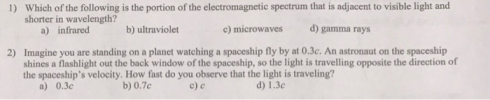 Which of the following is the portion of the electromagnetic spectrum that is adjacent to visible light and shorter in wavelength? 1) a) infrared b) ultraviolet c) microwaves d) gamma rays Imagine you are standing on a planet watching a spaceship fly by at 0.3c. An astronaut on the spaceship shines a flashlight out the back window of the spaceship, so the light is travelling opposite the direction of the spaceship's velocity. How fast do you observe that the light...
Which part of the electromagnetic spectrum is used for colorimetric assays? A. ultraviolet B. infrared C....
 Which part of the electromagnetic spectrum is used for colorimetric assays? A. ultraviolet B. infrared C. visible D. ultrasonic
We can see wavelengths of light ranging from 350 to 750nm. Determine all of the visible...
We can see wavelengths of light ranging from 350 to 750nm. Determine all of the visible wavelengths that are maximally reflected from a soap bubble with a wall thickness of 1000nm. (n=1.3)
 The electromagnetic spectrum arranged by increasing wavelength is O radio waves, gamma rays, x-rays, visible light, infrared, microwave, ultra violet. O x-rays, gamma rays, ultraviolet, visible light, infrared, microwave, radio waves. O infrared, gamma rays, x-rays, ultraviolet, visible light, microwave, radio waves. O gamma rays, x-rays, ultraviolet, visible light, infrared, microwave, radio waves.
 Question 3 5 pts In the electromagnetic spectrum, humans see infrared light. O True O False
 Which of the following is the portion of the electromagnetic spectrum that is adjacent to visible light and shorter in wavelength? 1) a) infrared b) ultraviolet c) microwaves d) gamma rays Imagine you are standing on a planet watching a spaceship fly by at 0.3c. An astronaut on the spaceship shines a flashlight out the back window of the spaceship, so the light is travelling opposite the direction of the spaceship's velocity. How fast do you observe that the light...
 Which part of the electromagnetic spectrum is used for colorimetric assays? A. ultraviolet B. infrared C. visible D. ultrasonic
Most questions answered within 3 hours.
-
Where is the error in this code sequence?
String s1 = "Hello";
String s2 = "ello";...
asked 10 months ago -
Financial data for Joel de Paris, Inc., for last year
follow:
Joel de Paris, Inc.
Balance...
asked 10 months ago -
Consider this reaction:
Al2(SO4)3 (aq)+ BaCl3
(aq) Al2Cl6 (aq)- +
3BaSO4(s) . What is the...
asked 10 months ago -
Suppose that Savneet is considering increasing her
recent random sample from 20 car rentals to 40...
asked 10 months ago -
Trucks arrive at an unloading terminal at an average rate of 120
per hour.
Trucks arrive...
asked 10 months ago -
Why are methanol and ethanol completely soluble in water while
octanol is not very little soluble....
asked 10 months ago -
A facilities manager at a university reads in a research report
that the mean amount of...
asked 10 months ago -
When the CuSO4 is rehydrated by adding water to the anhydrous
compound, is this an endothermic...
asked 10 months ago -
A ray of sunlight is passing from diamond into crown glass; the
angle of incidence is...
asked 10 months ago -
A block of mass 0.249 kg is placed on top of a light, vertical
spring of...
asked 10 months ago -
how do the kidneys compensate in the presences of acidosis
a) trigger hyperventilate
b) reserve acid...
asked 10 months ago -
Question 501 pts
The rental rate of capital to the firm increases. Which of the
following...
asked 10 months ago