71. Pregnenolone is the intermediate before the biosynthesis (next step forms what) of: A. Estrogens B....
71. Pregnenolone is the intermediate before the biosynthesis
(next step forms what) of:
A. Estrogens
B. Progestins
C. Glucocorticoids
D. Mineralocorticoids
E. None of these
Homework Answers
Pregnenolone is the intermediate before the biosynthesis;
A. Estrogens
B. Progestins
C. Glucocorticoids
D. Mineralocorticoids
(AS it is the intermediate in the biosynthesis of most steroid hormones)
Add Answer to:
71. Pregnenolone is the intermediate before the biosynthesis
(next step forms what) of:
A. Estrogens
B....
1. Which of the following statements describes lipids? A) Lipids all have the steroid backbone. B)...
1. Which of the following statements describes lipids? A) Lipids all have the steroid backbone. B) The body stores excess calories as lipids. C) Lipids are insoluble in water, but soluble in nonpolar solvents. D) Lipids are soluble in water, but insoluble in nonpolar solvents. E) Lipids are insoluble in all solvents 2. Which of the following type of molecule is not a lipid? A) amino acid B) triglyceride C) phospholipid D) steroid E) eicosanoid 3. Which type of lipid...
STEP 3: What intermediate forms below and what reagent(s) will take that intermediate to the alcohol...
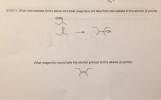 STEP 3: What intermediate forms below and what reagent(s) will take that intermediate to the alcohol (2 points): BrMg OH What reagent(s) would take the alcohol product to this alkene (2 points):
What compound serves as the starting material for the biosynthesis of fatty acids and is also...
What compound serves as the starting material for the biosynthesis of fatty acids and is also a key intermediate in fatty acid metabolism? a. carnitine b. glucose c. bile salt d. acetyl CoA e. lactate
GTP is important for protein biosynthesis by ribosome, because ____________. Which will fill blank correctly. Select...
GTP is important for protein biosynthesis by ribosome, because ____________. Which will fill blank correctly. Select one: a. initiation of the translation requires GTP. b. binding of the loaded tRNAs to ribosomes requires GTP. c. translocation of ribosome to the next codon requires GTP. d. All of these e. None of these
4. During the last step of the β-oxidation pathway for fatty acids, the intermediate below is con...
 Solve all
4. During the last step of the β-oxidation pathway for fatty acids, the intermediate below is converted to CH3 (CH2) 12ČCH2C-SCoA a. CH3 (CH2) 12C00H + CoA b. 2 CH3C-SCOA CH3 (CH2) 126CH2CHsCH3C-SCoA d. 5. The intermediate below is produced during the fatty acid synthesis pathway. The next reaction of the pathway at the double bond, involves which type of reaction? CH3 (CH2 ) 12CH=CHCH2-ACP -CH2CH2OH- d. none of the above 6. The product of the first step...
Solve all
4. During the last step of the β-oxidation pathway for fatty acids, the intermediate below is converted to CH3 (CH2) 12ČCH2C-SCoA a. CH3 (CH2) 12C00H + CoA b. 2 CH3C-SCOA CH3 (CH2) 126CH2CHsCH3C-SCoA d. 5. The intermediate below is produced during the fatty acid synthesis pathway. The next reaction of the pathway at the double bond, involves which type of reaction? CH3 (CH2 ) 12CH=CHCH2-ACP -CH2CH2OH- d. none of the above 6. The product of the first step...
Cholesterol biosynthesis involves a stepwise increase of carbon numbers from acetyl-CoA (C2) to ______ (C5), and,...
Cholesterol biosynthesis involves a stepwise increase of carbon numbers from acetyl-CoA (C2) to ______ (C5), and, finally, to squalene (C30). But, the rate-limiting step is catalyzed by _____. Inhibition of this enzyme is adopted as a strategy for the therapeutic control of cholesterol levels. Select one: a. isoprenoid ;;; HMG CoA synthase b. isoprenoid ;;; HMG CoA reductase c. flavonoid ;;; HMG CoA synthase d. flavonoid ;;; HMG CoA reductase e. None of these
Question 71. If 25.0 mL of 0.150 M aluminum bromide reacts with 15.0 mL of 0.200 M silver nitrate, what mass of silv...
 Question 71. If 25.0 mL of 0.150 M aluminum bromide reacts with 15.0 mL of 0.200 M silver nitrate, what mass of silver bromide is produced? AgBr ()+ AI(NO3)3 (aq) AIBr3 (aq)+AgNO3 (aq) a) 2.11 x 10⁴ g b) 2.11 g c) 5.63 x 10⁴ g d) 0.563 g e) none of the above Question 72 What is the molarity of aluminum ions in the above question before the reaction has taken place? a) 0.150 M A13 b) 0.350 M...
Sprint 11:27 AM 0 82% Schmelz-2018-example-pratic 30) What is this molecule? A) a TAG B) a...
 Sprint 11:27 AM 0 82% Schmelz-2018-example-pratic 30) What is this molecule? A) a TAG B) a phospholipid C) advanced glycation end product D) a mixed anhydride E) phosphocreatine H, 31) What is this molecule? A) one of the molecules known as a ketone body B) a molecule made in the Krebs cycle C) a molecule made in the urea cycle D) an intermediate in isoprenoid biosynthesis E) none of the above O-P-O-P-O
Identify the catalyst and intermediate in the following multi-step mechanism: step 1: Br+O3 -> BrO+ O2...
Identify the catalyst and intermediate in the following multi-step mechanism: step 1: Br+O3 -> BrO+ O2 step 2: BrO + O3 -> Br +2O2 a. There is no catalyst or intermediate in the above reaction b. Catalyst: O2 Intermediate: O3 c. Catalyst: BrO∙ Intermediate: Br∙ d. Catalyst: O3 Intermediate: O2 e. Catalyst: Br∙ Intermediate BrO
Q5 is D, Q6 is B. Please answer step-by-step. 5. What mass of 12 can be...
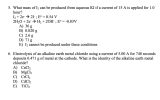 Q5 is D, Q6 is B. Please answer step-by-step.
5. What mass of 12 can be produced from aqueous KI if a current of 15 A is applied for 1.0 hour? 12 + 2e → 21" ; E° = 0.54 V 2H2O + 2e- → H2 + 20H"; E° = -0.83V A) 36 g B) 0.020 g C) 2.6 g D) 71 g E) 12 cannot be produced under these conditions Electrolysis of an alkaline earth metal chloride using a...
Q5 is D, Q6 is B. Please answer step-by-step.
5. What mass of 12 can be produced from aqueous KI if a current of 15 A is applied for 1.0 hour? 12 + 2e → 21" ; E° = 0.54 V 2H2O + 2e- → H2 + 20H"; E° = -0.83V A) 36 g B) 0.020 g C) 2.6 g D) 71 g E) 12 cannot be produced under these conditions Electrolysis of an alkaline earth metal chloride using a...
 STEP 3: What intermediate forms below and what reagent(s) will take that intermediate to the alcohol (2 points): BrMg OH What reagent(s) would take the alcohol product to this alkene (2 points):
 Solve all
4. During the last step of the β-oxidation pathway for fatty acids, the intermediate below is converted to CH3 (CH2) 12ČCH2C-SCoA a. CH3 (CH2) 12C00H + CoA b. 2 CH3C-SCOA CH3 (CH2) 126CH2CHsCH3C-SCoA d. 5. The intermediate below is produced during the fatty acid synthesis pathway. The next reaction of the pathway at the double bond, involves which type of reaction? CH3 (CH2 ) 12CH=CHCH2-ACP -CH2CH2OH- d. none of the above 6. The product of the first step...
Solve all
4. During the last step of the β-oxidation pathway for fatty acids, the intermediate below is converted to CH3 (CH2) 12ČCH2C-SCoA a. CH3 (CH2) 12C00H + CoA b. 2 CH3C-SCOA CH3 (CH2) 126CH2CHsCH3C-SCoA d. 5. The intermediate below is produced during the fatty acid synthesis pathway. The next reaction of the pathway at the double bond, involves which type of reaction? CH3 (CH2 ) 12CH=CHCH2-ACP -CH2CH2OH- d. none of the above 6. The product of the first step...
 Question 71. If 25.0 mL of 0.150 M aluminum bromide reacts with 15.0 mL of 0.200 M silver nitrate, what mass of silver bromide is produced? AgBr ()+ AI(NO3)3 (aq) AIBr3 (aq)+AgNO3 (aq) a) 2.11 x 10⁴ g b) 2.11 g c) 5.63 x 10⁴ g d) 0.563 g e) none of the above Question 72 What is the molarity of aluminum ions in the above question before the reaction has taken place? a) 0.150 M A13 b) 0.350 M...
 Sprint 11:27 AM 0 82% Schmelz-2018-example-pratic 30) What is this molecule? A) a TAG B) a phospholipid C) advanced glycation end product D) a mixed anhydride E) phosphocreatine H, 31) What is this molecule? A) one of the molecules known as a ketone body B) a molecule made in the Krebs cycle C) a molecule made in the urea cycle D) an intermediate in isoprenoid biosynthesis E) none of the above O-P-O-P-O
 Q5 is D, Q6 is B. Please answer step-by-step.
5. What mass of 12 can be produced from aqueous KI if a current of 15 A is applied for 1.0 hour? 12 + 2e → 21" ; E° = 0.54 V 2H2O + 2e- → H2 + 20H"; E° = -0.83V A) 36 g B) 0.020 g C) 2.6 g D) 71 g E) 12 cannot be produced under these conditions Electrolysis of an alkaline earth metal chloride using a...
Q5 is D, Q6 is B. Please answer step-by-step.
5. What mass of 12 can be produced from aqueous KI if a current of 15 A is applied for 1.0 hour? 12 + 2e → 21" ; E° = 0.54 V 2H2O + 2e- → H2 + 20H"; E° = -0.83V A) 36 g B) 0.020 g C) 2.6 g D) 71 g E) 12 cannot be produced under these conditions Electrolysis of an alkaline earth metal chloride using a...
Most questions answered within 3 hours.
-
Where is the error in this code sequence?
String s1 = "Hello";
String s2 = "ello";...
asked 10 months ago -
Financial data for Joel de Paris, Inc., for last year
follow:
Joel de Paris, Inc.
Balance...
asked 10 months ago -
Consider this reaction:
Al2(SO4)3 (aq)+ BaCl3
(aq) Al2Cl6 (aq)- +
3BaSO4(s) . What is the...
asked 10 months ago -
Suppose that Savneet is considering increasing her
recent random sample from 20 car rentals to 40...
asked 10 months ago -
Trucks arrive at an unloading terminal at an average rate of 120
per hour.
Trucks arrive...
asked 10 months ago -
Why are methanol and ethanol completely soluble in water while
octanol is not very little soluble....
asked 10 months ago -
A facilities manager at a university reads in a research report
that the mean amount of...
asked 10 months ago -
When the CuSO4 is rehydrated by adding water to the anhydrous
compound, is this an endothermic...
asked 10 months ago -
A ray of sunlight is passing from diamond into crown glass; the
angle of incidence is...
asked 10 months ago -
A block of mass 0.249 kg is placed on top of a light, vertical
spring of...
asked 10 months ago -
how do the kidneys compensate in the presences of acidosis
a) trigger hyperventilate
b) reserve acid...
asked 10 months ago -
Question 501 pts
The rental rate of capital to the firm increases. Which of the
following...
asked 10 months ago