
Homework Answers
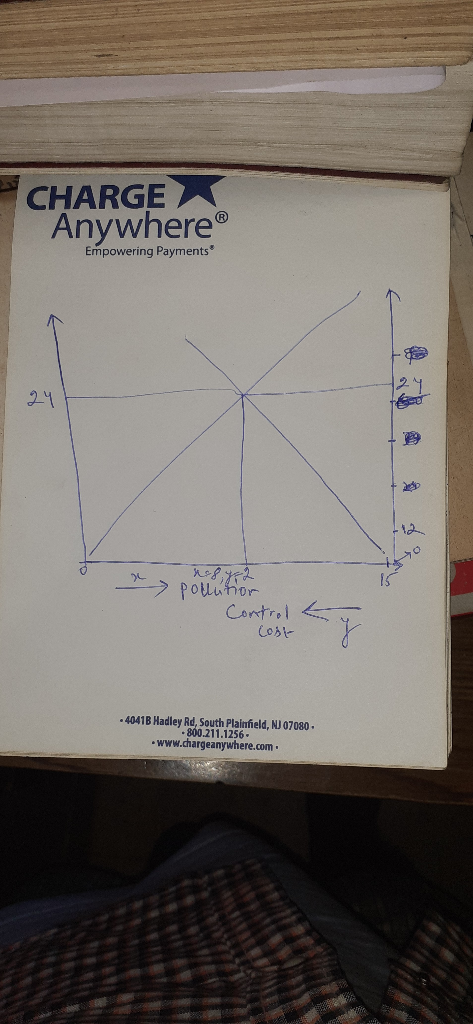
Profit = Total marginal control cost- Total cost of pollution=B-C....., x= units of pollution, y= unit of control
First order condition or FOC= B'-C'=0 or B'=C' and second order
condition or SOC= B''  C''
C''
B= 12 for 1 unit, 24 for 2unit, 39 for 3rd unit, 60 for 4 unit, 93 for 5 unit.
FOC is equal at x= 4, 8, 13. B'= 12 for y=1, B'=15 for y=2, B'=21 for y=3.The SOC is satisfied for x= 8, y=2 where B''=C''=3
So, optimal solution= y=2 and B= 24, MC=24, x=8.... so, socially optimal level of control=2 and socially optimal level of pollution=0.
social marginal cost= private marginal cost + tax rate
or s=p+t
or s= 24*8= 192, here p= unknown
so, optimal tax = 192-p.
Add Answer to:
Unit of Pollution Marginal Cost of damage Consider a scenario where there are 15 total units...
Price per unit and marginal cont R ST Units of emissions per period Pollution Abatement Curve...
 Price per unit and marginal cont R ST Units of emissions per period Pollution Abatement Curve A can be read from right to left as the marginal cost of: .O resources curve. O opportunities curve. O pollution curve. O abatement curve.
As society is near total pollution abatement O A. the marginal cost to society falls but...
 As society is near total pollution abatement O A. the marginal cost to society falls but then rises. O B. the marginal cost to society falls. O c. the marginal cost to society equals the marginal benefit to society. OD. the marginal cost to society rises. Technological change that makes it easier to produce in a "cleaner" fashion would cause O A. the marginal cost curve of pollution abatement to shift right, increasing the degree of air quality OB. the...
The marginal damage averted from pollution cleanup is MD = 200 – 5Q. The total cost associated with pollution cleanup is TC = 10Q + 0.5Q^2. a. What is the optimal level of pollution reduction? Show yo...
The marginal damage averted from pollution cleanup is MD = 200 – 5Q. The total cost associated with pollution cleanup is TC = 10Q + 0.5Q^2. a. What is the optimal level of pollution reduction? Show your work and explain b. What amount of tax per unit would generate the optimal amount of pollution reduction from part (a)? Show your work and explain
There are two firms producing cement. Each produces 20 units of pollution, and each has the...
There are two firms producing cement. Each produces 20 units of pollution, and each has the ability to reduce pollution (abate) their emissions by operating some machine. The marginal damage of each unit of pollution to society is $3 (i.e., the marginal benefit of each unit of abatement is $3). The total cost of firm 1 is where denotes the amount of abatement of firm 1. The total cost of firm 2 is where denotes the amount of abatement of...
cost of cleanup is constant at $120 per unit. What is the optimal level of pollution...
 cost of cleanup is constant at $120 per unit. What is the optimal level of pollution cleanup in each of the two regions? 12. The private marginal benefit associated with a product's consumption is PMB = 350 – 4Q and the private marginal cost associated with its production is PMC = 6Q. Furthermore, the marginal external damage associated with this good's production is MD = 4Q. To correct the externality, the government decides to impose a tax of T per...
At 15 units of output, a firm's marginal cost and average total cost each equal $75....
 At 15 units of output, a firm's marginal cost and average total cost each equal $75. Therefore, assuming 'typically' shaped cost curves, at 16 units of output: Its marginal cost is greater than $75 and its average total cost is less than $75. O Its marginal cost is less than $75 and its average total cost is greater than $75. O Its marginal cost and average total cost are each less than $75. 0 Its marginal cost and average total...
Possible Solutions Total Cost of eliminating 2 units of pollution The options for the first fill in the blank (Firm X) are: $295, $120, $215, $320. The options for the second fill in the blank (Firm...
 Possible Solutions
Total Cost of eliminating 2 units of
pollution
The options for the first fill in the blank (Firm X) are: $295,
$120, $215, $320.
The options for the second fill in the blank (Firm Y) are:
$1250, $800, $1850, $1500
The options for the third fill in the blank (Firm Z) are: $180,
$250, $230, $100
The options for the forth fill in the blank are: $1490, $2420,
$1625, $1645
Firm X
Firm Y
Firm Z
Initial pollution...
Possible Solutions
Total Cost of eliminating 2 units of
pollution
The options for the first fill in the blank (Firm X) are: $295,
$120, $215, $320.
The options for the second fill in the blank (Firm Y) are:
$1250, $800, $1850, $1500
The options for the third fill in the blank (Firm Z) are: $180,
$250, $230, $100
The options for the forth fill in the blank are: $1490, $2420,
$1625, $1645
Firm X
Firm Y
Firm Z
Initial pollution...
J. (Total Cost and Marginal Cost) Complete the following table, where Lis units oflabor, ais units...
 J. (Total Cost and Marginal Cost) Complete the following table, where Lis units oflabor, ais units of output, and MPLis the marginal product of labor. 0 cic di 、<b MPL VC TC MC 1 6 $3 15 3 $9 나 Oò 300 t00 160 a. At what quantity of labor do the marginal returns to labor begin to diminish? b. What is the average variable cost when a-24? c. What is this firm's fixed cost? d. What is the wage...
4. Marginal resource cost A company operates in a perfectly competitive market, selling each unit of...
 4. Marginal resource cost A company operates in a perfectly competitive market, selling each unit of output for a price of $20 and paying the market wage of $270 per day for each worker it hires. In the following table, complete the column for the value of the marginal product of labor (VMPL) at each quantity of workers. Labor (Number of workers) 0 Output Marginal Product of Labor (Units of output) (Units of output) Value of the Marginal Product of...
Consider total cost and total revenue, given in the following table: In the final column, enter...
 Consider total cost and total revenue, given in the following
table:
In the final column, enter profit for each quantity.
(Note: If the firm suffers a loss, enter a
negative number in the appropriate cell.)
Quantity
Total Cost
Marginal Cost
Total Revenue
Marginal Revenue
Profit
(Dollars)
(Dollars)
(Dollars)
(Dollars)
(Dollars)
0
6
0
1
8
7
2
10
14
3
13
21
4
17
28
5
24
35
6
32
42
7
42
49
In order to maximize profit, how...
Consider total cost and total revenue, given in the following
table:
In the final column, enter profit for each quantity.
(Note: If the firm suffers a loss, enter a
negative number in the appropriate cell.)
Quantity
Total Cost
Marginal Cost
Total Revenue
Marginal Revenue
Profit
(Dollars)
(Dollars)
(Dollars)
(Dollars)
(Dollars)
0
6
0
1
8
7
2
10
14
3
13
21
4
17
28
5
24
35
6
32
42
7
42
49
In order to maximize profit, how...
 Price per unit and marginal cont R ST Units of emissions per period Pollution Abatement Curve A can be read from right to left as the marginal cost of: .O resources curve. O opportunities curve. O pollution curve. O abatement curve.
 As society is near total pollution abatement O A. the marginal cost to society falls but then rises. O B. the marginal cost to society falls. O c. the marginal cost to society equals the marginal benefit to society. OD. the marginal cost to society rises. Technological change that makes it easier to produce in a "cleaner" fashion would cause O A. the marginal cost curve of pollution abatement to shift right, increasing the degree of air quality OB. the...
 cost of cleanup is constant at $120 per unit. What is the optimal level of pollution cleanup in each of the two regions? 12. The private marginal benefit associated with a product's consumption is PMB = 350 – 4Q and the private marginal cost associated with its production is PMC = 6Q. Furthermore, the marginal external damage associated with this good's production is MD = 4Q. To correct the externality, the government decides to impose a tax of T per...
 At 15 units of output, a firm's marginal cost and average total cost each equal $75. Therefore, assuming 'typically' shaped cost curves, at 16 units of output: Its marginal cost is greater than $75 and its average total cost is less than $75. O Its marginal cost is less than $75 and its average total cost is greater than $75. O Its marginal cost and average total cost are each less than $75. 0 Its marginal cost and average total...
 Possible Solutions
Total Cost of eliminating 2 units of
pollution
The options for the first fill in the blank (Firm X) are: $295,
$120, $215, $320.
The options for the second fill in the blank (Firm Y) are:
$1250, $800, $1850, $1500
The options for the third fill in the blank (Firm Z) are: $180,
$250, $230, $100
The options for the forth fill in the blank are: $1490, $2420,
$1625, $1645
Firm X
Firm Y
Firm Z
Initial pollution...
Possible Solutions
Total Cost of eliminating 2 units of
pollution
The options for the first fill in the blank (Firm X) are: $295,
$120, $215, $320.
The options for the second fill in the blank (Firm Y) are:
$1250, $800, $1850, $1500
The options for the third fill in the blank (Firm Z) are: $180,
$250, $230, $100
The options for the forth fill in the blank are: $1490, $2420,
$1625, $1645
Firm X
Firm Y
Firm Z
Initial pollution...
 J. (Total Cost and Marginal Cost) Complete the following table, where Lis units oflabor, ais units of output, and MPLis the marginal product of labor. 0 cic di 、<b MPL VC TC MC 1 6 $3 15 3 $9 나 Oò 300 t00 160 a. At what quantity of labor do the marginal returns to labor begin to diminish? b. What is the average variable cost when a-24? c. What is this firm's fixed cost? d. What is the wage...
 4. Marginal resource cost A company operates in a perfectly competitive market, selling each unit of output for a price of $20 and paying the market wage of $270 per day for each worker it hires. In the following table, complete the column for the value of the marginal product of labor (VMPL) at each quantity of workers. Labor (Number of workers) 0 Output Marginal Product of Labor (Units of output) (Units of output) Value of the Marginal Product of...
 Consider total cost and total revenue, given in the following
table:
In the final column, enter profit for each quantity.
(Note: If the firm suffers a loss, enter a
negative number in the appropriate cell.)
Quantity
Total Cost
Marginal Cost
Total Revenue
Marginal Revenue
Profit
(Dollars)
(Dollars)
(Dollars)
(Dollars)
(Dollars)
0
6
0
1
8
7
2
10
14
3
13
21
4
17
28
5
24
35
6
32
42
7
42
49
In order to maximize profit, how...
Consider total cost and total revenue, given in the following
table:
In the final column, enter profit for each quantity.
(Note: If the firm suffers a loss, enter a
negative number in the appropriate cell.)
Quantity
Total Cost
Marginal Cost
Total Revenue
Marginal Revenue
Profit
(Dollars)
(Dollars)
(Dollars)
(Dollars)
(Dollars)
0
6
0
1
8
7
2
10
14
3
13
21
4
17
28
5
24
35
6
32
42
7
42
49
In order to maximize profit, how...
Most questions answered within 3 hours.
-
Where is the error in this code sequence?
String s1 = "Hello";
String s2 = "ello";...
asked 11 months ago -
Financial data for Joel de Paris, Inc., for last year
follow:
Joel de Paris, Inc.
Balance...
asked 11 months ago -
Consider this reaction:
Al2(SO4)3 (aq)+ BaCl3
(aq) Al2Cl6 (aq)- +
3BaSO4(s) . What is the...
asked 11 months ago -
Suppose that Savneet is considering increasing her
recent random sample from 20 car rentals to 40...
asked 11 months ago -
Trucks arrive at an unloading terminal at an average rate of 120
per hour.
Trucks arrive...
asked 11 months ago -
Why are methanol and ethanol completely soluble in water while
octanol is not very little soluble....
asked 11 months ago -
A facilities manager at a university reads in a research report
that the mean amount of...
asked 11 months ago -
When the CuSO4 is rehydrated by adding water to the anhydrous
compound, is this an endothermic...
asked 11 months ago -
A ray of sunlight is passing from diamond into crown glass; the
angle of incidence is...
asked 11 months ago -
A block of mass 0.249 kg is placed on top of a light, vertical
spring of...
asked 11 months ago -
how do the kidneys compensate in the presences of acidosis
a) trigger hyperventilate
b) reserve acid...
asked 11 months ago -
Question 501 pts
The rental rate of capital to the firm increases. Which of the
following...
asked 11 months ago