Which of the following diseases is a vector-borne disease transmitted by mosquitoes? a. Malaria b. Norwalk...
Which of the following diseases is a vector-borne disease transmitted by mosquitoes?
a. Malaria
b. Norwalk virus
c. Poliovirus
d. Rabies
Homework Answers
Answer: Malaria
It's a infection caused by Malarial parasite(plasmodium)transmitted through mosquito bites. Anopheles mosquitoes are responsible for malaria transmission. Symptoms are fever, headaches and vomiting
Nowalk virus is also known as winter vomiting bug. The disease caused by this virus mainly through fecal- oral route. It mainly affects gastro intestinal system with symptoms of diarrhea, vomiting and stomach pain.
Polio virus is also transmitted through fecal- oral route. It affects central nervous system which leads to paralysis. It's a vaccine preventable disease.
Rabies virus is transmitted through the saliva of animals especially dogs. It also affects central nervous system with symptoms of hydrophobia (lock jaw). It rarely transmits through human saliva.
Add Answer to:
Which of the following diseases is a vector-borne disease
transmitted by mosquitoes?
a. Malaria
b. Norwalk...
There are several different modes of transmission for communicable diseases (e.g. food borne, vector borne, respiratory...
There are several different modes of transmission for communicable diseases (e.g. food borne, vector borne, respiratory etc.) discussed in your textbook. Choose ONE disease that falls into one of the categories and discuss the methods used to control this disease. Why might it be difficult to eliminate or eradicate his disease? Be Specific and use supportive examples to support response
28. Mosquitoes may carry all of the following pathogens/diseases EXCEPT: a Arboviruses b. Yellow Fever C....
 28. Mosquitoes may carry all of the following pathogens/diseases EXCEPT: a Arboviruses b. Yellow Fever C. Plasmodium d. Samedia e West Nile virus
Which disease would you predict to be more prevalent in people, malaria or DENV? Mosquitoes on...
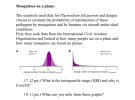 Which disease would you predict to be more prevalent in people,
malaria or DENV?
Mosquitoes on a plane: The scientists used data for Plasmodium falciparum and dengue viruses to estimate the probability of introduction of these pathogens by mosquitoes and by humans via aircraft under ideal conditions First, they took data from the International Civil Aviation Organization and looked at how many people are on a plane and how many mosquitos are found on planes A B Median: 104 Median:...
Which disease would you predict to be more prevalent in people,
malaria or DENV?
Mosquitoes on a plane: The scientists used data for Plasmodium falciparum and dengue viruses to estimate the probability of introduction of these pathogens by mosquitoes and by humans via aircraft under ideal conditions First, they took data from the International Civil Aviation Organization and looked at how many people are on a plane and how many mosquitos are found on planes A B Median: 104 Median:...
Which of the following pair of diseases is caused by virus? (a) rabies, mumps (b) cholera,...
Which of the following pair of diseases is caused by virus? (a) rabies, mumps (b) cholera, tuberculosis (c) typhoid, tetanus (d) AIDS, syphilis.
Which of the following pair of diseases is caused by virus? (a) rabies, mumps (b) cholera,...
Which of the following pair of diseases is caused by virus? (a) rabies, mumps (b) cholera, tuberculosis (c) typhoid, tetanus (d) AIDS, syphilis.
In the last two decades, several vector-borne diseases have emerged as major causes of human morbidity...
In the last two decades, several vector-borne diseases have emerged as major causes of human morbidity and mortality. All four serotypes of Dengue virus have emerged in Central and South America and in the Caribbean. Chikungunya has re-emerged on the Indian sub-continent and Japanese encephalitis has been seen for the first time in India and Pakistan. In the last decade, the incidence of tick-borne encephalitis has increased dramatically in Russia, eastern and central Europe and yellow fever has emerged in...
________________ is a virus that infects the widest range of mammals. A) HIV B) Malaria...
________________ is a virus that infects the widest range of mammals. A) HIV B) Malaria C) The common cold virus D) Rabies
Read the following scenario to answer the following question. Malaria is a disease caused by parasitic...
 Read the following scenario to answer the following question. Malaria is a disease caused by parasitic protists in the genus Plasmodium. The parasite is transmitted to humans by female Anopheles mosquitoes. The Plasmodium parasite feeds on human red blood cells, eventually destroying them. Humans infected with malaria can exhibit many symptoms. Depending on the severity of the infection, these can range from fever, chills, sweating, and headaches to anemia and kidney failure. Ultimately, malaria can result in death. However, if...
For ebola Virus, How is the disease transmitted? Direct Person to Person: Physical Contact Indirect Person...
For ebola Virus, How is the disease transmitted? Direct Person to Person: Physical Contact Indirect Person to Person: Fomites or Vehicles Vector Borne Zoonotic Air borne Droplet Food borne Please mark all the characteristics that are applicable to this organism. Gram + Gram - Acid Fast + Acid Fast - Endospore Forming Non-Endospore Forming Motile Non-Motile Catalase + Catalase - Aerobic Facultative Anaerobe Anaerobic Microaerophile Not Applicable
Do you know of any vector- borne disease which has been successfully controlled? What methods were...
 Do you know of any vector- borne disease which has been successfully controlled? What methods were used? Do you know of a vector-borne disease which has not beern controlled in spite of control activities in place? What are the challenges hampering the control methods? 8:45 AM
 28. Mosquitoes may carry all of the following pathogens/diseases EXCEPT: a Arboviruses b. Yellow Fever C. Plasmodium d. Samedia e West Nile virus
 Which disease would you predict to be more prevalent in people,
malaria or DENV?
Mosquitoes on a plane: The scientists used data for Plasmodium falciparum and dengue viruses to estimate the probability of introduction of these pathogens by mosquitoes and by humans via aircraft under ideal conditions First, they took data from the International Civil Aviation Organization and looked at how many people are on a plane and how many mosquitos are found on planes A B Median: 104 Median:...
Which disease would you predict to be more prevalent in people,
malaria or DENV?
Mosquitoes on a plane: The scientists used data for Plasmodium falciparum and dengue viruses to estimate the probability of introduction of these pathogens by mosquitoes and by humans via aircraft under ideal conditions First, they took data from the International Civil Aviation Organization and looked at how many people are on a plane and how many mosquitos are found on planes A B Median: 104 Median:...
 Read the following scenario to answer the following question. Malaria is a disease caused by parasitic protists in the genus Plasmodium. The parasite is transmitted to humans by female Anopheles mosquitoes. The Plasmodium parasite feeds on human red blood cells, eventually destroying them. Humans infected with malaria can exhibit many symptoms. Depending on the severity of the infection, these can range from fever, chills, sweating, and headaches to anemia and kidney failure. Ultimately, malaria can result in death. However, if...
 Do you know of any vector- borne disease which has been successfully controlled? What methods were used? Do you know of a vector-borne disease which has not beern controlled in spite of control activities in place? What are the challenges hampering the control methods? 8:45 AM
Most questions answered within 3 hours.
-
Where is the error in this code sequence?
String s1 = "Hello";
String s2 = "ello";...
asked 11 months ago -
Financial data for Joel de Paris, Inc., for last year
follow:
Joel de Paris, Inc.
Balance...
asked 11 months ago -
Consider this reaction:
Al2(SO4)3 (aq)+ BaCl3
(aq) Al2Cl6 (aq)- +
3BaSO4(s) . What is the...
asked 11 months ago -
Suppose that Savneet is considering increasing her
recent random sample from 20 car rentals to 40...
asked 11 months ago -
Trucks arrive at an unloading terminal at an average rate of 120
per hour.
Trucks arrive...
asked 11 months ago -
Why are methanol and ethanol completely soluble in water while
octanol is not very little soluble....
asked 11 months ago -
A facilities manager at a university reads in a research report
that the mean amount of...
asked 11 months ago -
When the CuSO4 is rehydrated by adding water to the anhydrous
compound, is this an endothermic...
asked 11 months ago -
A ray of sunlight is passing from diamond into crown glass; the
angle of incidence is...
asked 11 months ago -
A block of mass 0.249 kg is placed on top of a light, vertical
spring of...
asked 11 months ago -
how do the kidneys compensate in the presences of acidosis
a) trigger hyperventilate
b) reserve acid...
asked 11 months ago -
Question 501 pts
The rental rate of capital to the firm increases. Which of the
following...
asked 11 months ago