
Homework Answers
Add Answer to:
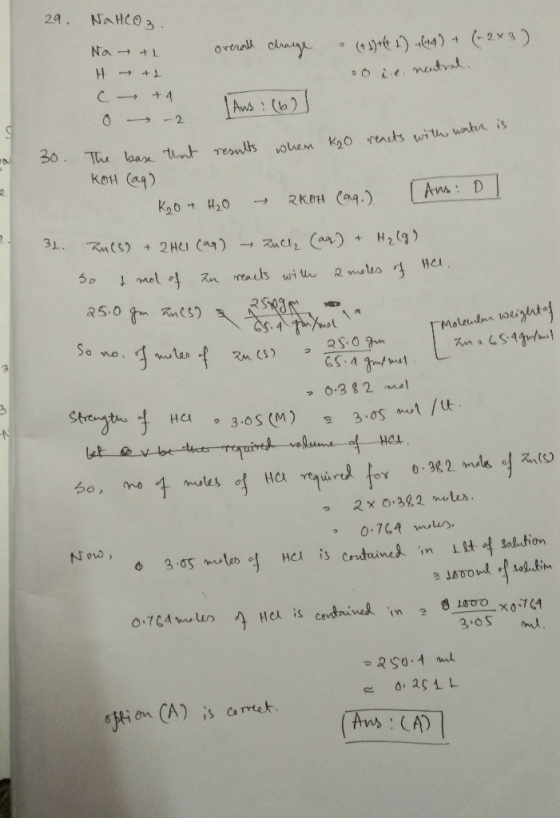
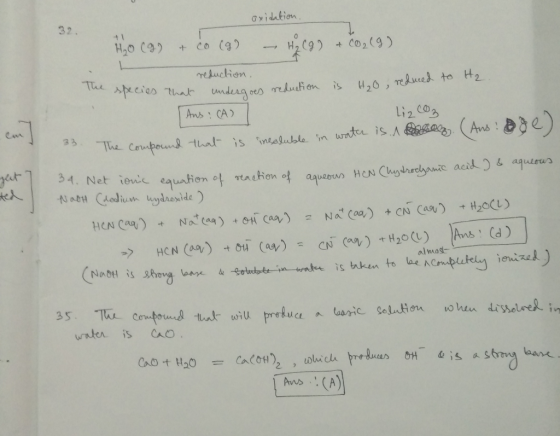
29 to 35
hem. 103 Chapts 3&4 Test , What is the oxidation number of each...
1) The net ionic equation for the reaction between aqueous nitric acid and aqueous sodium hydroxide...
 1) The net ionic equation for the reaction between aqueous nitric acid and aqueous sodium hydroxide is A) H+ (aq) + HNO3 (aq) + 2OH- (aq) → 2H20 (1) + NO3- (aq) B) HNO3 (aq) + NaOH(aq) → NaNO3(aq) + H20 (1) C) H+ (aq) + OH- (aq) + H2O (1) D) HNO3 (aq) + OH- (aq) + NO3- (aq) + H2O (1) E) H+ (aq) + Na+ (aq) + OH- (aq) → H20 (1) + Na+ (aq) 2) Which...
4. Equal moles of the indicated acids are dissolved in the ammon of he acid be...
 4. Equal moles of the indicated acids are dissolved in the ammon of he acid be beakers below. In which solution will the percent ionization of water shown in the of the acid be the lowest? Op -HC a. All have equal percent ionization of acid. c.Ⅳ e. 5. For a 0.05 M H2SOs solution, which of the following relationships is true? b. [SO327 키HS037 C [HSOs 1> [H2SO3] dHSH) 6. Which of the following reactions is associated with the...
please write legible 1. Identify each of the following reactions as a precipitation reaction, an acid-base...
 please write legible
1. Identify each of the following reactions as a precipitation reaction, an acid-base reaction, or as a redox reaction + a. Pb(NO3)2 (aq) + 2 HCl(aq) PbCl (s) + 2 HNO, (aq) b. 2 Hxe + O2 + 2 H2O c. HNO, (aq) + KOH(aq) KNO, (aq) + H20 (1) d. Zna + 2HCl(a) - ZnClaraq) + Halle e. Ba?'(aq) + 2 Br(aq) + 2 Na(aq) + SO/"(aq) BaSO. (s) + 2 Na'(aq) + 2 Br" (aq)...
please write legible
1. Identify each of the following reactions as a precipitation reaction, an acid-base reaction, or as a redox reaction + a. Pb(NO3)2 (aq) + 2 HCl(aq) PbCl (s) + 2 HNO, (aq) b. 2 Hxe + O2 + 2 H2O c. HNO, (aq) + KOH(aq) KNO, (aq) + H20 (1) d. Zna + 2HCl(a) - ZnClaraq) + Halle e. Ba?'(aq) + 2 Br(aq) + 2 Na(aq) + SO/"(aq) BaSO. (s) + 2 Na'(aq) + 2 Br" (aq)...
please write legible. answer all questions. 1. Identify each of the following reactions as a precipitation...
 please write legible. answer all questions.
1. Identify each of the following reactions as a precipitation reaction, an acid-base reaction or as a redox reaction Pb(NO), (aq) + 2 HCl(aq) - PbCl(s) + 2 HNO(aq) b. 2 H2 + Oxel - 2 H2O CHNO, (aq) + KOH(aq) - KNO, (aq) + H2O (1) d. Zn + 2HCl - ZnCl + H e. Ba"(aq) + 2 Br(aq) + 2 Na' (aq) +SO. (aq) BaSO. (s) + 2 Na'(aq) + 2 Br"...
please write legible. answer all questions.
1. Identify each of the following reactions as a precipitation reaction, an acid-base reaction or as a redox reaction Pb(NO), (aq) + 2 HCl(aq) - PbCl(s) + 2 HNO(aq) b. 2 H2 + Oxel - 2 H2O CHNO, (aq) + KOH(aq) - KNO, (aq) + H2O (1) d. Zn + 2HCl - ZnCl + H e. Ba"(aq) + 2 Br(aq) + 2 Na' (aq) +SO. (aq) BaSO. (s) + 2 Na'(aq) + 2 Br"...
46. Which species in the reaction below undergoes reduction? H2O(g) + CO(g) -H2(g) + CO2(g) a....
 46. Which species in the reaction below undergoes reduction? H2O(g) + CO(g) -H2(g) + CO2(g) a. H20 b.CO CH2 d. co2 e. None 47. Which species is reduced in the reaction below? (aq) + CIO (aq) + 10 (aq) + C (aq) a. b. H20 c.cr d. 10 e. CIO 48. Which of the following elements generally acts as an oxidizing agent? a. Br2 b.H2 c. Fed . C e. Li 49. What is the oxidation number of Fe in...
1. Label the acids, bases, conjugate acids, and conjugate bases in the reactions below: a. Na2CO3(aq)...
 1. Label the acids, bases, conjugate acids, and conjugate bases in the reactions below: a. Na2CO3(aq) + 2 HCl (aq) H2CO, (aq) + 2 NaCl (aq) b. NH” (aq) + CN + NH3 (aq) + HCN (aq) c. Na2HPO4 (aq) + NaOH(aq) - Na PO. (aq) + H20 (1) d. H2O(l) + NaH (s) H2(g) + NaOH(aq) 2. Calculate the pH of the following solutions: a. [H,O') = 4.5 x 10° b. 12 M HCl C. 0.13 M NaOH d....
1. What volume of 1.00 M HCl in liters is needed to react completely (with nothing...
 1. What volume of 1.00 M HCl in liters is needed to react
completely (with nothing left over) with 0.750 L of 0.200 M
Na2CO3?
Express your answer to three significant figures and include the
appropriate units.
2. A 639-mL sample of unknown HCl solution reacts completely
with Na2CO3 to form 15.1 g CO2. What was the concentration of the
HCl solution?
Express your answer to three significant figures and include the
appropriate units.
Hydrochloric acid (HCl) reacts with sodium...
1. What volume of 1.00 M HCl in liters is needed to react
completely (with nothing left over) with 0.750 L of 0.200 M
Na2CO3?
Express your answer to three significant figures and include the
appropriate units.
2. A 639-mL sample of unknown HCl solution reacts completely
with Na2CO3 to form 15.1 g CO2. What was the concentration of the
HCl solution?
Express your answer to three significant figures and include the
appropriate units.
Hydrochloric acid (HCl) reacts with sodium...
1. Which of the followi ch of the following reactions is not readily explained by the...
 1. Which of the followi ch of the following reactions is not readily explained by the Arrhenius concept of acids and bases? a. A. HCl(aq) + NaOH(aq) - NaCl(aq) + H20() b. H30(aq) + OH-(aq) + 2H20(1) c. HCI(g) + NH3(g) - NH4Cl(s) d. HC2H302(aq) + H2O(l) H30*(aq) + C2H302-(ag) e. H30 (aq) + OH-(aq) + 2H2O(aq) 2. Classify each of the following species as Brønsted acid or base or both: a) H20, b) OH", c) H30, d) NH3, e)...
1. Which of the followi ch of the following reactions is not readily explained by the Arrhenius concept of acids a...
 1. Which of the followi ch of the following reactions is not readily explained by the Arrhenius concept of acids and bases? a. A. HCl(aq) + NaOH(aq) - NaCl(aq) + H20() b. H30(aq) + OH-(aq) + 2H20(1) c. HCI(g) + NH3(g) - NH4Cl(s) d. HC2H302(aq) + H2O(l) H30*(aq) + C2H302-(ag) e. H30 (aq) + OH-(aq) + 2H2O(aq) 2. Classify each of the following species as Brønsted acid or base or both: a) H20, b) OH", c) H30, d) NH3, e)...
9) What is the total number of atoms in 0.139 mol of Fe(OH263-? A) 19.0 B)...
 9) What is the total number of atoms in 0.139 mol of Fe(OH263-? A) 19.0 B) 2.64 98.37. 1022 D) 1.59. 1024 E) 184. 1024 10) How many carbon atoms are there in 52.06 g of carbon dioxide? A) 8.648.10-23 B) 3.134 x 1025 C) 7.122 1023 D) 5.206 X 1024 E) 1.424 . 1024 11) A nitrogen oxide is 63.65% by mass nitrogen. The molecular formula could be A) NO B) NO2 CN204 D) N20 E) either NO2 or...
 1) The net ionic equation for the reaction between aqueous nitric acid and aqueous sodium hydroxide is A) H+ (aq) + HNO3 (aq) + 2OH- (aq) → 2H20 (1) + NO3- (aq) B) HNO3 (aq) + NaOH(aq) → NaNO3(aq) + H20 (1) C) H+ (aq) + OH- (aq) + H2O (1) D) HNO3 (aq) + OH- (aq) + NO3- (aq) + H2O (1) E) H+ (aq) + Na+ (aq) + OH- (aq) → H20 (1) + Na+ (aq) 2) Which...
 4. Equal moles of the indicated acids are dissolved in the ammon of he acid be beakers below. In which solution will the percent ionization of water shown in the of the acid be the lowest? Op -HC a. All have equal percent ionization of acid. c.Ⅳ e. 5. For a 0.05 M H2SOs solution, which of the following relationships is true? b. [SO327 키HS037 C [HSOs 1> [H2SO3] dHSH) 6. Which of the following reactions is associated with the...
 please write legible
1. Identify each of the following reactions as a precipitation reaction, an acid-base reaction, or as a redox reaction + a. Pb(NO3)2 (aq) + 2 HCl(aq) PbCl (s) + 2 HNO, (aq) b. 2 Hxe + O2 + 2 H2O c. HNO, (aq) + KOH(aq) KNO, (aq) + H20 (1) d. Zna + 2HCl(a) - ZnClaraq) + Halle e. Ba?'(aq) + 2 Br(aq) + 2 Na(aq) + SO/"(aq) BaSO. (s) + 2 Na'(aq) + 2 Br" (aq)...
please write legible
1. Identify each of the following reactions as a precipitation reaction, an acid-base reaction, or as a redox reaction + a. Pb(NO3)2 (aq) + 2 HCl(aq) PbCl (s) + 2 HNO, (aq) b. 2 Hxe + O2 + 2 H2O c. HNO, (aq) + KOH(aq) KNO, (aq) + H20 (1) d. Zna + 2HCl(a) - ZnClaraq) + Halle e. Ba?'(aq) + 2 Br(aq) + 2 Na(aq) + SO/"(aq) BaSO. (s) + 2 Na'(aq) + 2 Br" (aq)...
 please write legible. answer all questions.
1. Identify each of the following reactions as a precipitation reaction, an acid-base reaction or as a redox reaction Pb(NO), (aq) + 2 HCl(aq) - PbCl(s) + 2 HNO(aq) b. 2 H2 + Oxel - 2 H2O CHNO, (aq) + KOH(aq) - KNO, (aq) + H2O (1) d. Zn + 2HCl - ZnCl + H e. Ba"(aq) + 2 Br(aq) + 2 Na' (aq) +SO. (aq) BaSO. (s) + 2 Na'(aq) + 2 Br"...
please write legible. answer all questions.
1. Identify each of the following reactions as a precipitation reaction, an acid-base reaction or as a redox reaction Pb(NO), (aq) + 2 HCl(aq) - PbCl(s) + 2 HNO(aq) b. 2 H2 + Oxel - 2 H2O CHNO, (aq) + KOH(aq) - KNO, (aq) + H2O (1) d. Zn + 2HCl - ZnCl + H e. Ba"(aq) + 2 Br(aq) + 2 Na' (aq) +SO. (aq) BaSO. (s) + 2 Na'(aq) + 2 Br"...
 46. Which species in the reaction below undergoes reduction? H2O(g) + CO(g) -H2(g) + CO2(g) a. H20 b.CO CH2 d. co2 e. None 47. Which species is reduced in the reaction below? (aq) + CIO (aq) + 10 (aq) + C (aq) a. b. H20 c.cr d. 10 e. CIO 48. Which of the following elements generally acts as an oxidizing agent? a. Br2 b.H2 c. Fed . C e. Li 49. What is the oxidation number of Fe in...
 1. Label the acids, bases, conjugate acids, and conjugate bases in the reactions below: a. Na2CO3(aq) + 2 HCl (aq) H2CO, (aq) + 2 NaCl (aq) b. NH” (aq) + CN + NH3 (aq) + HCN (aq) c. Na2HPO4 (aq) + NaOH(aq) - Na PO. (aq) + H20 (1) d. H2O(l) + NaH (s) H2(g) + NaOH(aq) 2. Calculate the pH of the following solutions: a. [H,O') = 4.5 x 10° b. 12 M HCl C. 0.13 M NaOH d....
 1. What volume of 1.00 M HCl in liters is needed to react
completely (with nothing left over) with 0.750 L of 0.200 M
Na2CO3?
Express your answer to three significant figures and include the
appropriate units.
2. A 639-mL sample of unknown HCl solution reacts completely
with Na2CO3 to form 15.1 g CO2. What was the concentration of the
HCl solution?
Express your answer to three significant figures and include the
appropriate units.
Hydrochloric acid (HCl) reacts with sodium...
1. What volume of 1.00 M HCl in liters is needed to react
completely (with nothing left over) with 0.750 L of 0.200 M
Na2CO3?
Express your answer to three significant figures and include the
appropriate units.
2. A 639-mL sample of unknown HCl solution reacts completely
with Na2CO3 to form 15.1 g CO2. What was the concentration of the
HCl solution?
Express your answer to three significant figures and include the
appropriate units.
Hydrochloric acid (HCl) reacts with sodium...
 1. Which of the followi ch of the following reactions is not readily explained by the Arrhenius concept of acids and bases? a. A. HCl(aq) + NaOH(aq) - NaCl(aq) + H20() b. H30(aq) + OH-(aq) + 2H20(1) c. HCI(g) + NH3(g) - NH4Cl(s) d. HC2H302(aq) + H2O(l) H30*(aq) + C2H302-(ag) e. H30 (aq) + OH-(aq) + 2H2O(aq) 2. Classify each of the following species as Brønsted acid or base or both: a) H20, b) OH", c) H30, d) NH3, e)...
 1. Which of the followi ch of the following reactions is not readily explained by the Arrhenius concept of acids and bases? a. A. HCl(aq) + NaOH(aq) - NaCl(aq) + H20() b. H30(aq) + OH-(aq) + 2H20(1) c. HCI(g) + NH3(g) - NH4Cl(s) d. HC2H302(aq) + H2O(l) H30*(aq) + C2H302-(ag) e. H30 (aq) + OH-(aq) + 2H2O(aq) 2. Classify each of the following species as Brønsted acid or base or both: a) H20, b) OH", c) H30, d) NH3, e)...
 9) What is the total number of atoms in 0.139 mol of Fe(OH263-? A) 19.0 B) 2.64 98.37. 1022 D) 1.59. 1024 E) 184. 1024 10) How many carbon atoms are there in 52.06 g of carbon dioxide? A) 8.648.10-23 B) 3.134 x 1025 C) 7.122 1023 D) 5.206 X 1024 E) 1.424 . 1024 11) A nitrogen oxide is 63.65% by mass nitrogen. The molecular formula could be A) NO B) NO2 CN204 D) N20 E) either NO2 or...
Most questions answered within 3 hours.
-
Where is the error in this code sequence?
String s1 = "Hello";
String s2 = "ello";...
asked 11 months ago -
Financial data for Joel de Paris, Inc., for last year
follow:
Joel de Paris, Inc.
Balance...
asked 11 months ago -
Consider this reaction:
Al2(SO4)3 (aq)+ BaCl3
(aq) Al2Cl6 (aq)- +
3BaSO4(s) . What is the...
asked 11 months ago -
Suppose that Savneet is considering increasing her
recent random sample from 20 car rentals to 40...
asked 11 months ago -
Trucks arrive at an unloading terminal at an average rate of 120
per hour.
Trucks arrive...
asked 11 months ago -
Why are methanol and ethanol completely soluble in water while
octanol is not very little soluble....
asked 11 months ago -
A facilities manager at a university reads in a research report
that the mean amount of...
asked 11 months ago -
When the CuSO4 is rehydrated by adding water to the anhydrous
compound, is this an endothermic...
asked 11 months ago -
A ray of sunlight is passing from diamond into crown glass; the
angle of incidence is...
asked 11 months ago -
A block of mass 0.249 kg is placed on top of a light, vertical
spring of...
asked 11 months ago -
how do the kidneys compensate in the presences of acidosis
a) trigger hyperventilate
b) reserve acid...
asked 11 months ago -
Question 501 pts
The rental rate of capital to the firm increases. Which of the
following...
asked 11 months ago