
Homework Answers
Lets Consider Rs (Top Black) as x and Rm( Market) as y
| Year | Rs (Top Black)/ x | Rm (Market)/y |  |
 |
F*G |
| 1 | 15% | 8% | 12% | 6% | 1% |
| 2xxxxxx | 6% | 2% | 3% | 0% | 0% |
| 3 | -10% | -7% | -13% | -9% | 1% |
| 4 | 0% | 3% | -3% | 1% | 0% |
| 5 | 4% | 2% | 1% | 0% | 0% |
| Mean/sum | 3% | 2% | 2% |

Therefore, Covariance = 2% / 4
Covariance = 0.465%
Now Beta, we also need variance of benchmark
| Year | Rm (Market)/y |  |
 |
| 1 | 8% | 6% | 0% |
| 2 | 2% | 0% | 0% |
| 3 | -7% | -9% | 1% |
| 4 | 3% | 1% | 0% |
| 5 | 2% | 0% | 0% |
| Mean/sum | 2% | 1% |
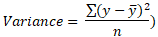
Variance = 1%/5
Variance = 0.23%
And Beta = Covariance/Variance
Beta = 0.465% / 0.23%
Beta = 1.98
Add Answer to:
. Given the sample of returns of the Top Black Asphalt Company and the S&P 500...
Given the sample of returns of the Top Black Asphalt Company and the S&P 500 index,...
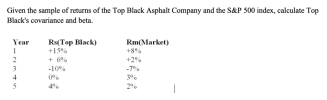 Given the sample of returns of the Top Black Asphalt Company and the S&P 500 index, calculate Top Black's covariance and beta. Year Rm(Market) +8% +2% Rs(Top Black) +15% + 6% -10% 0% 4% -7% 3% 2
Consider a portfolio that is 60% (wS) in the S&P 500 index and 40% (wB) in...
Consider a portfolio that is 60% (wS) in the S&P 500 index and 40% (wB) in the JPM bond index. Suppose an analyst estimates that E[rS] = 15%, σs = 20%, E[rB] = 10%, σB =12%, and ρ = 0%. 1) Calculate the portfolio's standard deviation given that the correlation is zero: 2) Calculate the weighted average of the standard deviations of the S&P 500 index and the JPM bond index:
1. using daily historical returns for the S&P 500 and the Toronto Stock Exchange Composite (TSX)...
1. using daily historical returns for the S&P 500 and the Toronto Stock Exchange Composite (TSX) you notice that the majority of the times when the S&P 500 has positive returns so does the TSX composite. Based on this qualitative assessment, one could expect that: a) the covariance between the return in the S&P 500 and TSX is greater than 0 b)the covariance between the return in the S&P 500 and TSX is equal to 0 c) the correlation between...
For the past two years, S&P 500 Index has the annual returns of 9% and 22%....
For the past two years, S&P 500 Index has the annual returns of 9% and 22%. FB stock has the annual returns of 32% and 27%. Based on the information, compute the beta for FB stock.
Average 4-2 The spreadsheet below contains the total returns for the S&P 500 Index for the...
 Average 4-2 The spreadsheet below contains the total returns for the S&P 500 Index for the years 2000-2009 in decimal form. This 10-year period has been called the "Lost Decade a. Calculate the average annual total return (geometric mean) for this index for this 10-year period. Interpret your result. b. What was the cumulative wealth on December 31, 2009, per dollar invested on January 1, 2000? c. What was the cumulative wealth on December 31, 2002, per dollar invested on...
I am quite pressed for time! Can someone help me find this solution? You are given...
 I am quite pressed for time! Can someone help me find this
solution?
You are given the following information: Stock return (rs) Probability (p) Market return Krm) 0.2 15 10 0.3 0.3 0.2 a. Compute the expected market return and expected stock returns. [4+4 marks] b. If the standard deviation of market returns is 5.64%, what is the standard deviation of stock returns? (5 marks) c. If you create a portfolio with 40% weight on market index and 60% weight...
I am quite pressed for time! Can someone help me find this
solution?
You are given the following information: Stock return (rs) Probability (p) Market return Krm) 0.2 15 10 0.3 0.3 0.2 a. Compute the expected market return and expected stock returns. [4+4 marks] b. If the standard deviation of market returns is 5.64%, what is the standard deviation of stock returns? (5 marks) c. If you create a portfolio with 40% weight on market index and 60% weight...
Let Y and X be weekly excess returns of a US firm and S&P 500 index...
 Let Y and X be weekly excess returns of a US firm and S&P 500 index for the past two years, respectively. The regression output for this data set in shown in the table below: (You can actually download similar data from http://finance.yahoo.com/) Variable Coefficient Intercept -0.008194 1.690067 t-value p-value 0.0282 12.392<2×10-16 s.e. 0.003680-2.22 7 0.136379 n 103 R 0.6033 s 0.03734 (ii) Compute the sample variance for Y (รื่.) and sample correlation between X and Y (Txy).
Last month a stock with a beta of 1.0 lost 20% while the S&P 500 had...
Last month a stock with a beta of 1.0 lost 20% while the S&P 500 had a 10% gain. Given this, it is most likely that the: Multiple Choice stock's beta has been calculated incorrectly. S&P 500 cannot represent the overall market. Incorrect firm released some negative information about itself. the market index had an exceptionally good month.
1. Stock prices and stand-alone risk The S&P 500 Index is one of the most commonly...
 1. Stock prices and stand-alone risk The S&P 500 Index is one of the most commonly used benchmark indices for the U.S. equity markets. Consisting of 500 companies, it is a market value-weighted index. This means that each company's performance is reflected in the index, weighted by the ratio of the company's value to the total value of all the companies. Based on your understanding of P/E ratios, in which of the following situations would the average trailing P/E ratio...
Last month a stock with a beta of 1.0 lost 20% while the S&P 500 had...
Last month a stock with a beta of 1.0 lost 20% while the S&P 500 had a 10% gain. Given this, it is most likely that the: (Multiple Choice) S&P 500 cannot represent the overall market. firm released some negative information about itself. the market index had an exceptionally good month.
 Given the sample of returns of the Top Black Asphalt Company and the S&P 500 index, calculate Top Black's covariance and beta. Year Rm(Market) +8% +2% Rs(Top Black) +15% + 6% -10% 0% 4% -7% 3% 2
 Average 4-2 The spreadsheet below contains the total returns for the S&P 500 Index for the years 2000-2009 in decimal form. This 10-year period has been called the "Lost Decade a. Calculate the average annual total return (geometric mean) for this index for this 10-year period. Interpret your result. b. What was the cumulative wealth on December 31, 2009, per dollar invested on January 1, 2000? c. What was the cumulative wealth on December 31, 2002, per dollar invested on...
 I am quite pressed for time! Can someone help me find this
solution?
You are given the following information: Stock return (rs) Probability (p) Market return Krm) 0.2 15 10 0.3 0.3 0.2 a. Compute the expected market return and expected stock returns. [4+4 marks] b. If the standard deviation of market returns is 5.64%, what is the standard deviation of stock returns? (5 marks) c. If you create a portfolio with 40% weight on market index and 60% weight...
I am quite pressed for time! Can someone help me find this
solution?
You are given the following information: Stock return (rs) Probability (p) Market return Krm) 0.2 15 10 0.3 0.3 0.2 a. Compute the expected market return and expected stock returns. [4+4 marks] b. If the standard deviation of market returns is 5.64%, what is the standard deviation of stock returns? (5 marks) c. If you create a portfolio with 40% weight on market index and 60% weight...
 Let Y and X be weekly excess returns of a US firm and S&P 500 index for the past two years, respectively. The regression output for this data set in shown in the table below: (You can actually download similar data from http://finance.yahoo.com/) Variable Coefficient Intercept -0.008194 1.690067 t-value p-value 0.0282 12.392<2×10-16 s.e. 0.003680-2.22 7 0.136379 n 103 R 0.6033 s 0.03734 (ii) Compute the sample variance for Y (รื่.) and sample correlation between X and Y (Txy).
 1. Stock prices and stand-alone risk The S&P 500 Index is one of the most commonly used benchmark indices for the U.S. equity markets. Consisting of 500 companies, it is a market value-weighted index. This means that each company's performance is reflected in the index, weighted by the ratio of the company's value to the total value of all the companies. Based on your understanding of P/E ratios, in which of the following situations would the average trailing P/E ratio...
Most questions answered within 3 hours.
-
Where is the error in this code sequence?
String s1 = "Hello";
String s2 = "ello";...
asked 11 months ago -
Financial data for Joel de Paris, Inc., for last year
follow:
Joel de Paris, Inc.
Balance...
asked 11 months ago -
Consider this reaction:
Al2(SO4)3 (aq)+ BaCl3
(aq) Al2Cl6 (aq)- +
3BaSO4(s) . What is the...
asked 11 months ago -
Suppose that Savneet is considering increasing her
recent random sample from 20 car rentals to 40...
asked 11 months ago -
Trucks arrive at an unloading terminal at an average rate of 120
per hour.
Trucks arrive...
asked 11 months ago -
Why are methanol and ethanol completely soluble in water while
octanol is not very little soluble....
asked 11 months ago -
A facilities manager at a university reads in a research report
that the mean amount of...
asked 11 months ago -
When the CuSO4 is rehydrated by adding water to the anhydrous
compound, is this an endothermic...
asked 11 months ago -
A ray of sunlight is passing from diamond into crown glass; the
angle of incidence is...
asked 11 months ago -
A block of mass 0.249 kg is placed on top of a light, vertical
spring of...
asked 11 months ago -
how do the kidneys compensate in the presences of acidosis
a) trigger hyperventilate
b) reserve acid...
asked 11 months ago -
Question 501 pts
The rental rate of capital to the firm increases. Which of the
following...
asked 11 months ago