Question )
a)
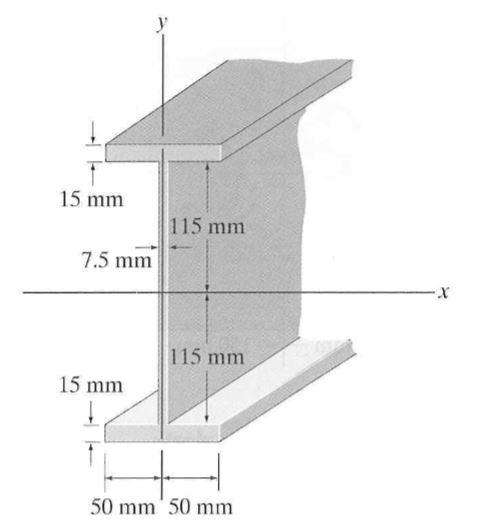
Determine the I-beam's cross-sectional moment of inertia Ix about the horizontal x axis passing through the centroid.
options:
|
a |
1.42 x 106 mm4 |
|
b |
5.3 x 107 mm4 |
|
c |
2.5 x 106 mm4 |
|
d |
1.25 x 106 mm4 |
|
e |
4700 mm4 |
b)
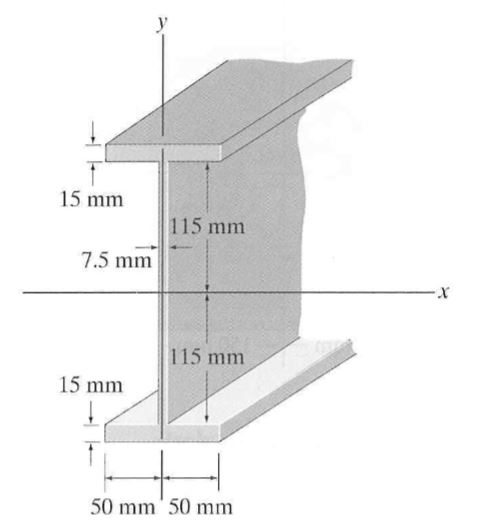
Determine the I-beam's cross-sectional moment of inertia Iy about the vertical y axis passing through the centroid.
options:
|
a |
5.3 x 107 mm4 |
|
b |
2.5 x 106 mm4 |
|
c |
4.10 x 106 mm4 |
|
d |
1.29 x 107 mm4 |
|
e |
1.25 x 106 mm4 |
c)
What is the atomic number of an atom?
options:
|
a |
It is the total number of electrons, protons, and neutrons in the atom. |
|
b |
It is the total charge of the atom. |
|
c |
It is the total number of protons and neutrons in the atom. |
|
d |
It is the number of protons in the atom. |
|
e |
It is the total charge of the nucleus. |
d)
A positively charged insulated rod is brought close to an object that is suspended by a string. If the object is shifted towards the rod we can conclude:
options:
|
a |
The object is positively charge. |
|
b |
The object is an insulator. |
|
c |
The object is a conductor. |
|
d |
None of these answers are correct. |
|
e |
The object is negatively charged. |
e)
A small glass bead has been charged to +20 nC. An electron is placed 1.0 cm from the bead. What is the acceleration of the electron?
Question 25 options:
|
a |
1.7 x 10¹⁴ m/s2, directly toward the bead. |
|
b |
2.9 x 10⁻¹³ m/s2, directly toward the bead. |
|
c |
3.2 x 10¹⁷ m/s2, directly away from the bead. |
|
d |
3.2 x 10¹⁷ m/s2, directly toward the bead. |
|
e |
zero |
Homework Answers
Provifing the solution of c and d ...
Add Answer to:
Question )
a)
Determine the I-beam's cross-sectional moment of
inertia Ix about the horizontal x axis...
Determine the beam's moment of inertia ly about the centroidal y axis. 15 mm 15 mm...
 Determine the beam's moment of inertia ly about the centroidal y axis. 15 mm 15 mm 50 mm X C 10 mm 50 mm 100 mm 100 mm a) ly 25.8 x 106 mm4 = b) ly 29.8 x 106 mm4 c) Iv = 21.8 x 100 mm4 d) 23.8 x 106 mm4
Determine the beam's moment of inertia ly about the centroidal y axis. 15 mm 15 mm 50 mm X C 10 mm 50 mm 100 mm 100...
Determine the beam's moment of inertia ly about the centroidal y axis. 15 mm 15 mm 50 mm X C 10 mm 50 mm 100 mm 100 mm a) ly 25.8 x 106 mm4 = b) ly 29.8 x 106 mm4 c) Iv = 21.8 x 100 mm4 d) 23.8 x 106 mm4
Determine the beam's moment of inertia ly about the centroidal y axis. 15 mm 15 mm 50 mm X C 10 mm 50 mm 100 mm 100...
Part A Determine the moment of inertia of the beam's cross-sectional area about the r axis....
 Part A Determine the moment of inertia of the beam's cross-sectional area about the r axis. (Figure 1) Express your answer with the appropriate units. Figure 1 of 1 μΑ ? 1 = Value Units 60 mm 15 mm. 60 mm - 15 mm Submit Request Answer 100 mm 15 mm Provide Feedback 50 mm 50 mm 100 mm 15 mm P Pearson
Determine the distance to the centroid for the beam's cross sectional area; then determine the moment of inertia about the x' axis.
 Determine the distance to the centroid for the beam's cross sectional area; then determine the moment of inertia about the x' axis. Organize your final answers using the following format at the end of your calculation:
Determine the distance ý to the centroid of the beam's cross- sectional area; then determine the moment of inertia about the x’-axis.
 Determine the distance ý to the centroid of the beam's cross- sectional area; then determine the moment of inertia about the x’-axis. Set up all calculations in a table form.
Determine the moment of inertia of the beam's cross-sectional area about the x' axis. C is centroid the composite beam.
 Determine the moment of inertia of the beam's cross-sectional area about the x' axis. C is centroid the composite beam.
Determine the moment of inertia of the beam's cross-sectional area with respect to the x' axis passing through the centroid C of the cross section.
 Determine the moment of inertia of the beam's cross-sectional area with respect to the x' axis passing through the centroid C of the cross section. y = 104.3 mm. Refer Figure Q1(b).
Determine the moment of inertia of the beam's cross-sectional area about the x and y axis....
 Determine the moment of inertia of the beam's cross-sectional area about the x and y axis.
Question ) a) For the composite area shown, determine the position of the centroid, (x,y) options:...
Question ) a) For the composite area shown, determine the position of the centroid, (x,y) options: a) none of these are correct. b) (0,0) c) (4.8, 2.6) m d) (9, 4.5) m e) (2.6, 4.8) m b) For the triangular shape shown, locate the horizontal position of the centroid, x. Question 17 options: a) b/2 b) h/2 c) 2h/3 d) h/3 e) b/3 c) For the triangular shape shown, locate the vertical position of the centroid, y. options: a) b/3...
Determine the distance y to the centroid of the beam's cross- sectional area; then determine the moment of inertia about the x'-axis. Set up all calculations in a table form.
 Determine the distance y to the centroid of the beam's cross- sectional area; then determine the moment of inertia about the x'-axis. Set up all calculations in a table form.
t Part A Determine the moment of inertia of the beam's cross-sectional area about the z Figure 1) axis. Set a 8...
 t Part A Determine the moment of inertia of the beam's cross-sectional area about the z Figure 1) axis. Set a 8 in b3 in3 in d 1 in Express your answer with the appropriate units 184.334 in Submit Previsus Answers Request Answer X Incorrect; Try Again;5 attempts remaining gure 1 of 1 Return to Assignment | Provide Feedback
t Part A Determine the moment of inertia of the beam's cross-sectional area about the z Figure 1) axis. Set a...
t Part A Determine the moment of inertia of the beam's cross-sectional area about the z Figure 1) axis. Set a 8 in b3 in3 in d 1 in Express your answer with the appropriate units 184.334 in Submit Previsus Answers Request Answer X Incorrect; Try Again;5 attempts remaining gure 1 of 1 Return to Assignment | Provide Feedback
t Part A Determine the moment of inertia of the beam's cross-sectional area about the z Figure 1) axis. Set a...
 Determine the beam's moment of inertia ly about the centroidal y axis. 15 mm 15 mm 50 mm X C 10 mm 50 mm 100 mm 100 mm a) ly 25.8 x 106 mm4 = b) ly 29.8 x 106 mm4 c) Iv = 21.8 x 100 mm4 d) 23.8 x 106 mm4
Determine the beam's moment of inertia ly about the centroidal y axis. 15 mm 15 mm 50 mm X C 10 mm 50 mm 100 mm 100...
Determine the beam's moment of inertia ly about the centroidal y axis. 15 mm 15 mm 50 mm X C 10 mm 50 mm 100 mm 100 mm a) ly 25.8 x 106 mm4 = b) ly 29.8 x 106 mm4 c) Iv = 21.8 x 100 mm4 d) 23.8 x 106 mm4
Determine the beam's moment of inertia ly about the centroidal y axis. 15 mm 15 mm 50 mm X C 10 mm 50 mm 100 mm 100...
 Part A Determine the moment of inertia of the beam's cross-sectional area about the r axis. (Figure 1) Express your answer with the appropriate units. Figure 1 of 1 μΑ ? 1 = Value Units 60 mm 15 mm. 60 mm - 15 mm Submit Request Answer 100 mm 15 mm Provide Feedback 50 mm 50 mm 100 mm 15 mm P Pearson
 Determine the moment of inertia of the beam's cross-sectional area about the x and y axis.
 t Part A Determine the moment of inertia of the beam's cross-sectional area about the z Figure 1) axis. Set a 8 in b3 in3 in d 1 in Express your answer with the appropriate units 184.334 in Submit Previsus Answers Request Answer X Incorrect; Try Again;5 attempts remaining gure 1 of 1 Return to Assignment | Provide Feedback
t Part A Determine the moment of inertia of the beam's cross-sectional area about the z Figure 1) axis. Set a...
t Part A Determine the moment of inertia of the beam's cross-sectional area about the z Figure 1) axis. Set a 8 in b3 in3 in d 1 in Express your answer with the appropriate units 184.334 in Submit Previsus Answers Request Answer X Incorrect; Try Again;5 attempts remaining gure 1 of 1 Return to Assignment | Provide Feedback
t Part A Determine the moment of inertia of the beam's cross-sectional area about the z Figure 1) axis. Set a...
Most questions answered within 3 hours.
-
Where is the error in this code sequence?
String s1 = "Hello";
String s2 = "ello";...
asked 10 months ago -
Financial data for Joel de Paris, Inc., for last year
follow:
Joel de Paris, Inc.
Balance...
asked 10 months ago -
Consider this reaction:
Al2(SO4)3 (aq)+ BaCl3
(aq) Al2Cl6 (aq)- +
3BaSO4(s) . What is the...
asked 10 months ago -
Suppose that Savneet is considering increasing her
recent random sample from 20 car rentals to 40...
asked 10 months ago -
Trucks arrive at an unloading terminal at an average rate of 120
per hour.
Trucks arrive...
asked 10 months ago -
Why are methanol and ethanol completely soluble in water while
octanol is not very little soluble....
asked 10 months ago -
A facilities manager at a university reads in a research report
that the mean amount of...
asked 10 months ago -
When the CuSO4 is rehydrated by adding water to the anhydrous
compound, is this an endothermic...
asked 10 months ago -
A ray of sunlight is passing from diamond into crown glass; the
angle of incidence is...
asked 10 months ago -
A block of mass 0.249 kg is placed on top of a light, vertical
spring of...
asked 10 months ago -
how do the kidneys compensate in the presences of acidosis
a) trigger hyperventilate
b) reserve acid...
asked 10 months ago -
Question 501 pts
The rental rate of capital to the firm increases. Which of the
following...
asked 10 months ago