
Homework Answers
Add Answer to:
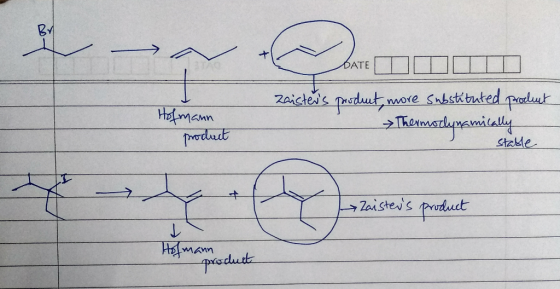
3. (2 pts) Draw all possible elimination products for the following alkyl halides, circle the favored...
S. a) Draw all the possible elimination products from these alkyl halides. b) Circle the major...
 S. a) Draw all the possible elimination products from these alkyl halides. b) Circle the major reaction product in each of parts (i) and (ii) above.
Alkyl Halides: Elimination reaction with (2R,3R)-2-chloro-3-methylpentane Draw the product formed when (2R,3R)-2-chloro-3-methylpentane under-goes an elimination reaction...
Alkyl Halides: Elimination reaction with (2R,3R)-2-chloro-3-methylpentane Draw the product formed when (2R,3R)-2-chloro-3-methylpentane under-goes an elimination reaction with NaOCH3. Alkyl Halides: Elimination reaction with 3-chloro-3-ethyl-2,2-dimethylpentane. Draw the structure of the product that is formed when 3-chloro-3-ethyl-2,2-dimethylpentane undergoes an elimination reaction with NaOCH3. Indicate the stereochemistry of the product. Identify the three products formed when 2-bromo-2-methylpropane is dissolved in a mixture of 80% ethanol and 20% water.
3. Assuming only E, elimination, write structures for all the possible elimination products from each of...
 3. Assuming only E, elimination, write structures for all the possible elimination products from each of the following alkyl halides with reaction mechanisms (show all attacks with arrows): -CI
Draw all possible elimination products or alkyl halide substrate for the following dehydrohalogenation reactions. 0
 Draw all possible elimination products or alkyl halide substrate
for the following dehydrohalogenation reactions.
0
Draw all possible elimination products or alkyl halide substrate
for the following dehydrohalogenation reactions.
0
CHEM 3401 PreLaboratory Assignment, Elimination Reactions of Alkyl Halides, day 2 Due at the beginning of...
 CHEM 3401 PreLaboratory Assignment, Elimination Reactions of Alkyl Halides, day 2 Due at the beginning of the lab period. Reading Assignment from Zubrick, 9th ed.: Reflux, pp. 201-202; Elimination Reactions of Alkyl Halides Experiment, GSU Laboratory Manual 1. What purpose does the water in the Hempel column/condenser serve in the reflux setup? The purpose of the water in the Hemper column] ondenser is too cool vapors before they leave the system, which maintains volume and induces reaction 2. You are...
Draw the possible elimination products formed when the alkyl halide is treated with K-OC(CH). Elimination product...
 Draw the possible elimination products formed when the alkyl halide is treated with K-OC(CH). Elimination product formed when carbon 1 is the ß carbon: draw structure ... Elimination product formed when carbon 2 or 4 is the ß carbon: draw structure...
Alkyl Halides and their Reactions: Nucleophilic Substitution and Elimination l. Predict the major organic product for...
 Alkyl Halides and their Reactions: Nucleophilic Substitution and Elimination l. Predict the major organic product for each of the following. (1 major structure is all that needed in each case). (3 points each) Br CH3ONa CH3CH2ONa (for "d", show elimination product only, there will also be some substitution) NaOH e, optically active (for "e", show substitution product or products only. If both enantiomers form, draw both) Is the product solution for reaction "e" above racemic or optically active? (1 point...
Alkyl Bromide Alkyl Bromide Classification Base Base Classification | % Reaction | % 1-Substituted | %...
 Alkyl Bromide Alkyl Bromide Classification Base Base Classification | % Reaction | % 1-Substituted | % 2-Substituted Yield Alkene Alkene Alkene 90 1.0 M The data above is from a paper published in 1956 in a chemistry journal. Answer the following questions based on the data: 1. Draw the mechanism to show how each alkene product is formed from the alkyl bromide and the base. 2. What does Zaitsev's rule say about double-bonds that are formed in an elimination reaction?...
1. Draw all constitutional isomers formed in the elimination reaction and predict the major product using...
 1. Draw all constitutional isomers formed in the elimination reaction and predict the major product using the Zaitsev rule. A . KOCICH ! KOC(CH) 2. Draw all possible elimination reaction product(s) for the following alkyl halide. 4. Classify the following alkenes as mono, di-, tri, or tetra- substituted alkenes. Then, circle the most stable one. thayo by my 5. Which of the following alkenes is more stable?
1. Rank the alkyl halides in each group in order of increasing E2 reactivity. a. Br...
 1. Rank the alkyl halides in each group in order of increasing E2 reactivity. a. Br Br Br I П III b. Cн, Br Нас CI CH3 П III Rank the alkyl halides in each group of problem one in order of increasing El reactivity. 2. Which elimination reaction in each pair is faster? (I or II) 3. а. сн, Нас. Он Он II. b. HO DMSO он (CH),CCI (CH),CCI П. I. Н.о What alkenes are formed from each alkyl...
 S. a) Draw all the possible elimination products from these alkyl halides. b) Circle the major reaction product in each of parts (i) and (ii) above.
 3. Assuming only E, elimination, write structures for all the possible elimination products from each of the following alkyl halides with reaction mechanisms (show all attacks with arrows): -CI
 Draw all possible elimination products or alkyl halide substrate
for the following dehydrohalogenation reactions.
0
Draw all possible elimination products or alkyl halide substrate
for the following dehydrohalogenation reactions.
0
 CHEM 3401 PreLaboratory Assignment, Elimination Reactions of Alkyl Halides, day 2 Due at the beginning of the lab period. Reading Assignment from Zubrick, 9th ed.: Reflux, pp. 201-202; Elimination Reactions of Alkyl Halides Experiment, GSU Laboratory Manual 1. What purpose does the water in the Hempel column/condenser serve in the reflux setup? The purpose of the water in the Hemper column] ondenser is too cool vapors before they leave the system, which maintains volume and induces reaction 2. You are...
 Draw the possible elimination products formed when the alkyl halide is treated with K-OC(CH). Elimination product formed when carbon 1 is the ß carbon: draw structure ... Elimination product formed when carbon 2 or 4 is the ß carbon: draw structure...
 Alkyl Halides and their Reactions: Nucleophilic Substitution and Elimination l. Predict the major organic product for each of the following. (1 major structure is all that needed in each case). (3 points each) Br CH3ONa CH3CH2ONa (for "d", show elimination product only, there will also be some substitution) NaOH e, optically active (for "e", show substitution product or products only. If both enantiomers form, draw both) Is the product solution for reaction "e" above racemic or optically active? (1 point...
 Alkyl Bromide Alkyl Bromide Classification Base Base Classification | % Reaction | % 1-Substituted | % 2-Substituted Yield Alkene Alkene Alkene 90 1.0 M The data above is from a paper published in 1956 in a chemistry journal. Answer the following questions based on the data: 1. Draw the mechanism to show how each alkene product is formed from the alkyl bromide and the base. 2. What does Zaitsev's rule say about double-bonds that are formed in an elimination reaction?...
 1. Draw all constitutional isomers formed in the elimination reaction and predict the major product using the Zaitsev rule. A . KOCICH ! KOC(CH) 2. Draw all possible elimination reaction product(s) for the following alkyl halide. 4. Classify the following alkenes as mono, di-, tri, or tetra- substituted alkenes. Then, circle the most stable one. thayo by my 5. Which of the following alkenes is more stable?
 1. Rank the alkyl halides in each group in order of increasing E2 reactivity. a. Br Br Br I П III b. Cн, Br Нас CI CH3 П III Rank the alkyl halides in each group of problem one in order of increasing El reactivity. 2. Which elimination reaction in each pair is faster? (I or II) 3. а. сн, Нас. Он Он II. b. HO DMSO он (CH),CCI (CH),CCI П. I. Н.о What alkenes are formed from each alkyl...
Most questions answered within 3 hours.
-
Where is the error in this code sequence?
String s1 = "Hello";
String s2 = "ello";...
asked 10 months ago -
Financial data for Joel de Paris, Inc., for last year
follow:
Joel de Paris, Inc.
Balance...
asked 10 months ago -
Consider this reaction:
Al2(SO4)3 (aq)+ BaCl3
(aq) Al2Cl6 (aq)- +
3BaSO4(s) . What is the...
asked 10 months ago -
Suppose that Savneet is considering increasing her
recent random sample from 20 car rentals to 40...
asked 10 months ago -
Trucks arrive at an unloading terminal at an average rate of 120
per hour.
Trucks arrive...
asked 10 months ago -
Why are methanol and ethanol completely soluble in water while
octanol is not very little soluble....
asked 10 months ago -
A facilities manager at a university reads in a research report
that the mean amount of...
asked 10 months ago -
When the CuSO4 is rehydrated by adding water to the anhydrous
compound, is this an endothermic...
asked 10 months ago -
A ray of sunlight is passing from diamond into crown glass; the
angle of incidence is...
asked 10 months ago -
A block of mass 0.249 kg is placed on top of a light, vertical
spring of...
asked 10 months ago -
how do the kidneys compensate in the presences of acidosis
a) trigger hyperventilate
b) reserve acid...
asked 10 months ago -
Question 501 pts
The rental rate of capital to the firm increases. Which of the
following...
asked 10 months ago