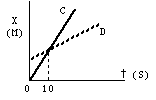
Figure 2-1
At t = 0 s
a) C is moving, and D is at rest.
b) D is moving, and C is at rest.
c) C and D are both moving.
d) C and D are both at rest.
Please explain how you got the answer and any equations you may have used! A step-by-step solution would be very helpful. Thanks!
Homework Answers
At t = 0 s
(b) D is moving, and C is at rest.
Because at t=0 sec. Object C is at origin and object D has already moved from origin.
Figure 2-1 At t = 0 s a) Rider C is ahead of rider D. b)...
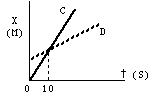 Figure 2-1
At t = 0 s
a) Rider C is ahead of rider D.
b) Rider D is ahead of rider C.
c) Rider C and D are at the same position.
Please explain how you got the answer and any equations you may
have used! A step-by-step solution would be very helpful.
Thanks!
Figure 2-1
At t = 0 s
a) Rider C is ahead of rider D.
b) Rider D is ahead of rider C.
c) Rider C and D are at the same position.
Please explain how you got the answer and any equations you may
have used! A step-by-step solution would be very helpful.
Thanks!
An object of mass m is at rest in equilibrium at the origin. At t=0 a...
An object of mass m is at rest in equilibrium at the origin. At t=0 a new force F⃗ (t) is applied that has components Fx(t)=k1+k2y,Fy(t)=k3t, where k1, k2, and k3 are constants. Part A Calculate the position r⃗ (t) vector as function of time. Part B Calculate the velocity v⃗ (t) vector as function of time. I know that you have to derive to figure out these equations im just not sure where to start, help would be much...
7. Two positive charges Q positioned at (0,d/2) in vacuum experience a repelling force of 4περα2 when they are at rest,...
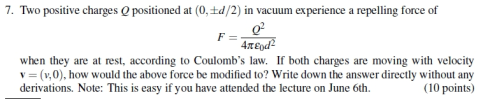 7. Two positive charges Q positioned at (0,d/2) in vacuum experience a repelling force of 4περα2 when they are at rest, according to Coulomb's law. If both charges are moving with velocity v (v,0), how would the above force be modified to? Write down the answer directly without any derivations. Note: This is easy if you have attended the lecture on June 6th (10 points)
7. Two positive charges Q positioned at (0,d/2) in vacuum experience a repelling force of...
7. Two positive charges Q positioned at (0,d/2) in vacuum experience a repelling force of 4περα2 when they are at rest, according to Coulomb's law. If both charges are moving with velocity v (v,0), how would the above force be modified to? Write down the answer directly without any derivations. Note: This is easy if you have attended the lecture on June 6th (10 points)
7. Two positive charges Q positioned at (0,d/2) in vacuum experience a repelling force of...
A body is at rest on the ground. At t = 0 s, a force is...
A body is at rest on the ground. At t = 0 s, a force is applied on the body causing it to have a constant acceleration of a = 3 m/s^2 upwards. At t = 15 s, the force stops. (You may ignore air resistance in your calculations) a. What is the height of the body at t = 15 s? b. What is the maximum height the body reaches, and what is time at that point? c. How...
Question 3 (35 marks) Consider a mechanical system shown in Figure 3. The system is at rest for t
 Question 3 (35 marks) Consider a mechanical system shown in Figure 3. The system is at rest for t<0. The input force f is applied at 0. The displacement x is the output of the system and is measured from the equilibrium position. kI b2 bi it Figure 3. Schematic of a mechanical system. (a) Obtain the traf) (10 marks) X (s) F(s) (b) Use of force-voltage analogy, obtain the equations for an electrical system (5 marks) (c) Draw a...
Find K r" = kt r = 1 t = 0 r = 2 t =3...
 Find K
r" = kt
r = 1 t = 0
r = 2 t =3
Imagine that you are an engineer working in à mahufaclug created a machine that is used to adhere one part to another. Figure 2 shows Part A being adhered to Part B. You will assume that you have constrained the manipulator such that 0 for all time. Additionally, you will control the acceleration of the end-point of the manipulator, and this expression is given...
Find K
r" = kt
r = 1 t = 0
r = 2 t =3
Imagine that you are an engineer working in à mahufaclug created a machine that is used to adhere one part to another. Figure 2 shows Part A being adhered to Part B. You will assume that you have constrained the manipulator such that 0 for all time. Additionally, you will control the acceleration of the end-point of the manipulator, and this expression is given...
At t=0, the 3.00-kg mass of Figure 5.27 is moving to the left on the frictionless...
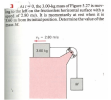 At t=0, the 3.00-kg mass of Figure 5.27 is moving to the left on
the frictionless horizontal surface with a speed of 2.80m/s. It is
momentarily at rest when it is 5.60m from its initial position.
Determine the value of the mass M.
3 Att0, the 3.00-kg mass of Figure 5.27 is mov- ing to the left on the frictionless horizontal surface with a speed of 2.80 m/s. It is momentarily at rest when it is 5.60 m from its...
At t=0, the 3.00-kg mass of Figure 5.27 is moving to the left on
the frictionless horizontal surface with a speed of 2.80m/s. It is
momentarily at rest when it is 5.60m from its initial position.
Determine the value of the mass M.
3 Att0, the 3.00-kg mass of Figure 5.27 is mov- ing to the left on the frictionless horizontal surface with a speed of 2.80 m/s. It is momentarily at rest when it is 5.60 m from its...
Im trying to figure out how to do these three questions, im not positive of the...
 Im trying to figure out how to do these three questions, im not
positive of the formulas and cant find them in my notes. I did come
up with an answer for number 20. but im not positive if i worked
thru it right or not. i converted N to lbs (8) then got an answer
of 7.4 seconds, if thats right please let me know, if it isnt maybe
you can help me with where i may have gone...
Im trying to figure out how to do these three questions, im not
positive of the formulas and cant find them in my notes. I did come
up with an answer for number 20. but im not positive if i worked
thru it right or not. i converted N to lbs (8) then got an answer
of 7.4 seconds, if thats right please let me know, if it isnt maybe
you can help me with where i may have gone...
The parameters are as follows k=0.1,a=1.00,b=1,c=1.0,d=25,w_1=20,w_2=25,Kv=50 e(t) r(t) e (t) G(s) Figure 1: Feedback...
 The parameters are as follows
k=0.1,a=1.00,b=1,c=1.0,d=25,w_1=20,w_2=25,Kv=50
e(t) r(t) e (t) G(s) Figure 1: Feedback control system A pulley and belt transmission has a linearized relationship between the driven pulley angle e (t) in degrees and the input torque u(t) in Newton meters given by the following differential equation du(t) dt A feedback control system (illustrated in Figure 1) needs to be designed such that the closed-loop system is asymptotically stable and such that the following design criteria are met 1....
The parameters are as follows
k=0.1,a=1.00,b=1,c=1.0,d=25,w_1=20,w_2=25,Kv=50
e(t) r(t) e (t) G(s) Figure 1: Feedback control system A pulley and belt transmission has a linearized relationship between the driven pulley angle e (t) in degrees and the input torque u(t) in Newton meters given by the following differential equation du(t) dt A feedback control system (illustrated in Figure 1) needs to be designed such that the closed-loop system is asymptotically stable and such that the following design criteria are met 1....
I T ILL 3: A motorcycle begins at rest at t=0 seconds. The motorcycle starts moving,...
 I T ILL 3: A motorcycle begins at rest at t=0 seconds. The motorcycle starts moving, and eventually covers a distance d=880 m, in a time = 108 s. In a coordinate system with north being the positive x-direction, the motorcycle's motion is in the northern direction (see figure). V south(-x) north(x) time, 60 Otheexpertta.com 25% Part() What was the motorcycle's average speed, ve, during this period, in meters per second? A 25% Part (b) What was the motorcycle's displacement...
 Figure 2-1
At t = 0 s
a) Rider C is ahead of rider D.
b) Rider D is ahead of rider C.
c) Rider C and D are at the same position.
Please explain how you got the answer and any equations you may
have used! A step-by-step solution would be very helpful.
Thanks!
Figure 2-1
At t = 0 s
a) Rider C is ahead of rider D.
b) Rider D is ahead of rider C.
c) Rider C and D are at the same position.
Please explain how you got the answer and any equations you may
have used! A step-by-step solution would be very helpful.
Thanks!
 7. Two positive charges Q positioned at (0,d/2) in vacuum experience a repelling force of 4περα2 when they are at rest, according to Coulomb's law. If both charges are moving with velocity v (v,0), how would the above force be modified to? Write down the answer directly without any derivations. Note: This is easy if you have attended the lecture on June 6th (10 points)
7. Two positive charges Q positioned at (0,d/2) in vacuum experience a repelling force of...
7. Two positive charges Q positioned at (0,d/2) in vacuum experience a repelling force of 4περα2 when they are at rest, according to Coulomb's law. If both charges are moving with velocity v (v,0), how would the above force be modified to? Write down the answer directly without any derivations. Note: This is easy if you have attended the lecture on June 6th (10 points)
7. Two positive charges Q positioned at (0,d/2) in vacuum experience a repelling force of...
 Question 3 (35 marks) Consider a mechanical system shown in Figure 3. The system is at rest for t<0. The input force f is applied at 0. The displacement x is the output of the system and is measured from the equilibrium position. kI b2 bi it Figure 3. Schematic of a mechanical system. (a) Obtain the traf) (10 marks) X (s) F(s) (b) Use of force-voltage analogy, obtain the equations for an electrical system (5 marks) (c) Draw a...
 Find K
r" = kt
r = 1 t = 0
r = 2 t =3
Imagine that you are an engineer working in à mahufaclug created a machine that is used to adhere one part to another. Figure 2 shows Part A being adhered to Part B. You will assume that you have constrained the manipulator such that 0 for all time. Additionally, you will control the acceleration of the end-point of the manipulator, and this expression is given...
Find K
r" = kt
r = 1 t = 0
r = 2 t =3
Imagine that you are an engineer working in à mahufaclug created a machine that is used to adhere one part to another. Figure 2 shows Part A being adhered to Part B. You will assume that you have constrained the manipulator such that 0 for all time. Additionally, you will control the acceleration of the end-point of the manipulator, and this expression is given...
 At t=0, the 3.00-kg mass of Figure 5.27 is moving to the left on
the frictionless horizontal surface with a speed of 2.80m/s. It is
momentarily at rest when it is 5.60m from its initial position.
Determine the value of the mass M.
3 Att0, the 3.00-kg mass of Figure 5.27 is mov- ing to the left on the frictionless horizontal surface with a speed of 2.80 m/s. It is momentarily at rest when it is 5.60 m from its...
At t=0, the 3.00-kg mass of Figure 5.27 is moving to the left on
the frictionless horizontal surface with a speed of 2.80m/s. It is
momentarily at rest when it is 5.60m from its initial position.
Determine the value of the mass M.
3 Att0, the 3.00-kg mass of Figure 5.27 is mov- ing to the left on the frictionless horizontal surface with a speed of 2.80 m/s. It is momentarily at rest when it is 5.60 m from its...
 Im trying to figure out how to do these three questions, im not
positive of the formulas and cant find them in my notes. I did come
up with an answer for number 20. but im not positive if i worked
thru it right or not. i converted N to lbs (8) then got an answer
of 7.4 seconds, if thats right please let me know, if it isnt maybe
you can help me with where i may have gone...
Im trying to figure out how to do these three questions, im not
positive of the formulas and cant find them in my notes. I did come
up with an answer for number 20. but im not positive if i worked
thru it right or not. i converted N to lbs (8) then got an answer
of 7.4 seconds, if thats right please let me know, if it isnt maybe
you can help me with where i may have gone...
 The parameters are as follows
k=0.1,a=1.00,b=1,c=1.0,d=25,w_1=20,w_2=25,Kv=50
e(t) r(t) e (t) G(s) Figure 1: Feedback control system A pulley and belt transmission has a linearized relationship between the driven pulley angle e (t) in degrees and the input torque u(t) in Newton meters given by the following differential equation du(t) dt A feedback control system (illustrated in Figure 1) needs to be designed such that the closed-loop system is asymptotically stable and such that the following design criteria are met 1....
The parameters are as follows
k=0.1,a=1.00,b=1,c=1.0,d=25,w_1=20,w_2=25,Kv=50
e(t) r(t) e (t) G(s) Figure 1: Feedback control system A pulley and belt transmission has a linearized relationship between the driven pulley angle e (t) in degrees and the input torque u(t) in Newton meters given by the following differential equation du(t) dt A feedback control system (illustrated in Figure 1) needs to be designed such that the closed-loop system is asymptotically stable and such that the following design criteria are met 1....
 I T ILL 3: A motorcycle begins at rest at t=0 seconds. The motorcycle starts moving, and eventually covers a distance d=880 m, in a time = 108 s. In a coordinate system with north being the positive x-direction, the motorcycle's motion is in the northern direction (see figure). V south(-x) north(x) time, 60 Otheexpertta.com 25% Part() What was the motorcycle's average speed, ve, during this period, in meters per second? A 25% Part (b) What was the motorcycle's displacement...
Most questions answered within 3 hours.
-
Where is the error in this code sequence?
String s1 = "Hello";
String s2 = "ello";...
asked 11 months ago -
Financial data for Joel de Paris, Inc., for last year
follow:
Joel de Paris, Inc.
Balance...
asked 11 months ago -
Consider this reaction:
Al2(SO4)3 (aq)+ BaCl3
(aq) Al2Cl6 (aq)- +
3BaSO4(s) . What is the...
asked 11 months ago -
Suppose that Savneet is considering increasing her
recent random sample from 20 car rentals to 40...
asked 11 months ago -
Trucks arrive at an unloading terminal at an average rate of 120
per hour.
Trucks arrive...
asked 11 months ago -
Why are methanol and ethanol completely soluble in water while
octanol is not very little soluble....
asked 11 months ago -
A facilities manager at a university reads in a research report
that the mean amount of...
asked 11 months ago -
When the CuSO4 is rehydrated by adding water to the anhydrous
compound, is this an endothermic...
asked 11 months ago -
A ray of sunlight is passing from diamond into crown glass; the
angle of incidence is...
asked 11 months ago -
A block of mass 0.249 kg is placed on top of a light, vertical
spring of...
asked 11 months ago -
how do the kidneys compensate in the presences of acidosis
a) trigger hyperventilate
b) reserve acid...
asked 11 months ago -
Question 501 pts
The rental rate of capital to the firm increases. Which of the
following...
asked 11 months ago