


Homework Answers
Add Answer to:
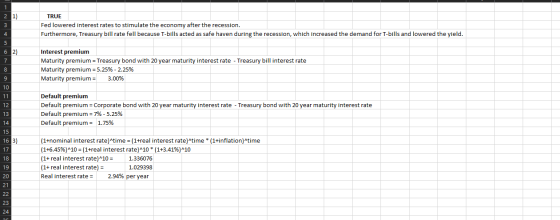
Q1:
Q2
Q3:
The historically low Treasury bill rates between 2008 and 2013 reflect the Federal...
Inflation and interest rates The following table shows the average nominal interest rates on six-month Treasury bills between 2004 and 2008
 4. Inflation and interest rates The following table shows the average nominal interest rates on six-month Treasury bills between 2004 and 2008, which determined the nominal interest rate that the U.S. government paid when it issued debt in those years. The table also shows the inflation rate for the years 2004 to 2008. (All rates are rounded to the nearest tenth of a percent.)On the following graph, use the orange points (square symbol) to plot the nominal interest rates for...
Answer the next 3 questions based on the following information: Assume that3-month Treasury bill are yielding...
 Answer the next 3 questions based on the following information: Assume that3-month Treasury bill are yielding 1.4%, 10-year Treasury bonds are yielding 2.8%, an Aaa-rated 10-year corporate bond is 5%, and real risk-free rate is 1%. 18) What is the inflation risk premium for 3-month Treasury b ill? (Hint: the inte rest rate of 3-month Treasury bill is a proxy for risk-free rate) A) 1.8% B) 1.4% C) 1% D) 0.4% 19) What is the maturity risk premium for 10-year...
From 1991 to 2000, the U.S. economy had an annual inflation rate of around 2.93%. The...
From 1991 to 2000, the U.S. economy had an annual inflation rate of around 2.93%. The historical annual nominal risk-free rate for this same period was around 5.02%. Using the approximate nominal interest rate equation and the true nominal interest rate equation, compute the real interest rate for that decade. What is the estimated real interest rate using the approximate nominal interest rate equation for that decade?
1) For U.S. Treasury bonds, what type of risk exists when rates are historically low? _______...
1) For U.S. Treasury bonds, what type of risk exists when rates are historically low? _______ A) Gap risk B) Interest-rate risk C) Default risk D) Reinvestment risk 2) Which of the following institutions assign ratings for bonds in the United States? _______ A) The Securities and Exchange Commission B) The Federal Reserve District Banks C) The U.S. Treasury D) Private companies such as Moody’s and Fitch 3) If the three-month Treasury bill yields 3.1% while the yield on a...
3. Calculating interest rates The real risk-free rate (r) is 2.80% and is expected to remain...
 3. Calculating interest rates The real risk-free rate (r) is 2.80% and is expected to remain constant into the future. Inflation is expected to be 3.20% per year for each of the next four years and 2.00% thereafter. The maturity risk premium (MRP) is determined from the formula: 0.10 x(t-1)%, where is the security's maturity. The liquidity premium (LP) on all Tahoe Hydroponics's bonds is 0.60%. The following table shows the current relationship between bond ratings and default risk premiums...
Some agreed-upon procedures related to generating estimates for key variables in equation (2-1) follow. a. The...
Some agreed-upon procedures related to generating estimates for key variables in equation (2-1) follow. a. The current 3-month Treasury bill rate is 3.05 percent, the 30-year Treasury bond rate is 5.32 percent, the 30-year Aaa-rated corporate bond rate is 6.74 percent, and the inflation rate is 2.33 percent . b. The real risk-free rate of interest is the difference between the calculated average yield on 3-month Treasury bills and the inflation rate. c. The default-risk premium is estimated by the...
3. Calculating interest rates The real risk-free rate (r*) is 2.8% and is expected to remain...
 3. Calculating interest rates The real risk-free rate (r*) is 2.8% and is expected to remain constant. Inflation is expected to be 5% per year for each of the next two years and 4% thereafter. The maturity risk premium (MRP) is determined from the formula: 0.1(t - 1)%, where t is the security's maturity. The liquidity premium (LP) on all Harrington Horticulture Co.'s bonds is 0.55%. The following table shows the current relationship between bond ratings and default risk premiums...
drop down option the same for all questions Which tend to be more volatile, short- or...
 drop down option the same for all questions
Which tend to be more volatile, short- or long-term interest rates? Long-term interest rates Short-term interest rates If the inflation rate was 2.60% and the nominal interest rate was 6.00% over the last year, what was the real rate of interest over the last year? Disregard cross-product terms; that is, if averaging is required, use the arithmetic average. O 3.40% 3.91% 2.89% 4.25% Component Symbol Characteristic This is the rate for a...
drop down option the same for all questions
Which tend to be more volatile, short- or long-term interest rates? Long-term interest rates Short-term interest rates If the inflation rate was 2.60% and the nominal interest rate was 6.00% over the last year, what was the real rate of interest over the last year? Disregard cross-product terms; that is, if averaging is required, use the arithmetic average. O 3.40% 3.91% 2.89% 4.25% Component Symbol Characteristic This is the rate for a...
23. (a) = 4% You are given the following data for a corporate bond in a...
 23. (a) = 4% You are given the following data for a corporate bond in a particular economy: r* = real risk-free rate Inflation premium Maturity risk premium = 1% Default risk premium Liquidity premium = 7% = 3% = 2% Assume that a highly liquid market does not exist for long-term Treasury bonds in that economy, and the expected rate of inflation is constant. Given these conditions find the appropriate rates for a Treasury bill and a long-term Treasury...
Assignment 06 - Interest Rates 4. Calculating interest rates Aa Aa The real risk-free rate (r*)...
 Assignment 06 - Interest Rates 4. Calculating interest rates Aa Aa The real risk-free rate (r*) is 2.8% and is expected to remain constant. Inflation is expected to be 6% per year for each of the next two years and 5% thereafter. The maturity risk premium (MRP) is determined from the formula: 0.1(t - 1)%, where t is the security's maturity. The liquidity premium (LP) on all Global Satellite Corp.'s bonds is 0.55%. The following table shows the current relationship...
 4. Inflation and interest rates The following table shows the average nominal interest rates on six-month Treasury bills between 2004 and 2008, which determined the nominal interest rate that the U.S. government paid when it issued debt in those years. The table also shows the inflation rate for the years 2004 to 2008. (All rates are rounded to the nearest tenth of a percent.)On the following graph, use the orange points (square symbol) to plot the nominal interest rates for...
 Answer the next 3 questions based on the following information: Assume that3-month Treasury bill are yielding 1.4%, 10-year Treasury bonds are yielding 2.8%, an Aaa-rated 10-year corporate bond is 5%, and real risk-free rate is 1%. 18) What is the inflation risk premium for 3-month Treasury b ill? (Hint: the inte rest rate of 3-month Treasury bill is a proxy for risk-free rate) A) 1.8% B) 1.4% C) 1% D) 0.4% 19) What is the maturity risk premium for 10-year...
 3. Calculating interest rates The real risk-free rate (r) is 2.80% and is expected to remain constant into the future. Inflation is expected to be 3.20% per year for each of the next four years and 2.00% thereafter. The maturity risk premium (MRP) is determined from the formula: 0.10 x(t-1)%, where is the security's maturity. The liquidity premium (LP) on all Tahoe Hydroponics's bonds is 0.60%. The following table shows the current relationship between bond ratings and default risk premiums...
 3. Calculating interest rates The real risk-free rate (r*) is 2.8% and is expected to remain constant. Inflation is expected to be 5% per year for each of the next two years and 4% thereafter. The maturity risk premium (MRP) is determined from the formula: 0.1(t - 1)%, where t is the security's maturity. The liquidity premium (LP) on all Harrington Horticulture Co.'s bonds is 0.55%. The following table shows the current relationship between bond ratings and default risk premiums...
 drop down option the same for all questions
Which tend to be more volatile, short- or long-term interest rates? Long-term interest rates Short-term interest rates If the inflation rate was 2.60% and the nominal interest rate was 6.00% over the last year, what was the real rate of interest over the last year? Disregard cross-product terms; that is, if averaging is required, use the arithmetic average. O 3.40% 3.91% 2.89% 4.25% Component Symbol Characteristic This is the rate for a...
drop down option the same for all questions
Which tend to be more volatile, short- or long-term interest rates? Long-term interest rates Short-term interest rates If the inflation rate was 2.60% and the nominal interest rate was 6.00% over the last year, what was the real rate of interest over the last year? Disregard cross-product terms; that is, if averaging is required, use the arithmetic average. O 3.40% 3.91% 2.89% 4.25% Component Symbol Characteristic This is the rate for a...
 23. (a) = 4% You are given the following data for a corporate bond in a particular economy: r* = real risk-free rate Inflation premium Maturity risk premium = 1% Default risk premium Liquidity premium = 7% = 3% = 2% Assume that a highly liquid market does not exist for long-term Treasury bonds in that economy, and the expected rate of inflation is constant. Given these conditions find the appropriate rates for a Treasury bill and a long-term Treasury...
 Assignment 06 - Interest Rates 4. Calculating interest rates Aa Aa The real risk-free rate (r*) is 2.8% and is expected to remain constant. Inflation is expected to be 6% per year for each of the next two years and 5% thereafter. The maturity risk premium (MRP) is determined from the formula: 0.1(t - 1)%, where t is the security's maturity. The liquidity premium (LP) on all Global Satellite Corp.'s bonds is 0.55%. The following table shows the current relationship...
Most questions answered within 3 hours.
-
Where is the error in this code sequence?
String s1 = "Hello";
String s2 = "ello";...
asked 11 months ago -
Financial data for Joel de Paris, Inc., for last year
follow:
Joel de Paris, Inc.
Balance...
asked 11 months ago -
Consider this reaction:
Al2(SO4)3 (aq)+ BaCl3
(aq) Al2Cl6 (aq)- +
3BaSO4(s) . What is the...
asked 11 months ago -
Suppose that Savneet is considering increasing her
recent random sample from 20 car rentals to 40...
asked 11 months ago -
Trucks arrive at an unloading terminal at an average rate of 120
per hour.
Trucks arrive...
asked 11 months ago -
Why are methanol and ethanol completely soluble in water while
octanol is not very little soluble....
asked 11 months ago -
A facilities manager at a university reads in a research report
that the mean amount of...
asked 11 months ago -
When the CuSO4 is rehydrated by adding water to the anhydrous
compound, is this an endothermic...
asked 11 months ago -
A ray of sunlight is passing from diamond into crown glass; the
angle of incidence is...
asked 11 months ago -
A block of mass 0.249 kg is placed on top of a light, vertical
spring of...
asked 11 months ago -
how do the kidneys compensate in the presences of acidosis
a) trigger hyperventilate
b) reserve acid...
asked 11 months ago -
Question 501 pts
The rental rate of capital to the firm increases. Which of the
following...
asked 11 months ago