
Homework Answers
Add Answer to:
7. Calculation of the Amount of Energy Given Off in a Combustion Reaction Section PreLab Questions...
7. Calculation of the Amount of Energy Given Off in a Combustion Reaction Section PreLab Questions...
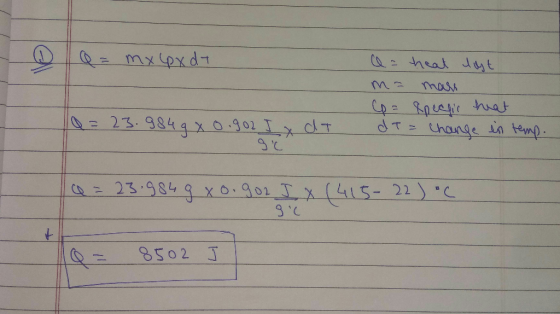
 7. Calculation of the Amount of Energy Given Off in a Combustion Reaction Section PreLab Questions 1. Aluminum has a specific heat of 0.902 J/g x °C. How much heat is lost when a piece of aluminum with a mass of 23.984 g cools from a temperature of 415.0 °C to a temperature of 22.0 °C? = 8.50215 2. The temperature of a sample of water increases by 69.5 °C when 24 500 J are applied. The specific heat of...
Heat Flow and Calorimetry Prelab Questions Section: Name: 1. Prepare for It! Prelab Question A A...
 Heat Flow and Calorimetry Prelab Questions Section: Name: 1. Prepare for It! Prelab Question A A 235.0 g sample of metal is heated to 100.0C and poured into a calorimeter containing 50.0 g of water at 20.5°c. The equilibrium temperature of the water and metal is 30.5 C. Using the specific heat of water, 4.18 J/goC, determine the specific heat of the metal from equation 3. Use equation 5 to find the approximate molar mass of the metal. Show your...
8.502 1S . The temperature of a sample of water increases by 69.5 °C when 24...
 8.502 1S . The temperature of a sample of water increases by 69.5 °C when 24 500 J are applied. The specific heat of liquid water is 4.18 J/g x °C. What is the mass of the sample of water? m q/(AT)Cp
A hot piece of aluminum weighing 50.0 grams at 350°C is dropped into 500. grams of...
A hot piece of aluminum weighing 50.0 grams at 350°C is dropped into 500. grams of water at 22.0°C. What is the final temperature of the water? The specific heat of aluminum is 0.902 J/g°C and that of water is 4.184 J/g°C.
1. Prepare for It! Prelab Question A A 235.0 g sample of metal is heated to...
 1. Prepare for It! Prelab Question A A 235.0 g sample of metal is heated to 100.0°C and poured into a calorimeter containing 50.0 g of water at 20.5°C. The equilibrium temperature of the water and metal is 30.5°C. Using the specific heat of water, 4.18 J/g C, determine the specific heat of the metal from equation 3. Use equation 5 to find the approximate molar mass of the metal. Show your work! Use back if needed. 2. Prepare for...
CHM 2045L- Heat Effects and Calorimetry Post-Lab Sheet: Heat Effects and Calorimetry Name: Show calculations for...
 CHM 2045L- Heat Effects and Calorimetry Post-Lab Sheet: Heat Effects and Calorimetry Name: Show calculations for credit. Be mindful of significant figures. 1. A piece of aluminum with a mass of 32.5 g is heated to 674°C and put into a Syru foam calonnea containing 582 g of water that is initially at 212℃ Assuming no heat is lost, what is the final temperature? The specific heat of aluminum is 0.902 J/g'C; for water 4.18 J/gC. (6 pt.)
B. When 34 700 J of heat are applied to a 350 g sample of an...
 B. When 34 700 J of heat are applied to a 350 g sample of an unknown material, the temperature rises from 22.0 °C to 173.0 °C. What must be the specific heat of this material? 2. A barometer measures a pressure of 745 mm Hg. What is this pressure in atm? 0.980 atm d. 1.00 x 10 atm a. b. 1.02 atm 0.556 atm е. 1.03 x 10 atm с.
1a) Consider the reaction: C12H22O11(s)+12O2(g)→12CO2(g)+11H2O(l) in which 10.0 g of sucrose, C12H22O11, was burned in a...
1a) Consider the reaction: C12H22O11(s)+12O2(g)→12CO2(g)+11H2O(l) in which 10.0 g of sucrose, C12H22O11, was burned in a bomb calorimeter with a heat capacity of 7.50 kJ/∘C. The temperature increase inside the calorimeter was found to be 22.0 ∘C. What is the heat of this reaction per mole of sucrose? 1b) One tablespoon of peanut butter has a mass of 17.0 g. It is combusted in a calorimeter whose heat capacity is 110 kJ/°C. The temperature of the calorimeter rises from 21.6...
What is the amount of heat, in calories, given off from a 5 g piece of...
What is the amount of heat, in calories, given off from a 5 g piece of aluminum when it cools from 80°C to 20°C? The specific heat capacity of aluminum is 0.215 cal/g∙°C. Show your work.
3. Calculate the heat absorbed by 25.0 g of water needed to raise its temperature from 20.0°C to 65.0'C. The specif...
 3. Calculate the heat absorbed by 25.0 g of water needed to raise its temperature from 20.0°C to 65.0'C. The specific heat of water is 4.18 J/gºC. Show your work Final Answer 4. Aluminum metal has a specific heat of 0.901 J/g C. How much heat is transferred to a 6.75 g piece of aluminum initially at room temperature, 20.0°C, when it is placed into boiling water? The temperature of boiling water is 100°C. Show your work Final Answer 5....
 7. Calculation of the Amount of Energy Given Off in a Combustion Reaction Section PreLab Questions 1. Aluminum has a specific heat of 0.902 J/g x °C. How much heat is lost when a piece of aluminum with a mass of 23.984 g cools from a temperature of 415.0 °C to a temperature of 22.0 °C? = 8.50215 2. The temperature of a sample of water increases by 69.5 °C when 24 500 J are applied. The specific heat of...
 Heat Flow and Calorimetry Prelab Questions Section: Name: 1. Prepare for It! Prelab Question A A 235.0 g sample of metal is heated to 100.0C and poured into a calorimeter containing 50.0 g of water at 20.5°c. The equilibrium temperature of the water and metal is 30.5 C. Using the specific heat of water, 4.18 J/goC, determine the specific heat of the metal from equation 3. Use equation 5 to find the approximate molar mass of the metal. Show your...
 8.502 1S . The temperature of a sample of water increases by 69.5 °C when 24 500 J are applied. The specific heat of liquid water is 4.18 J/g x °C. What is the mass of the sample of water? m q/(AT)Cp
 1. Prepare for It! Prelab Question A A 235.0 g sample of metal is heated to 100.0°C and poured into a calorimeter containing 50.0 g of water at 20.5°C. The equilibrium temperature of the water and metal is 30.5°C. Using the specific heat of water, 4.18 J/g C, determine the specific heat of the metal from equation 3. Use equation 5 to find the approximate molar mass of the metal. Show your work! Use back if needed. 2. Prepare for...
 CHM 2045L- Heat Effects and Calorimetry Post-Lab Sheet: Heat Effects and Calorimetry Name: Show calculations for credit. Be mindful of significant figures. 1. A piece of aluminum with a mass of 32.5 g is heated to 674°C and put into a Syru foam calonnea containing 582 g of water that is initially at 212℃ Assuming no heat is lost, what is the final temperature? The specific heat of aluminum is 0.902 J/g'C; for water 4.18 J/gC. (6 pt.)
 B. When 34 700 J of heat are applied to a 350 g sample of an unknown material, the temperature rises from 22.0 °C to 173.0 °C. What must be the specific heat of this material? 2. A barometer measures a pressure of 745 mm Hg. What is this pressure in atm? 0.980 atm d. 1.00 x 10 atm a. b. 1.02 atm 0.556 atm е. 1.03 x 10 atm с.
 3. Calculate the heat absorbed by 25.0 g of water needed to raise its temperature from 20.0°C to 65.0'C. The specific heat of water is 4.18 J/gºC. Show your work Final Answer 4. Aluminum metal has a specific heat of 0.901 J/g C. How much heat is transferred to a 6.75 g piece of aluminum initially at room temperature, 20.0°C, when it is placed into boiling water? The temperature of boiling water is 100°C. Show your work Final Answer 5....
Most questions answered within 3 hours.
-
Where is the error in this code sequence?
String s1 = "Hello";
String s2 = "ello";...
asked 11 months ago -
Financial data for Joel de Paris, Inc., for last year
follow:
Joel de Paris, Inc.
Balance...
asked 11 months ago -
Consider this reaction:
Al2(SO4)3 (aq)+ BaCl3
(aq) Al2Cl6 (aq)- +
3BaSO4(s) . What is the...
asked 11 months ago -
Suppose that Savneet is considering increasing her
recent random sample from 20 car rentals to 40...
asked 11 months ago -
Trucks arrive at an unloading terminal at an average rate of 120
per hour.
Trucks arrive...
asked 11 months ago -
Why are methanol and ethanol completely soluble in water while
octanol is not very little soluble....
asked 11 months ago -
A facilities manager at a university reads in a research report
that the mean amount of...
asked 11 months ago -
When the CuSO4 is rehydrated by adding water to the anhydrous
compound, is this an endothermic...
asked 11 months ago -
A ray of sunlight is passing from diamond into crown glass; the
angle of incidence is...
asked 11 months ago -
A block of mass 0.249 kg is placed on top of a light, vertical
spring of...
asked 11 months ago -
how do the kidneys compensate in the presences of acidosis
a) trigger hyperventilate
b) reserve acid...
asked 11 months ago -
Question 501 pts
The rental rate of capital to the firm increases. Which of the
following...
asked 11 months ago