
Homework Answers
CH3COOH is an acid so it reacts with OH- to form aconjugate base
CH3COOH + OH- --------------> CH3COO- + H2O
CH3CH2NH2 is a base. so reaction with OH- ( a base)
CH3CH2NH3+ is a conjugate acid so reacts with basic OH-
CH3CH2NH3+ + OH- --------------> CH3CH2NH2 + H2O
CH3C= CH is very, very weak acid and OH- is not sufficiently basic to remove the proton from it. so ther is no reaction between them.
To remove acetylenic proton we use strong bases like NH2- or H-.
Add Answer to:
1. Circle the compounds that will react with Hot and explain your choice(s). CH,COOH CH,CH2NH2 CH3CH2NH...
please explain the work ch of the following pairs of organic molecules or lons, circle the...
 please explain the work
ch of the following pairs of organic molecules or lons, circle the one that is the better nucleophile, and briefly explain your choice. for each of the Holon von Hello "es-CN vs. oo-on H₂C NH₂ vs. Ha Ha H₃CNH2 4. For each of the following pairs of organic molecules, circle the one that would react with a given nucleophile at a faster rate in the Su2 reaction, and briefly explain your choice. amor
please explain the work
ch of the following pairs of organic molecules or lons, circle the one that is the better nucleophile, and briefly explain your choice. for each of the Holon von Hello "es-CN vs. oo-on H₂C NH₂ vs. Ha Ha H₃CNH2 4. For each of the following pairs of organic molecules, circle the one that would react with a given nucleophile at a faster rate in the Su2 reaction, and briefly explain your choice. amor
1. Given: K. for CH,COOH - 1.8x10⁶ 50 mL of 0.1 M CH,COOH is titrated with...
 1. Given: K. for CH,COOH - 1.8x10⁶ 50 mL of 0.1 M CH,COOH is titrated with 0.1 M NaOH (a) Write down the balanced neutralization equation: Answer: - (ii) (iii) (iv) no. of mole of CH,COOH How many mole of NaOH is needed to react with the no. of mole of CH,COOH found in (11)? From your answer in (ili), find the volume of NaOH needed to reach the equivalent point (b) What is the initial pH? (before the addition...
D Question 9 6 pts Name the functional group in the following compounds: CH-S A) CH.CH...
 D Question 9 6 pts Name the functional group in the following compounds: CH-S A) CH.CH CH, i B) CH-C-CHÚC- N-H CH CH,CH CH3 C)CH3--0-0-CH2CH CH3 HTML Editor BIVA-A-I EI 1 1 XX, ET 12pt Paragraph x V
7. Circle the compounds that could be successfully react with a Grignard reagent as substrates in...
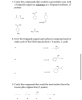 7. Circle the compounds that could be successfully react with a Grignard reagent as substrates in a Grignard synthesis. (5 points) 에 HC) O CH₂ H₃CC-CH3 8. Give the Grignard reagent and carbonyl compound need to make each of the following alcohols. (6 points, 2 each) 9. Circle the compound that would be most acidic (have the lowest pKa, highest Ka) (5 points)
Predict the products, if any, of the following reactions. COOH (1) LiAlH (2) H2O* (b) CH...
 Predict the products, if any, of the following reactions. COOH (1) LiAlH (2) H2O* (b) CH B (1) NaCN (2) 40*, heat (1) SOCI2 (a) oct-4-ino KMnO4 H20 (warm , conc.) (2) AICI COOH Ph 10 O Na,Cr,O, H,SO4 BH CH,OHN_C6:0, 14,50. CHCH.–CH-COOH BH, CH,OH (1) CH,CH, -CH-COOH CH,OH KMnO4, H2O (warm, conc.) KMnO,H,O (hot , conc.)
2. For the set of molecules shown circle the strongest acid and explain your selection. FH,CH,CH,CH,CH,...
 2. For the set of molecules shown circle the strongest acid and explain your selection. FH,CH,CH,CH,CH, C OH H2CH2CH2CH,C(F)HCOH HCHC(F)HCH,CH, COH 3. For the set of molecules shown circle the strongest acid and explain your selection, OP F₃CH₂ cse HẠCHỤC H3CH2C- 20% 3CH₂C-5-00
General Module 1. Identify the fumily of each of the following compounds b) CH, CH,O CH,...
 General Module 1. Identify the fumily of each of the following compounds b) CH, CH,O CH, CH, CH, 2. Write siructural formulas for the following compounds: s a) 3-chloro-2-methylheptanal @ d) 3-methyl-4-hexene-2-ol II-H cz 3. Which of the following are nonsaponifiable lipids? i) waxes j) leukotrienes k) plasmalogens a) triacylglycerols b) oils c) sphingomyelins d) steroids c) terpenes f)" sphyngolipids g) glycolipids h) prostoglandins 4. Write the equation showing triacylglycerol from glycerol and oleic, palmitic and stearic acids 5. Point...
1. Unsopropylacetylene 7.7 Name the following compounds: CH3 COOH СІ ОН NH2 Br Br CH3CH CH2CH2CH; F CH; CHCH
 1. Unsopropylacetylene 7.7 Name the following compounds: CH3 COOH СІ ОН NH2 Br Br CH3CH CH2CH2CH; F CH; CHCH
Name Extra credit. 1. Which of the following compounds may exhibit an IR spectrum as that...
 Name Extra credit. 1. Which of the following compounds may exhibit an IR spectrum as that provided below? a. Hexanoic acid (CH CH CH CH CH COOH): 1-Hexanol; 2-Hexanone; 2-Hexene Explain your choice based on the IR spectrum. (S pts) b. Wavenumber (e) Show how you would convert 3-bromo-cyclohexanol to the following diol. You can use any reagents or any form of transformative process that you deem necessary (10 pts) 2. он Br HO. но Several steps
Please answer clearly and correctly.Show your original work!!! Will rate! CH,CH,COOH(aq) + H2O(1) = CH3CH2COO(aq) +...
 Please answer clearly and correctly.Show your original
work!!!
Will rate!
CH,CH,COOH(aq) + H2O(1) = CH3CH2COO(aq) + H30*(aq) Propanoic acid, CH,CH,COOH, is a carboxylic acid that reacts with water according to the equation above. At 25°C the pH of a 50.0 mL sample of 0.20 M CH,CH,COOH is 2.79. a. Identify a Brønsted-Lowry conjugate acid-base pair in the reaction. Clearly label which is the acid and which is the base. b. Determine the value of K, for propanoic acid at 25°C....
Please answer clearly and correctly.Show your original
work!!!
Will rate!
CH,CH,COOH(aq) + H2O(1) = CH3CH2COO(aq) + H30*(aq) Propanoic acid, CH,CH,COOH, is a carboxylic acid that reacts with water according to the equation above. At 25°C the pH of a 50.0 mL sample of 0.20 M CH,CH,COOH is 2.79. a. Identify a Brønsted-Lowry conjugate acid-base pair in the reaction. Clearly label which is the acid and which is the base. b. Determine the value of K, for propanoic acid at 25°C....
 please explain the work
ch of the following pairs of organic molecules or lons, circle the one that is the better nucleophile, and briefly explain your choice. for each of the Holon von Hello "es-CN vs. oo-on H₂C NH₂ vs. Ha Ha H₃CNH2 4. For each of the following pairs of organic molecules, circle the one that would react with a given nucleophile at a faster rate in the Su2 reaction, and briefly explain your choice. amor
please explain the work
ch of the following pairs of organic molecules or lons, circle the one that is the better nucleophile, and briefly explain your choice. for each of the Holon von Hello "es-CN vs. oo-on H₂C NH₂ vs. Ha Ha H₃CNH2 4. For each of the following pairs of organic molecules, circle the one that would react with a given nucleophile at a faster rate in the Su2 reaction, and briefly explain your choice. amor
 1. Given: K. for CH,COOH - 1.8x10⁶ 50 mL of 0.1 M CH,COOH is titrated with 0.1 M NaOH (a) Write down the balanced neutralization equation: Answer: - (ii) (iii) (iv) no. of mole of CH,COOH How many mole of NaOH is needed to react with the no. of mole of CH,COOH found in (11)? From your answer in (ili), find the volume of NaOH needed to reach the equivalent point (b) What is the initial pH? (before the addition...
 D Question 9 6 pts Name the functional group in the following compounds: CH-S A) CH.CH CH, i B) CH-C-CHÚC- N-H CH CH,CH CH3 C)CH3--0-0-CH2CH CH3 HTML Editor BIVA-A-I EI 1 1 XX, ET 12pt Paragraph x V
 7. Circle the compounds that could be successfully react with a Grignard reagent as substrates in a Grignard synthesis. (5 points) 에 HC) O CH₂ H₃CC-CH3 8. Give the Grignard reagent and carbonyl compound need to make each of the following alcohols. (6 points, 2 each) 9. Circle the compound that would be most acidic (have the lowest pKa, highest Ka) (5 points)
 Predict the products, if any, of the following reactions. COOH (1) LiAlH (2) H2O* (b) CH B (1) NaCN (2) 40*, heat (1) SOCI2 (a) oct-4-ino KMnO4 H20 (warm , conc.) (2) AICI COOH Ph 10 O Na,Cr,O, H,SO4 BH CH,OHN_C6:0, 14,50. CHCH.–CH-COOH BH, CH,OH (1) CH,CH, -CH-COOH CH,OH KMnO4, H2O (warm, conc.) KMnO,H,O (hot , conc.)
 2. For the set of molecules shown circle the strongest acid and explain your selection. FH,CH,CH,CH,CH, C OH H2CH2CH2CH,C(F)HCOH HCHC(F)HCH,CH, COH 3. For the set of molecules shown circle the strongest acid and explain your selection, OP F₃CH₂ cse HẠCHỤC H3CH2C- 20% 3CH₂C-5-00
 General Module 1. Identify the fumily of each of the following compounds b) CH, CH,O CH, CH, CH, 2. Write siructural formulas for the following compounds: s a) 3-chloro-2-methylheptanal @ d) 3-methyl-4-hexene-2-ol II-H cz 3. Which of the following are nonsaponifiable lipids? i) waxes j) leukotrienes k) plasmalogens a) triacylglycerols b) oils c) sphingomyelins d) steroids c) terpenes f)" sphyngolipids g) glycolipids h) prostoglandins 4. Write the equation showing triacylglycerol from glycerol and oleic, palmitic and stearic acids 5. Point...
 1. Unsopropylacetylene 7.7 Name the following compounds: CH3 COOH СІ ОН NH2 Br Br CH3CH CH2CH2CH; F CH; CHCH
 Name Extra credit. 1. Which of the following compounds may exhibit an IR spectrum as that provided below? a. Hexanoic acid (CH CH CH CH CH COOH): 1-Hexanol; 2-Hexanone; 2-Hexene Explain your choice based on the IR spectrum. (S pts) b. Wavenumber (e) Show how you would convert 3-bromo-cyclohexanol to the following diol. You can use any reagents or any form of transformative process that you deem necessary (10 pts) 2. он Br HO. но Several steps
 Please answer clearly and correctly.Show your original
work!!!
Will rate!
CH,CH,COOH(aq) + H2O(1) = CH3CH2COO(aq) + H30*(aq) Propanoic acid, CH,CH,COOH, is a carboxylic acid that reacts with water according to the equation above. At 25°C the pH of a 50.0 mL sample of 0.20 M CH,CH,COOH is 2.79. a. Identify a Brønsted-Lowry conjugate acid-base pair in the reaction. Clearly label which is the acid and which is the base. b. Determine the value of K, for propanoic acid at 25°C....
Please answer clearly and correctly.Show your original
work!!!
Will rate!
CH,CH,COOH(aq) + H2O(1) = CH3CH2COO(aq) + H30*(aq) Propanoic acid, CH,CH,COOH, is a carboxylic acid that reacts with water according to the equation above. At 25°C the pH of a 50.0 mL sample of 0.20 M CH,CH,COOH is 2.79. a. Identify a Brønsted-Lowry conjugate acid-base pair in the reaction. Clearly label which is the acid and which is the base. b. Determine the value of K, for propanoic acid at 25°C....
Most questions answered within 3 hours.
-
Where is the error in this code sequence?
String s1 = "Hello";
String s2 = "ello";...
asked 10 months ago -
Financial data for Joel de Paris, Inc., for last year
follow:
Joel de Paris, Inc.
Balance...
asked 10 months ago -
Consider this reaction:
Al2(SO4)3 (aq)+ BaCl3
(aq) Al2Cl6 (aq)- +
3BaSO4(s) . What is the...
asked 10 months ago -
Suppose that Savneet is considering increasing her
recent random sample from 20 car rentals to 40...
asked 10 months ago -
Trucks arrive at an unloading terminal at an average rate of 120
per hour.
Trucks arrive...
asked 10 months ago -
Why are methanol and ethanol completely soluble in water while
octanol is not very little soluble....
asked 10 months ago -
A facilities manager at a university reads in a research report
that the mean amount of...
asked 10 months ago -
When the CuSO4 is rehydrated by adding water to the anhydrous
compound, is this an endothermic...
asked 10 months ago -
A ray of sunlight is passing from diamond into crown glass; the
angle of incidence is...
asked 10 months ago -
A block of mass 0.249 kg is placed on top of a light, vertical
spring of...
asked 10 months ago -
how do the kidneys compensate in the presences of acidosis
a) trigger hyperventilate
b) reserve acid...
asked 10 months ago -
Question 501 pts
The rental rate of capital to the firm increases. Which of the
following...
asked 10 months ago