
Homework Answers
Answer to part
a: Since, enthalpy change is related to the number of bonds
(the difference between the the energy required to break the bonds
and energy gained by the formation of new bonds). Here (N-4)
hydrogen bonds are present. The enthalpy term is written as
 .
.
The entropy is a state of function. Therefore, entropy would
depend on number of molecules take part in the reactant. Therefore,
the entropy change is written as  .
.
Answer to part b:
At melting temperature Tm the system is in
equilibrium. Thus  .
.

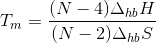
Answer to part c:

When N = 4, the graph will converge because then Tm = 0.
Add Answer to:
Proteins are polymers of amino acids that can exist in ordered structures stabilized by a variety...
5. Which of the following molecules form complex structures linked by covalent bonds through Lys, HyLys,...
 5. Which of the following molecules form complex structures linked by covalent bonds through Lys, HyLys, or His residues? A) Collagen B) Alpha keratin C) Hemoglobin D) Myoglobin E) Beta barrels 6. Which of the following correlates to the classic experiment demonstrating that reduced and denatured RNase A could refold into the native form? A) Disulfide bonds do not stabilize folded proteins B) Reducing agents denature proteins C) 1° structure can determine 3° structure D) Urea cleaves disulfide bonds E)...
(2%) Indicate which secondary structure or structures (α -helix, β -pleated, random coil) will the following...
 (2%) Indicate which secondary structure or structures (α -helix,
β -pleated, random coil) will the following peptide adopt in an
aqueous solution at pH 7
(2%) The unfolding of the alpha helix of a polypeptide to a
randomly coiled conformation is accompanied by a large decrease in
a property called specific rotation, a measure of
a solution’s capacity to rotate circularly polarized light.
Polyglutamate, a polypeptide made up of only L-Glu residues, has
the alpha helical
conformation at pH 3....
(2%) Indicate which secondary structure or structures (α -helix,
β -pleated, random coil) will the following peptide adopt in an
aqueous solution at pH 7
(2%) The unfolding of the alpha helix of a polypeptide to a
randomly coiled conformation is accompanied by a large decrease in
a property called specific rotation, a measure of
a solution’s capacity to rotate circularly polarized light.
Polyglutamate, a polypeptide made up of only L-Glu residues, has
the alpha helical
conformation at pH 3....
Proteins are made from chains of amino acids. The amino acids are joined together by structures...
 Proteins are made from chains of amino acids. The amino acids
are joined together by structures called peptide
bonds.
Draw the dipeptide that results when a peptide bond is formed
between the two glycine molecules shown here. (Figure 1) Draw it as
it would occur at the pHpH of most body fluids.
Draw the molecule on the canvas by choosing buttons from the
Tools (for bonds), Atoms, and Advanced Template toolbars. The
single bond is active by default. Include all...
Proteins are made from chains of amino acids. The amino acids
are joined together by structures called peptide
bonds.
Draw the dipeptide that results when a peptide bond is formed
between the two glycine molecules shown here. (Figure 1) Draw it as
it would occur at the pHpH of most body fluids.
Draw the molecule on the canvas by choosing buttons from the
Tools (for bonds), Atoms, and Advanced Template toolbars. The
single bond is active by default. Include all...
Question 1 (0.5 points) Saved Proteins are formed by joining together. carboxylic acids fatty acids amino...
 Question 1 (0.5 points) Saved Proteins are formed by joining together. carboxylic acids fatty acids amino acids none of the above Question 2 (0.5 points) Which two functional groups does an amino acid contain? amine and carboxylic acid carboxylic acid and amide amide and heterocyclic ring heterocyclic ring and amine Question 3 (0.5 points) Do amino acids commonly exist in nature as neutral molecules with all uncharged atoms? Yes No Question 1 (0.5 points) What is a protein? A polymer...
Question 11. Certain amino acids destabilize or prevent formation of alpha-helices. Which amino acid is more...
 Question 11. Certain amino acids destabilize or prevent formation of alpha-helices. Which amino acid is more likely to be found in these structures based on its charge and R-group size? A. Glycine B. Proline C. A sequence of several Glutamate D. A sequence of several Lysine E. Alanine Question 12. Which of the following is least likely to result in protein denaturation? A) Altering net charge by changing pH B) Changing the salt concentration C) Disruption of weak interactions by...
QUESTION 1 To study how proteins fold, scientists must be able to purify the protein of...
QUESTION 1 To study how proteins fold, scientists must be able to purify the protein of interest, use solvents like urea to denature the folded protein, and observe the process of refolding at successive time points. What is the effect of the solvents used in the denaturation process? a. The solvents break all noncovalent interactions. b. The solvents break all covalent interactions. c. The solvents create a new folded conformation. d. The solvents break some of the noncovalent interactions, resulting...
Which of the following is NOT a dehydration synthesis reaction? a. amino acids forming proteins b....
Which of the following is NOT a dehydration synthesis reaction? a. amino acids forming proteins b. glycogen forming glucose molecules c. nucleotides forming DNA d. glucose units forming starch e .fatty acids and glycerol forming a fat 2) The monomer of a protein is a(n) monosaccharide. nucleotide. peptide. glycerol and three fatty acids. amino acid. 3) A starch molecule is to glucose as a protein is to a polypeptide. DNA is to an amino acid. a lipid is to nucleic...
Identify the structure of amino acids, and describe the process by which they join together to...
Identify the structure of amino acids, and describe the process by which they join together to form polypeptides. Describe the 4 different groups of amino acids and their properties (Neutral, Polar, Acidic, Basic). Describe the levels of structure of proteins (primary, secondary, tertiary, and quaternary), including what bonds and interactions occur at EACH level. Describe denaturation of a protein and indicate how temperature and pH affect the protein functions. Describe the major functions of proteins
THIS IS BIOCHEMISTRY A peptide has a low pI value. Which of the following amino acids...
THIS IS BIOCHEMISTRY A peptide has a low pI value. Which of the following amino acids are likely to be present? Glycine Serine Valine Aspartic aci Arginine The R-groups of which of the following pairs of amino acids could participate in the formation of salt bridge electrostatic interaction? Alanine and valine Valine and lysine Lysine and glutamate Serine and isoleucine Asparagine and glutamine Which of the following interactions does NOT contribute to stabilizing tertiary structure? Hydrophobic interactions Electrostatic interations...
Question 10 (4 points) Although all protein structures are unique, there are common structural building blocks...
 Question 10 (4 points) Although all protein structures are unique, there are common structural building blocks that are referred to as regular secondary structures, Some proteins have alpha-helices, some have beta-sheets, and still others have a combination of both. What makes it possible for proteins to have these common structural elements? 12 15 a) the hydrophobic-core interactions. b) hydrogen bonds that form along (alpha helices) or between (beta sheets) polypeptide backbones. c) side-chain interactions d) specific amino acid sequences. 7...
 5. Which of the following molecules form complex structures linked by covalent bonds through Lys, HyLys, or His residues? A) Collagen B) Alpha keratin C) Hemoglobin D) Myoglobin E) Beta barrels 6. Which of the following correlates to the classic experiment demonstrating that reduced and denatured RNase A could refold into the native form? A) Disulfide bonds do not stabilize folded proteins B) Reducing agents denature proteins C) 1° structure can determine 3° structure D) Urea cleaves disulfide bonds E)...
 (2%) Indicate which secondary structure or structures (α -helix,
β -pleated, random coil) will the following peptide adopt in an
aqueous solution at pH 7
(2%) The unfolding of the alpha helix of a polypeptide to a
randomly coiled conformation is accompanied by a large decrease in
a property called specific rotation, a measure of
a solution’s capacity to rotate circularly polarized light.
Polyglutamate, a polypeptide made up of only L-Glu residues, has
the alpha helical
conformation at pH 3....
(2%) Indicate which secondary structure or structures (α -helix,
β -pleated, random coil) will the following peptide adopt in an
aqueous solution at pH 7
(2%) The unfolding of the alpha helix of a polypeptide to a
randomly coiled conformation is accompanied by a large decrease in
a property called specific rotation, a measure of
a solution’s capacity to rotate circularly polarized light.
Polyglutamate, a polypeptide made up of only L-Glu residues, has
the alpha helical
conformation at pH 3....
 Proteins are made from chains of amino acids. The amino acids
are joined together by structures called peptide
bonds.
Draw the dipeptide that results when a peptide bond is formed
between the two glycine molecules shown here. (Figure 1) Draw it as
it would occur at the pHpH of most body fluids.
Draw the molecule on the canvas by choosing buttons from the
Tools (for bonds), Atoms, and Advanced Template toolbars. The
single bond is active by default. Include all...
Proteins are made from chains of amino acids. The amino acids
are joined together by structures called peptide
bonds.
Draw the dipeptide that results when a peptide bond is formed
between the two glycine molecules shown here. (Figure 1) Draw it as
it would occur at the pHpH of most body fluids.
Draw the molecule on the canvas by choosing buttons from the
Tools (for bonds), Atoms, and Advanced Template toolbars. The
single bond is active by default. Include all...
 Question 1 (0.5 points) Saved Proteins are formed by joining together. carboxylic acids fatty acids amino acids none of the above Question 2 (0.5 points) Which two functional groups does an amino acid contain? amine and carboxylic acid carboxylic acid and amide amide and heterocyclic ring heterocyclic ring and amine Question 3 (0.5 points) Do amino acids commonly exist in nature as neutral molecules with all uncharged atoms? Yes No Question 1 (0.5 points) What is a protein? A polymer...
 Question 11. Certain amino acids destabilize or prevent formation of alpha-helices. Which amino acid is more likely to be found in these structures based on its charge and R-group size? A. Glycine B. Proline C. A sequence of several Glutamate D. A sequence of several Lysine E. Alanine Question 12. Which of the following is least likely to result in protein denaturation? A) Altering net charge by changing pH B) Changing the salt concentration C) Disruption of weak interactions by...
 Question 10 (4 points) Although all protein structures are unique, there are common structural building blocks that are referred to as regular secondary structures, Some proteins have alpha-helices, some have beta-sheets, and still others have a combination of both. What makes it possible for proteins to have these common structural elements? 12 15 a) the hydrophobic-core interactions. b) hydrogen bonds that form along (alpha helices) or between (beta sheets) polypeptide backbones. c) side-chain interactions d) specific amino acid sequences. 7...
Most questions answered within 3 hours.
-
Where is the error in this code sequence?
String s1 = "Hello";
String s2 = "ello";...
asked 11 months ago -
Financial data for Joel de Paris, Inc., for last year
follow:
Joel de Paris, Inc.
Balance...
asked 11 months ago -
Consider this reaction:
Al2(SO4)3 (aq)+ BaCl3
(aq) Al2Cl6 (aq)- +
3BaSO4(s) . What is the...
asked 11 months ago -
Suppose that Savneet is considering increasing her
recent random sample from 20 car rentals to 40...
asked 11 months ago -
Trucks arrive at an unloading terminal at an average rate of 120
per hour.
Trucks arrive...
asked 11 months ago -
Why are methanol and ethanol completely soluble in water while
octanol is not very little soluble....
asked 11 months ago -
A facilities manager at a university reads in a research report
that the mean amount of...
asked 11 months ago -
When the CuSO4 is rehydrated by adding water to the anhydrous
compound, is this an endothermic...
asked 11 months ago -
A ray of sunlight is passing from diamond into crown glass; the
angle of incidence is...
asked 11 months ago -
A block of mass 0.249 kg is placed on top of a light, vertical
spring of...
asked 11 months ago -
how do the kidneys compensate in the presences of acidosis
a) trigger hyperventilate
b) reserve acid...
asked 11 months ago -
Question 501 pts
The rental rate of capital to the firm increases. Which of the
following...
asked 11 months ago