

Homework Answers
Add Answer to:
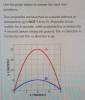
Use the graph below to answer the next four questions. Two projectiles are launched on a...
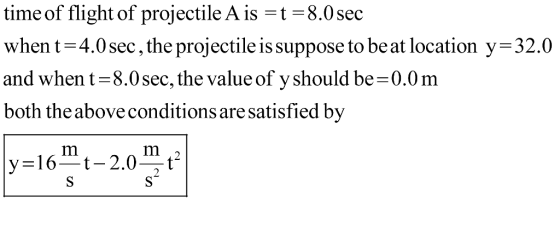
1. What is the initial x-velocity of projectile A? 2. what is the speed of the...
 1. What is the initial x-velocity of projectile
A?
2. what is the speed of the projectile at the top of its
trajectory?
3. what is the value of g on this planet?
Use the graph below to answer the next four questions Two projectiles are lunched on a planet without an atmosphere (g is NOT 9 8 m/sh. Projectile A is in motion for 8 seconds, while projectile B is in motion for 4 seconds before hitting the ground....
1. What is the initial x-velocity of projectile
A?
2. what is the speed of the projectile at the top of its
trajectory?
3. what is the value of g on this planet?
Use the graph below to answer the next four questions Two projectiles are lunched on a planet without an atmosphere (g is NOT 9 8 m/sh. Projectile A is in motion for 8 seconds, while projectile B is in motion for 4 seconds before hitting the ground....
Two projectiles are launched into the air. The first projectile has a y-component of its initial...
Two projectiles are launched into the air. The first projectile has a y-component of its initial velocity of 10 m/s and an x-component of its initial velocity of 10 m/s. (This is equivalent to an initial speed of 14.2 m/s at a 45 degree angle.) The second projectile also has a y-component of its initial velocity of 10 m/s but an x-component of 5 m/s for its initial velocity. (This is equivalent to an initial speed of 11.2 m/s at...
#8 Projectile Motion A projectile is launched from a height of 11.2 meters above a perfectly...
 #8 Projectile Motion A projectile is launched from a height of 11.2 meters above a perfectly flat horizontal surface with a launch speed of 20.5 m/s and a launch angle of 30° with respect to the horizontal direction. Using g = 9.8 m/s, how long is the projectile aloft? O A. 1.23s B. 1.54 s ° C. 229 s D. 2.88 s #9 Projectile Motion In #8, what is the range of the projectile before it strikes the ground? O...
Somewhere in the vast flat tundra of planet Tehar, a projectile is launched from the ground...
Somewhere in the vast flat tundra of planet Tehar, a projectile is launched from the ground at an angle of 60 degrees. It reaches the maximum height of 15 m. The acceleration due to gravity is 30 m/s2. Find the time in seconds the projectile spends in the air. Find the initial speed of the projectile in m/s. Find the minimum speed of the projectile in m/s. Find the horizontal range of the projectile in meters.
A circus act consists of a performer (a "human cannonball") being launched from a cannon into...
A circus act consists of a performer (a "human cannonball") being launched from a cannon into a net at the other end of the stage. The performer (mass 60 kg) leaves the cannon at a speed of 25 m/s at an angle of 30o above horizontal. She comes out of the cannon at a height of 2 meters above the ground and lands in the net at a horizontal distance of 45 meters away from the launch point. Let +x...
A rocket is fired at an initial speed v0 = 141.0 m/s from ground level, at...
A rocket is fired at an initial speed v0 = 141.0 m/s from ground level, at an angle θ = 33 degrees above the horizontal. Ignore air resistance. The magnitude of the gravitational acceleration is 9.8 m/s2. Choose the RIGHT as positive x-direction. Choose UPWARD as psotitive y-direction. Keep 2 decimal places in all answers (a) Find v0x, the x component of the initial velocity (in m/s) (b) Find v0y, the y component of the initial velocity (in m/s) (c)...
please answer questions 7 and 8 thank you D Question 7 10.5 pts A projectile is...
 please answer questions 7 and 8 thank you
D Question 7 10.5 pts A projectile is launched from the ground at an angle of 37 degrees above the horizontal. It reaches a maximum height of 21 meters above the ground. With what speed was it launched in m/s? DI Question 8 10.5 pts A projectile is launched from the top of a building at an angle of 28 degrees above the horizontal. It travels a horizontal displacement of 19 meters...
please answer questions 7 and 8 thank you
D Question 7 10.5 pts A projectile is launched from the ground at an angle of 37 degrees above the horizontal. It reaches a maximum height of 21 meters above the ground. With what speed was it launched in m/s? DI Question 8 10.5 pts A projectile is launched from the top of a building at an angle of 28 degrees above the horizontal. It travels a horizontal displacement of 19 meters...
EXPLORE A projectile is launched with a launch angle of 30° with respect to the horizontal...
EXPLORE A projectile is launched with a launch angle of 30° with respect to the horizontal direction and with an initial speed of 40 m/s. (A) How do the vertical and horizontal components of the projectile's velocity vary with time? (B) How long does it remain in flight? (C) For a given launch speed, what launch angle produces the longest time of flight? CONCEPTUALIZE Consider the projectile to be a point mass that starts with an initial velocity, upward and...
These questions are to be answered using MATLAB. I only need #3 answered, but #1 provides...
 These questions are to be answered using MATLAB. I only
need #3 answered, but #1 provides information (like initial
velocity, etc.) required for the questions. I think I have it done,
but I'd like to see if there are other ways to use MATLAB for this
question.
PROJECTILES The distance a projectile travels when fired at an angle 8 is a function of time and can be divided into horizontal and vertical distances. Horizontal (1) = 1.V.cos(0) Vertical(t) = 1•...
These questions are to be answered using MATLAB. I only
need #3 answered, but #1 provides information (like initial
velocity, etc.) required for the questions. I think I have it done,
but I'd like to see if there are other ways to use MATLAB for this
question.
PROJECTILES The distance a projectile travels when fired at an angle 8 is a function of time and can be divided into horizontal and vertical distances. Horizontal (1) = 1.V.cos(0) Vertical(t) = 1•...
1. If a projectile is fired with an initial velocity of vo meters per second at...
If a projectile is fired with an initial velocity of v0 meters per second at an angle α above the horizontal, and air resistance is assumed to be negligible, then its position after t seconds is given by the parametric equationsx=(v0 cos α) t y=(v0 sin α) t-1/2 g t2where g is the acceleration due to gravity (9.8 m / s2)(a) If a projectile is fired with α=45° and v0=900 m / s, when will it hit the ground? How...
 1. What is the initial x-velocity of projectile
A?
2. what is the speed of the projectile at the top of its
trajectory?
3. what is the value of g on this planet?
Use the graph below to answer the next four questions Two projectiles are lunched on a planet without an atmosphere (g is NOT 9 8 m/sh. Projectile A is in motion for 8 seconds, while projectile B is in motion for 4 seconds before hitting the ground....
1. What is the initial x-velocity of projectile
A?
2. what is the speed of the projectile at the top of its
trajectory?
3. what is the value of g on this planet?
Use the graph below to answer the next four questions Two projectiles are lunched on a planet without an atmosphere (g is NOT 9 8 m/sh. Projectile A is in motion for 8 seconds, while projectile B is in motion for 4 seconds before hitting the ground....
 #8 Projectile Motion A projectile is launched from a height of 11.2 meters above a perfectly flat horizontal surface with a launch speed of 20.5 m/s and a launch angle of 30° with respect to the horizontal direction. Using g = 9.8 m/s, how long is the projectile aloft? O A. 1.23s B. 1.54 s ° C. 229 s D. 2.88 s #9 Projectile Motion In #8, what is the range of the projectile before it strikes the ground? O...
 please answer questions 7 and 8 thank you
D Question 7 10.5 pts A projectile is launched from the ground at an angle of 37 degrees above the horizontal. It reaches a maximum height of 21 meters above the ground. With what speed was it launched in m/s? DI Question 8 10.5 pts A projectile is launched from the top of a building at an angle of 28 degrees above the horizontal. It travels a horizontal displacement of 19 meters...
please answer questions 7 and 8 thank you
D Question 7 10.5 pts A projectile is launched from the ground at an angle of 37 degrees above the horizontal. It reaches a maximum height of 21 meters above the ground. With what speed was it launched in m/s? DI Question 8 10.5 pts A projectile is launched from the top of a building at an angle of 28 degrees above the horizontal. It travels a horizontal displacement of 19 meters...
 These questions are to be answered using MATLAB. I only
need #3 answered, but #1 provides information (like initial
velocity, etc.) required for the questions. I think I have it done,
but I'd like to see if there are other ways to use MATLAB for this
question.
PROJECTILES The distance a projectile travels when fired at an angle 8 is a function of time and can be divided into horizontal and vertical distances. Horizontal (1) = 1.V.cos(0) Vertical(t) = 1•...
These questions are to be answered using MATLAB. I only
need #3 answered, but #1 provides information (like initial
velocity, etc.) required for the questions. I think I have it done,
but I'd like to see if there are other ways to use MATLAB for this
question.
PROJECTILES The distance a projectile travels when fired at an angle 8 is a function of time and can be divided into horizontal and vertical distances. Horizontal (1) = 1.V.cos(0) Vertical(t) = 1•...
Most questions answered within 3 hours.
-
Where is the error in this code sequence?
String s1 = "Hello";
String s2 = "ello";...
asked 10 months ago -
Financial data for Joel de Paris, Inc., for last year
follow:
Joel de Paris, Inc.
Balance...
asked 10 months ago -
Consider this reaction:
Al2(SO4)3 (aq)+ BaCl3
(aq) Al2Cl6 (aq)- +
3BaSO4(s) . What is the...
asked 10 months ago -
Suppose that Savneet is considering increasing her
recent random sample from 20 car rentals to 40...
asked 10 months ago -
Trucks arrive at an unloading terminal at an average rate of 120
per hour.
Trucks arrive...
asked 10 months ago -
Why are methanol and ethanol completely soluble in water while
octanol is not very little soluble....
asked 10 months ago -
A facilities manager at a university reads in a research report
that the mean amount of...
asked 10 months ago -
When the CuSO4 is rehydrated by adding water to the anhydrous
compound, is this an endothermic...
asked 10 months ago -
A ray of sunlight is passing from diamond into crown glass; the
angle of incidence is...
asked 10 months ago -
A block of mass 0.249 kg is placed on top of a light, vertical
spring of...
asked 10 months ago -
how do the kidneys compensate in the presences of acidosis
a) trigger hyperventilate
b) reserve acid...
asked 10 months ago -
Question 501 pts
The rental rate of capital to the firm increases. Which of the
following...
asked 10 months ago