
Homework Answers
Solution:
6. option A)increasing the sample size will decrease standard error
sd error = sd/sqrt(n).
Explanation:
This formula shows us that as  , the sample size increases, the standard error decreases. That
is, as the sample size gets larger, the standard error gets
smaller. This makes sense - the more data we have, the more precise
our estimate is.
, the sample size increases, the standard error decreases. That
is, as the sample size gets larger, the standard error gets
smaller. This makes sense - the more data we have, the more precise
our estimate is.
Also notice that the larger the standard deviation in the
population of the underlying variable, the larger the SE. Usually
we don't know  , and to estimate the standard error we plug in the sample
standard deviation in place of the unknown (true) standard
deviation
, and to estimate the standard error we plug in the sample
standard deviation in place of the unknown (true) standard
deviation
We were unable to transcribe this image
We were unable to transcribe this image
We were unable to transcribe this image
Add Answer to:
6. Each of the following statements are true, except that A) increasing the sample size will...
6. Each of the following statements are true, except that A) increasing the sample size will decrease standard erro...
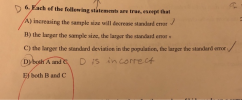 6. Each of the following statements are true, except that A) increasing the sample size will decrease standard error B) the larger the sample size, the larger the standard error C) the larger the standard deviation in the population, the larger the standard error DVboth A and C D is incorrect E) both B and C
Which statement about a confidence interval estimate of is true? A. Increasing the sample size decreases...
 Which statement about a confidence interval estimate of is true? A. Increasing the sample size decreases the error margin. B. Increasing the level of confidence decreases the error margin. OC. Decreasing the error margin makes the confidence interval wider. OD. Increasing the population mean increases the error margin, QUESTION 10 The fishing industry is interested in the mean weight of salmon caught by a certain fishing company. From previous years' data, the standard deviation of the weights of salmon caught...
How will increasing the sample size without changing the level of confidence affect the width of...
How will increasing the sample size without changing the level of confidence affect the width of a confidence interval for a population mean? Assume that the population standard deviation is unknown and the population distribution is approximately normal. Select your answer from the choices below. The margin of error will increase because the critical value will increase and the sample size, n, is located in the denominator of the formula for margin of error. The increased margin of error will...
1. Select all true statements about sample mean and sample median. A) When the population distribution...
1. Select all true statements about sample mean and sample median. A) When the population distribution is skewed, sample mean is biased but sample median is an unbiased estimator of population mean. B) When the population distribution is symmetric, both mean and sample median are unbiased estimators of population mean. C) Sampling distribution of sample mean has a smaller standard error than sample median when population distribution is normal. D) Both mean and median are unbiased estimators of population mean...
1. Which of the following statements is true about the standard deviation of X¯? A. It...
1. Which of the following statements is true about the standard deviation of X¯? A. It increases as the sample size n increases. B. It decreases as the sample size n increases. C. It changes each time a new sample is drawn. D. It does not change as the sample size n increases. 2. The standard deviation of the sampling distribution for a sample mean depends on the value(s) of A. neither the sample size nor the population standard deviation....
Which of the following statements is true about the standard deviation of X? A. It increases...
 Which of the following statements is true about the standard deviation of X? A. It increases as the sample size n increases. B. It decreases as the sample size n increases. C. It changes each time a new sample is draw D. It does not change as the sample size n increases The standard deviation of the sampling distribution for a sample mean depends on the value(s) of A. neither the sample size nor the population standard deviation B. the...
For the multiple choice questions, circle the best answer If the size of a randomly selected...
 For the multiple choice questions, circle the best answer If the size of a randomly selected sample from a population is increased from n- 100 to n400, then the standard deviation will A. increase by a factor of 4. B. remain the same C. decrease by a factor of 2. D. decrease by a factor of 4 Which of the following statements is true about the standard deviation of p? A. It decreases as the sample size n increases. B....
Which of the following statements about sample size is true? a. A rule of thumb is...
Which of the following statements about sample size is true? a. A rule of thumb is to include at least two members from every subgroup to be analyzed. b. If the sample size is very small, a judgmental sample may be more reliable and representative than a probability sample. c. The determination of sample size should not involve cost. d. Low sampling costs do not justify a larger sample. e. None of the above.
o be 4.5. A simple random sample of size n is drawn. The sample mean, X,...
 o be 4.5. A simple random sample of size n is drawn. The sample mean, X, is found to be 17.9, and the sample standard deviation, s, is found Click the icon to view the table of areas under the t-distribution. (a) Construct a 95% confidence interval about H if the sample size, n, is 35. Lower bound: Upper bound: (Use ascending order. Round to two decimal places as needed.) (b) Construct a 95% confidence interval about if the sample...
Question Which of the following is true about the one sample z-test and one sample t-test:...
 Question Which of the following is true about the one sample z-test and one sample t-test: A. for a t-test, the population mean and standard deviation are needed for a t-test only the sample mean is needed. for a z-test the population mean and standard deviation are needed. The z and t-tests are identical except for the size of the sample used. The z and t-tests are identical in terms of the amount of information needed. B. C. D. E....
 6. Each of the following statements are true, except that A) increasing the sample size will decrease standard error B) the larger the sample size, the larger the standard error C) the larger the standard deviation in the population, the larger the standard error DVboth A and C D is incorrect E) both B and C
 Which statement about a confidence interval estimate of is true? A. Increasing the sample size decreases the error margin. B. Increasing the level of confidence decreases the error margin. OC. Decreasing the error margin makes the confidence interval wider. OD. Increasing the population mean increases the error margin, QUESTION 10 The fishing industry is interested in the mean weight of salmon caught by a certain fishing company. From previous years' data, the standard deviation of the weights of salmon caught...
 Which of the following statements is true about the standard deviation of X? A. It increases as the sample size n increases. B. It decreases as the sample size n increases. C. It changes each time a new sample is draw D. It does not change as the sample size n increases The standard deviation of the sampling distribution for a sample mean depends on the value(s) of A. neither the sample size nor the population standard deviation B. the...
 For the multiple choice questions, circle the best answer If the size of a randomly selected sample from a population is increased from n- 100 to n400, then the standard deviation will A. increase by a factor of 4. B. remain the same C. decrease by a factor of 2. D. decrease by a factor of 4 Which of the following statements is true about the standard deviation of p? A. It decreases as the sample size n increases. B....
 o be 4.5. A simple random sample of size n is drawn. The sample mean, X, is found to be 17.9, and the sample standard deviation, s, is found Click the icon to view the table of areas under the t-distribution. (a) Construct a 95% confidence interval about H if the sample size, n, is 35. Lower bound: Upper bound: (Use ascending order. Round to two decimal places as needed.) (b) Construct a 95% confidence interval about if the sample...
 Question Which of the following is true about the one sample z-test and one sample t-test: A. for a t-test, the population mean and standard deviation are needed for a t-test only the sample mean is needed. for a z-test the population mean and standard deviation are needed. The z and t-tests are identical except for the size of the sample used. The z and t-tests are identical in terms of the amount of information needed. B. C. D. E....
Most questions answered within 3 hours.
-
Where is the error in this code sequence?
String s1 = "Hello";
String s2 = "ello";...
asked 11 months ago -
Financial data for Joel de Paris, Inc., for last year
follow:
Joel de Paris, Inc.
Balance...
asked 11 months ago -
Consider this reaction:
Al2(SO4)3 (aq)+ BaCl3
(aq) Al2Cl6 (aq)- +
3BaSO4(s) . What is the...
asked 11 months ago -
Suppose that Savneet is considering increasing her
recent random sample from 20 car rentals to 40...
asked 11 months ago -
Trucks arrive at an unloading terminal at an average rate of 120
per hour.
Trucks arrive...
asked 11 months ago -
Why are methanol and ethanol completely soluble in water while
octanol is not very little soluble....
asked 11 months ago -
A facilities manager at a university reads in a research report
that the mean amount of...
asked 11 months ago -
When the CuSO4 is rehydrated by adding water to the anhydrous
compound, is this an endothermic...
asked 11 months ago -
A ray of sunlight is passing from diamond into crown glass; the
angle of incidence is...
asked 11 months ago -
A block of mass 0.249 kg is placed on top of a light, vertical
spring of...
asked 11 months ago -
how do the kidneys compensate in the presences of acidosis
a) trigger hyperventilate
b) reserve acid...
asked 11 months ago -
Question 501 pts
The rental rate of capital to the firm increases. Which of the
following...
asked 11 months ago