
Homework Answers

6. A particle having a mass of 1.0 g and a charge of +2.0 μC is...
 6. A particle having a mass of 1.0 g and a charge of +2.0 μC is attached to the center of a uniformly positively charged insulating sheet 100 cm on a side by a thread of negligible mass that is 1 cm in length. The particle is displaced slightly from equilibrium and oscillates with a period of 10 ms, what is the charge on the plate? Ignore gravitational effects.
6. A particle having a mass of 1.0 g and a charge of +2.0 μC is...
 6. A particle having a mass of 1.0 g and a charge of +2.0 μC is attached to the center of a uniformly positively charged insulating sheet 100 cm on a side by a thread of negligible mass that is 1 cm in length. The particle is displaced slightly from equilibrium and oscillates with a period of 10 ms, what is the charge on the plate? lgnore gravitational effects.
Two opposite charged boards (area = 1.0 cm², magnitude of charge = 2.0 uC) are 1.0...
 Two opposite charged boards (area = 1.0 cm², magnitude of charge = 2.0 uC) are 1.0 cm apart, as shown in the figure. A proton (mass = 6.67x10⁻²⁷kg, e = 1.6x10⁻¹⁹C) is shot with an initial speed vo from the bottom toward the top vertically. What is the minimum initial speed needed that the proton can reach the top board? Ignore the gravity. [€ = 8.854 x 10⁻¹²c2/N] + VO 1.0 cm -0 30 ? ? wi ? A
In the figure, a charged particle of mass m = 3.40 g and charge q =...
 In the figure, a charged particle of mass m = 3.40 g and charge q = 0.290 mu C is suspended in static equilibrium at the end of an insulating thread that hangs from a very long, charged, thin rod. The thread is L = 13.0 cm long and makes an angle of theta = 35.00 degree with the vertical. Determine the linear charge density of the rod.
A thin conducting square plate 1.0 m on the side is given a charge of -2.0...
 A thin conducting square plate 1.0 m on the side is given a charge of -2.0 x 10⁻⁶c. An electron is placed 1.0 cm above the center of the plate. What is the acceleration of the electron? (Enter the magnitude in m/s2) magnitudie direction m/s2 Selectthe plate
A particle of a mass 1.2 x 10⁻¹¹ kg and negative charge – 1.0 uC moves...
 A particle of a mass 1.2 x 10⁻¹¹ kg and negative charge – 1.0 uC moves to the right with a speed of 3.0 x 10³ m/s. It enters a uniforn.lectric field region where the field is known to be parallel to particle's direction of motion. If the particle is to be brought to rest in the space of 4.0 cm, (a) What potential difference does it have to go through to stop this way? (b) what is the strength...
2. A particle, having a mass of 4.5 mg and a charge of 3.2 uC, is...
 2. A particle, having a mass of 4.5 mg and a charge of 3.2 uC, is traveling eastward with a velocity of 3.0 km/s. It enters a region with a magnetic field that is perpendicular to the particle and suddenly has an acceleration of 9.2 m/s2 upward. (A) What is the magnitude and direction of the magnetic field? (B) Describe the path of the particle quantitatively and qualitatively (i.e. give a description of the particle's path along with any relevant...
Two identical spheres each having charge Q =-11 nC and mass mOF 10 milligrams are held...
 Two identical spheres each having charge Q =-11 nC and mass mOF 10 milligrams are held fixed at their positions 5.0 cm apart. A particle with charge q-+1.0 nC and mass mo-0.40 milligrams is released from rest at a position 5.0 cm from each sphere (so initially the particle and the spheres form an equilateral triangle). Find the speed of the positively charged particle when it passes a point exactly in between the two spheres. (k - 9.0 x 10⁹...
A particle of a mass 1.2 x 10 ^-11 kg and a negative charge -1.0 uC...
A particle of a mass 1.2 x 10 ^-11 kg and a negative charge -1.0 uC moves to the right with a speed of 3.0 x 10 ^3 m/s. It enters a uniform electric field region where the field is known to be parallel to particle's direction of motion. If the particle is to be brought to rest in the space of 4.0cm what potential difference does it have to through to stop this way and what is the strength...
Two opposite charged boards (area = 1.0 cm2, magnitude of charge = 2.0 C) are 1.0...
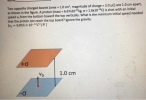 Two opposite charged boards (area = 1.0 cm2, magnitude of charge = 2.0 C) are 1.0 cm apart, as shown in the figure. A proton (mass = 6.67x10⁻²⁷kg, e = 1.6x10⁻¹°C) is shot with an initial speed ve from the bottom toward the top vertically. What is the minimum initial speed needed that the proton can reach the top board? Ignore the gravity. [€0 = 8.854 x 10⁻¹²C2/N] +0 vo 1.0 cm -
 6. A particle having a mass of 1.0 g and a charge of +2.0 μC is attached to the center of a uniformly positively charged insulating sheet 100 cm on a side by a thread of negligible mass that is 1 cm in length. The particle is displaced slightly from equilibrium and oscillates with a period of 10 ms, what is the charge on the plate? Ignore gravitational effects.
 6. A particle having a mass of 1.0 g and a charge of +2.0 μC is attached to the center of a uniformly positively charged insulating sheet 100 cm on a side by a thread of negligible mass that is 1 cm in length. The particle is displaced slightly from equilibrium and oscillates with a period of 10 ms, what is the charge on the plate? lgnore gravitational effects.
 Two opposite charged boards (area = 1.0 cm², magnitude of charge = 2.0 uC) are 1.0 cm apart, as shown in the figure. A proton (mass = 6.67x10⁻²⁷kg, e = 1.6x10⁻¹⁹C) is shot with an initial speed vo from the bottom toward the top vertically. What is the minimum initial speed needed that the proton can reach the top board? Ignore the gravity. [€ = 8.854 x 10⁻¹²c2/N] + VO 1.0 cm -0 30 ? ? wi ? A
 In the figure, a charged particle of mass m = 3.40 g and charge q = 0.290 mu C is suspended in static equilibrium at the end of an insulating thread that hangs from a very long, charged, thin rod. The thread is L = 13.0 cm long and makes an angle of theta = 35.00 degree with the vertical. Determine the linear charge density of the rod.
 A thin conducting square plate 1.0 m on the side is given a charge of -2.0 x 10⁻⁶c. An electron is placed 1.0 cm above the center of the plate. What is the acceleration of the electron? (Enter the magnitude in m/s2) magnitudie direction m/s2 Selectthe plate
 A particle of a mass 1.2 x 10⁻¹¹ kg and negative charge – 1.0 uC moves to the right with a speed of 3.0 x 10³ m/s. It enters a uniforn.lectric field region where the field is known to be parallel to particle's direction of motion. If the particle is to be brought to rest in the space of 4.0 cm, (a) What potential difference does it have to go through to stop this way? (b) what is the strength...
 2. A particle, having a mass of 4.5 mg and a charge of 3.2 uC, is traveling eastward with a velocity of 3.0 km/s. It enters a region with a magnetic field that is perpendicular to the particle and suddenly has an acceleration of 9.2 m/s2 upward. (A) What is the magnitude and direction of the magnetic field? (B) Describe the path of the particle quantitatively and qualitatively (i.e. give a description of the particle's path along with any relevant...
 Two identical spheres each having charge Q =-11 nC and mass mOF 10 milligrams are held fixed at their positions 5.0 cm apart. A particle with charge q-+1.0 nC and mass mo-0.40 milligrams is released from rest at a position 5.0 cm from each sphere (so initially the particle and the spheres form an equilateral triangle). Find the speed of the positively charged particle when it passes a point exactly in between the two spheres. (k - 9.0 x 10⁹...
 Two opposite charged boards (area = 1.0 cm2, magnitude of charge = 2.0 C) are 1.0 cm apart, as shown in the figure. A proton (mass = 6.67x10⁻²⁷kg, e = 1.6x10⁻¹°C) is shot with an initial speed ve from the bottom toward the top vertically. What is the minimum initial speed needed that the proton can reach the top board? Ignore the gravity. [€0 = 8.854 x 10⁻¹²C2/N] +0 vo 1.0 cm -
Most questions answered within 3 hours.
-
Where is the error in this code sequence?
String s1 = "Hello";
String s2 = "ello";...
asked 10 months ago -
Financial data for Joel de Paris, Inc., for last year
follow:
Joel de Paris, Inc.
Balance...
asked 10 months ago -
Consider this reaction:
Al2(SO4)3 (aq)+ BaCl3
(aq) Al2Cl6 (aq)- +
3BaSO4(s) . What is the...
asked 10 months ago -
Suppose that Savneet is considering increasing her
recent random sample from 20 car rentals to 40...
asked 10 months ago -
Trucks arrive at an unloading terminal at an average rate of 120
per hour.
Trucks arrive...
asked 10 months ago -
Why are methanol and ethanol completely soluble in water while
octanol is not very little soluble....
asked 10 months ago -
A facilities manager at a university reads in a research report
that the mean amount of...
asked 10 months ago -
When the CuSO4 is rehydrated by adding water to the anhydrous
compound, is this an endothermic...
asked 10 months ago -
A ray of sunlight is passing from diamond into crown glass; the
angle of incidence is...
asked 10 months ago -
A block of mass 0.249 kg is placed on top of a light, vertical
spring of...
asked 10 months ago -
how do the kidneys compensate in the presences of acidosis
a) trigger hyperventilate
b) reserve acid...
asked 10 months ago -
Question 501 pts
The rental rate of capital to the firm increases. Which of the
following...
asked 10 months ago