Uniform distribution with a = 0 and b = 1. A stick of wood with length...
Uniform distribution with a = 0 and b = 1.
A stick of wood with length 1 is cut at a random place into 2 parts. What is the probability that the longer part is more than twice as long as the shorter part?
Homework Answers
Let X be the place at which the wood was broken. Then X ~ Uniform(0, 1)
Let the U and V be the length of longer and shorter part. Then,
U = 1 - X for X < 1/2
= X for X 1/2
and
V = X for X < 1/2
= 1 - X for X 1/2
Probability that the longer part is more than twice as long as the shorter part = P(U > 2V)
= P(X < 1/2) * P(1-X > 2X | X < 1/2 ) + P(X 1/2) *
P(X > 2(1-X) | X
1/2)
= P(X < 1/2) * P(X < 1/3 | X < 1/2) + P(X 1/2) *
P(X > 2/3 | X
1/2)
= P(X < 1/2) * P(X < 1/3 and X < 1/2) / P( X < 1/2)
+ P(X 1/2) * P(X > 2/3
and X
1/2) / P(X
1/2)
= P(X < 1/2) * P(X < 1/3) / P( X < 1/2) + P(X 1/2) *
P(X > 2/3) / P(X
1/2)
= P(X < 1/3) + P(X > 2/3)
= (1/3) + (1 - 2/3)
= 2/3
Add Answer to:
Uniform distribution with a = 0 and b = 1.
A stick of wood with length...
A stick of length one is broken into two pieces at a random point. What is...
 A stick of length one is broken into two pieces at a random point. What is the probability that the length of the longer piece will be at least three times the length of the shorter piece?
A board 20 feet long
A board 20 ft long is to be cut into two pieces. 5 times the length of the shorter piece is 2 feet more than twice the longer piece. Find the length of each piece.
1. (a) A point is selected at random on the unit interval, dividing it into two pieces with total length 1. Find the probability that the ratio of the length of the shorter piece to the length of the...
 1. (a) A point is selected at random on the unit interval, dividing it into two pieces with total length 1. Find the probability that the ratio of the length of the shorter piece to the length of the longer piece is less than 1/4. 3 marks (b) Suppose X1 and X2 are two iid normal N(μ, σ*) variables. Define Are random variables V and W independent? Mathematically justify your answer 3 marks (c) Let C denote the unit circle...
4. Uniform Stick-Breaking A point X is chosen uniformly from the interval (0, 10) and then...
 4. Uniform Stick-Breaking A point X is chosen uniformly from the interval (0, 10) and then a point Y is chosen uniformly from the interval (0, X). This can be imagined as snapping a stick of length 10 and then snapping one of the broken bits. Such processes are called stick-breaking processes. a) Find E(X) and Var(X). See Section 15.3 of the textbook for the variance of the uniform. b) Find E(Y) and Var(Y) by conditioning on X. Uniform (a,...
1. (a) A point is selected at random on the unit interval, dividing it into two pieces with total length 1. Find the pr...
 1. (a) A point is selected at random on the unit interval, dividing it into two pieces with total length 1. Find the probability that the ratio of the length of the shorter piece to the length of the longer piece is less than 1/4 3 marks (b) Suppose X, and X2 are two iid normal N(μ, σ2) variables. Define Are random variables V and W independent? Mathematically justify your answer. 3 marks] (c) Let C denote the unit circle...
A stick is broken into three pieces at two randomly chosen points on the stick. What is the proba...
A stick is broken into three pieces at two randomly chosen points on the stick. What is the probability that no piece is longer than half the length of the stick? To do this problem, it is useful to split it into the following steps (assuming the length of stick is 1). (a) Let U1 and U2 are independent and uniformly distributed on (0, 1). Define X = min(U1, U2) and Y = max(U1, U2). Use the fact that P(a...
(1) We say a random variable X has the Uniform Distribution on [a, b] (with −∞...
(1) We say a random variable X has the Uniform Distribution on [a, b] (with −∞ < a < b < ∞) if fX (x) = 1/ b−a if a ≤ x ≤ b 0 otherwise (a) If X is a uniform random variable with positive probability on the interval [0, n], find the probability density function of e^X. (b) If X is a uniform random variable with positive probability on the interval [1, n], find E [1/X].
Consider a stick of length I, mass m, and uniform mass density. The stick is pivoted...
 Consider a stick of length I, mass m, and uniform mass density. The stick is pivoted at its top end and swings around the vertical axis. Assume that conditions have been set up so that the stick always makes an angle with the vertical. a) Figure out what the principal axes are. You do not necessarily need to diagonalize the I 3. matrix. It will be obvious to find them. Calculate the diagonal components of the moment of inertia tensor....
We have N i.i.d random variables from the uniform distribution between 0 and 1. If N=1,...
We have N i.i.d random variables from the uniform distribution between 0 and 1. If N=1, what is the probability that the nth order statistic is less than or equal to the value x? (In other words, what is Pr(X(n)1≤x)?)
3-51. The length of an injected-molded plastic case that holds tape is normally distributed with a...
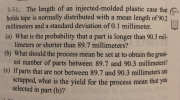 3-51. The length of an injected-molded plastic case that holds tape is normally distributed with a mean length of 90.2 GO millimeters and a standard deviation of 0.1 millimeter. (a) What is the probability that a part is longer than 90.3 mil limeters or shorter than 89.7 millimeters? (b) What should the process mean be set at to obtain the great- est number of parts between 89.7 and 90.3 millimeters? (c) If parts that are not between 89.7 and 90.3...
 A stick of length one is broken into two pieces at a random point. What is the probability that the length of the longer piece will be at least three times the length of the shorter piece?
 1. (a) A point is selected at random on the unit interval, dividing it into two pieces with total length 1. Find the probability that the ratio of the length of the shorter piece to the length of the longer piece is less than 1/4. 3 marks (b) Suppose X1 and X2 are two iid normal N(μ, σ*) variables. Define Are random variables V and W independent? Mathematically justify your answer 3 marks (c) Let C denote the unit circle...
 4. Uniform Stick-Breaking A point X is chosen uniformly from the interval (0, 10) and then a point Y is chosen uniformly from the interval (0, X). This can be imagined as snapping a stick of length 10 and then snapping one of the broken bits. Such processes are called stick-breaking processes. a) Find E(X) and Var(X). See Section 15.3 of the textbook for the variance of the uniform. b) Find E(Y) and Var(Y) by conditioning on X. Uniform (a,...
 1. (a) A point is selected at random on the unit interval, dividing it into two pieces with total length 1. Find the probability that the ratio of the length of the shorter piece to the length of the longer piece is less than 1/4 3 marks (b) Suppose X, and X2 are two iid normal N(μ, σ2) variables. Define Are random variables V and W independent? Mathematically justify your answer. 3 marks] (c) Let C denote the unit circle...
 Consider a stick of length I, mass m, and uniform mass density. The stick is pivoted at its top end and swings around the vertical axis. Assume that conditions have been set up so that the stick always makes an angle with the vertical. a) Figure out what the principal axes are. You do not necessarily need to diagonalize the I 3. matrix. It will be obvious to find them. Calculate the diagonal components of the moment of inertia tensor....
 3-51. The length of an injected-molded plastic case that holds tape is normally distributed with a mean length of 90.2 GO millimeters and a standard deviation of 0.1 millimeter. (a) What is the probability that a part is longer than 90.3 mil limeters or shorter than 89.7 millimeters? (b) What should the process mean be set at to obtain the great- est number of parts between 89.7 and 90.3 millimeters? (c) If parts that are not between 89.7 and 90.3...
Most questions answered within 3 hours.
-
Where is the error in this code sequence?
String s1 = "Hello";
String s2 = "ello";...
asked 10 months ago -
Financial data for Joel de Paris, Inc., for last year
follow:
Joel de Paris, Inc.
Balance...
asked 10 months ago -
Consider this reaction:
Al2(SO4)3 (aq)+ BaCl3
(aq) Al2Cl6 (aq)- +
3BaSO4(s) . What is the...
asked 10 months ago -
Suppose that Savneet is considering increasing her
recent random sample from 20 car rentals to 40...
asked 10 months ago -
Trucks arrive at an unloading terminal at an average rate of 120
per hour.
Trucks arrive...
asked 10 months ago -
Why are methanol and ethanol completely soluble in water while
octanol is not very little soluble....
asked 10 months ago -
A facilities manager at a university reads in a research report
that the mean amount of...
asked 10 months ago -
When the CuSO4 is rehydrated by adding water to the anhydrous
compound, is this an endothermic...
asked 10 months ago -
A ray of sunlight is passing from diamond into crown glass; the
angle of incidence is...
asked 10 months ago -
A block of mass 0.249 kg is placed on top of a light, vertical
spring of...
asked 10 months ago -
how do the kidneys compensate in the presences of acidosis
a) trigger hyperventilate
b) reserve acid...
asked 10 months ago -
Question 501 pts
The rental rate of capital to the firm increases. Which of the
following...
asked 10 months ago