The graphs below illustrate the market for thingamajigs and the cost structure for a typical firm
in the market. The market is perfectly competitive. Answer all of the following questions based
on the diagram.
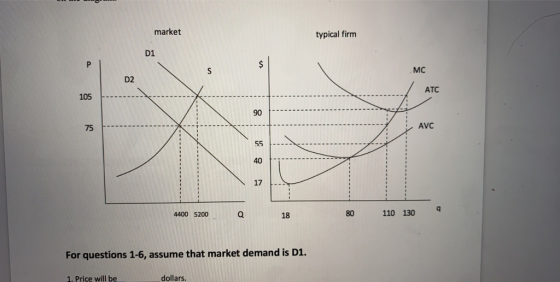
For parts 1-6 assume that market demand is D1.
1. Price will be _________ dollars.
2. Marginal Revenue will be ______ dollars.
3. Average revenue will be _______ dollars.
4. The typical firm will maximize profit by producing ________ units of output.
5. The firm's total revenue will equal ________ dollars.
6. The firm will earn a profit of _________ dollars.
Now assume that a change in consumer preferences causes the market
demand curve to shift to D2. Answer questions 7- 14 based on this
information.
7. Demand has __decreased / increased__ causing a _shortage / surplus_ at the previous equilibrium
price.
8. The new equilibrium price is _________ dollars.
9. If the typical firm produces at all, it would maximize profit by producing ______ units of output.
10. The firm's total revenue would equal _______ dollars.
11. Total cost would equal _______ dollars.
12. The firm would suffer a loss of ________ dollars.
13. If the firm shut down instead, it would suffer a loss of _______ dollars.
14. Thus the firm will operate in the short run. In fact, the firm will continue to operate at any price above
________ dollars.
15. How many firms are currently in this market? _________
Homework Answers
1. From the market demand(D1) and supply(S) graph, the equilibrium is achieved at a price of $115
Ans: Price = $115
2. In a perfectly competitive market, for a firm, the marginal revenue at any output equals the market price
Ans: Marginal Revenue = $115
3. In a perfectly competitive market, for a firm, the average revenue at any output equals the market price
Ans: Average Revenue = $115
4. P = MC = $115 line intersects the MC curve for the given firm at a quantity = 130
Ans: The profit-maximizing quantity = 130 units
5. Total Revenue = Price * Quantity = $105 * 130 = $13,650
Ans: Total Revenue = $13,650
6. At the quantity of 130 units, the firms' ATC = $90
Total Cost = ATC * Quantity = $90 * 130 = $11,700
Profit = Total Revenue - Total Cost = $13,650 - $11,700 = $1,950
Ans: Profit = $1,950
Add Answer to:
The graphs below illustrate the market for thingamajigs and the
cost structure for a typical firm...
The graphs below illustrate the market for thingamajigs and the cost structure for a typical firm...
 The graphs below illustrate the market for thingamajigs and the cost structure for a typical firm in the market. The market is perfectly competitive. Answer all of the following questions based on the diagram. Provide a correct answer for each blank or circle the correct word from each underlined pair of words. market typical firm D1 P1 MC AVC 4400 5200 80 110 130 1. If the current market demand is D1 then price will equal_ dollars. Price elasticity for...
1. If the current market demand is D1 then price will equal _ __ dollars. The...
 1. If the current market demand is D1 then price will equal _ __
dollars. The individual firm’s demand
curve will be _______________________________ at a price of
______ dollars. Average revenue will be
equal to ______ dollars. Marginal revenue will be equal to
______dollars. The typical firm will produce
______ units of output. Its total revenue will equal ________
dollars. The firm will earn a profit / suffer a
loss of _______dollars.
2. Now assume that a change in consumer...
1. If the current market demand is D1 then price will equal _ __
dollars. The individual firm’s demand
curve will be _______________________________ at a price of
______ dollars. Average revenue will be
equal to ______ dollars. Marginal revenue will be equal to
______dollars. The typical firm will produce
______ units of output. Its total revenue will equal ________
dollars. The firm will earn a profit / suffer a
loss of _______dollars.
2. Now assume that a change in consumer...
Consider the competitive market for halogen lamps. The following graph shows the marginal cost (MC), average total cost (ATC), and average variable cost (AVC) curves for a typical firm in the industry.
 Consider the competitive market for halogen lamps. The following graph shows the marginal cost (MC), average total cost (ATC), and average variable cost (AVC) curves for a typical firm in the industry. For each price in the following table, use the graph to determine the number of lamps this firm would produce in order to maximize its profit. Assume that when the price is exactly equal to the average variable cost, the firm is indifferent between producing zero lamps and the...
#5 75. The graphs below show the market demand and supply curves for a good in...
 #5
75. The graphs below show the market demand and supply curves for a good in a perfectly competitive industry along with a representative firm's short-run average and marginal cost curves. a. Determine the equilibrium price (label Pe) and output (label Qe) in the market. b. Draw the firm's demand (label d) and marginal revenue (label MR) curve. c. Determine the profit maximizing output (label 4). Explain why this is the profit-maximizing output d. Is the firm earning a profit...
#5
75. The graphs below show the market demand and supply curves for a good in a perfectly competitive industry along with a representative firm's short-run average and marginal cost curves. a. Determine the equilibrium price (label Pe) and output (label Qe) in the market. b. Draw the firm's demand (label d) and marginal revenue (label MR) curve. c. Determine the profit maximizing output (label 4). Explain why this is the profit-maximizing output d. Is the firm earning a profit...
(1)A firm in a perfectly competitive market sells all its product (Q) at a constant price...
 (1)A firm in a perfectly competitive market sells all its product (Q) at a constant price (P) of $60. Suppose the total cost function (TC) for this firm is described by the following equation: 2 3 Q TC(Q) = 128 +690-140 (a)Form the profit function and determine the output that maximizes the firm's profit. Evaluate the second order condition to assure that profit is maximized at this level of output. (b)Derive the marginal revenue (MR) and the marginal cost(MC). Graph...
15. Use the following figure for a firm in a perfectly competitive market. a What is the output that maximizes...
 15. Use the following figure for a firm in a perfectly competitive market. a What is the output that maximizes the firm's profit? b. At the profit-maximizing output, calculate total revenue and total cost. C. If the firm maximizes profit, how much profit does it earn? d. What will likely happen to market demand or market supply in the long run? e. What will likely happen to the market price in the long run? Price (s) d = P =...
typical perfect competitive firm in the coffee market is given by the The cost curve for...
 typical perfect competitive firm in the coffee market is given by the The cost curve for a following 1284qi + 2q% TC The market demand curve for coffee is given by the following P 84 2q (a) i) Find the long ru and quantity, output for each firm, the number of firms in the industry and the level of producer and consumer surplus. Show your answer in a clear well-labelled diagram (ii) What is the value of own price elasticity...
Consider the perfectly competitive market for sports jackets. The following graph shows the marginal cost (MC),...
 Consider the perfectly competitive market for sports jackets. The following graph shows the marginal cost (MC), average total cost (ATC), and average variable cost (AVC) curves for a typical firm in the industry. For each price in the following table, use the graph to determine the number of jackets this firm would produce in order to maximize its profit. Assume that when the price is exactly equal to the average variable cost, the firm is indifferent between producing zero jackets and...
Consider a perfectly competitive market for shirts. The following graph shows the dally cost curves of a firm oper...
 Consider a perfectly competitive market for shirts. The following graph shows the dally cost curves of a firm operating in this market. PRICE, COST (Dollars per shirt 20 Profit or Loss MC 16 ATC 12 AVC 6 12 18 24 30 36 QUANTITY OF OUTPUTIThousands of shirts per dayl Help Clear AIL In the short run, at a market price of $18 per shirt, this firm will choose to produce 27.00 shirts per day On the previous graph, use the...
1. Assume the market for tortillas is perfectly competitive. The market supply and demand curves for...
 1. Assume the market for tortillas is perfectly competitive. The market supply and demand curves for tortillas are given as follows: Supply curve: P = 0.20 Demand curve: P = 1100 – 20 The short-run total cost curve for a typical tortilla factory, ABC, is: TC = 500 + 10 + 4.522 a) Determine the market equilibrium price and quantity. b) Determine the profit-maximizing level of output for factory ABC. c) Assuming that all of the factories are identical, how...
 The graphs below illustrate the market for thingamajigs and the cost structure for a typical firm in the market. The market is perfectly competitive. Answer all of the following questions based on the diagram. Provide a correct answer for each blank or circle the correct word from each underlined pair of words. market typical firm D1 P1 MC AVC 4400 5200 80 110 130 1. If the current market demand is D1 then price will equal_ dollars. Price elasticity for...
 1. If the current market demand is D1 then price will equal _ __
dollars. The individual firm’s demand
curve will be _______________________________ at a price of
______ dollars. Average revenue will be
equal to ______ dollars. Marginal revenue will be equal to
______dollars. The typical firm will produce
______ units of output. Its total revenue will equal ________
dollars. The firm will earn a profit / suffer a
loss of _______dollars.
2. Now assume that a change in consumer...
1. If the current market demand is D1 then price will equal _ __
dollars. The individual firm’s demand
curve will be _______________________________ at a price of
______ dollars. Average revenue will be
equal to ______ dollars. Marginal revenue will be equal to
______dollars. The typical firm will produce
______ units of output. Its total revenue will equal ________
dollars. The firm will earn a profit / suffer a
loss of _______dollars.
2. Now assume that a change in consumer...
 #5
75. The graphs below show the market demand and supply curves for a good in a perfectly competitive industry along with a representative firm's short-run average and marginal cost curves. a. Determine the equilibrium price (label Pe) and output (label Qe) in the market. b. Draw the firm's demand (label d) and marginal revenue (label MR) curve. c. Determine the profit maximizing output (label 4). Explain why this is the profit-maximizing output d. Is the firm earning a profit...
#5
75. The graphs below show the market demand and supply curves for a good in a perfectly competitive industry along with a representative firm's short-run average and marginal cost curves. a. Determine the equilibrium price (label Pe) and output (label Qe) in the market. b. Draw the firm's demand (label d) and marginal revenue (label MR) curve. c. Determine the profit maximizing output (label 4). Explain why this is the profit-maximizing output d. Is the firm earning a profit...
 (1)A firm in a perfectly competitive market sells all its product (Q) at a constant price (P) of $60. Suppose the total cost function (TC) for this firm is described by the following equation: 2 3 Q TC(Q) = 128 +690-140 (a)Form the profit function and determine the output that maximizes the firm's profit. Evaluate the second order condition to assure that profit is maximized at this level of output. (b)Derive the marginal revenue (MR) and the marginal cost(MC). Graph...
 15. Use the following figure for a firm in a perfectly competitive market. a What is the output that maximizes the firm's profit? b. At the profit-maximizing output, calculate total revenue and total cost. C. If the firm maximizes profit, how much profit does it earn? d. What will likely happen to market demand or market supply in the long run? e. What will likely happen to the market price in the long run? Price (s) d = P =...
 typical perfect competitive firm in the coffee market is given by the The cost curve for a following 1284qi + 2q% TC The market demand curve for coffee is given by the following P 84 2q (a) i) Find the long ru and quantity, output for each firm, the number of firms in the industry and the level of producer and consumer surplus. Show your answer in a clear well-labelled diagram (ii) What is the value of own price elasticity...
 Consider a perfectly competitive market for shirts. The following graph shows the dally cost curves of a firm operating in this market. PRICE, COST (Dollars per shirt 20 Profit or Loss MC 16 ATC 12 AVC 6 12 18 24 30 36 QUANTITY OF OUTPUTIThousands of shirts per dayl Help Clear AIL In the short run, at a market price of $18 per shirt, this firm will choose to produce 27.00 shirts per day On the previous graph, use the...
 1. Assume the market for tortillas is perfectly competitive. The market supply and demand curves for tortillas are given as follows: Supply curve: P = 0.20 Demand curve: P = 1100 – 20 The short-run total cost curve for a typical tortilla factory, ABC, is: TC = 500 + 10 + 4.522 a) Determine the market equilibrium price and quantity. b) Determine the profit-maximizing level of output for factory ABC. c) Assuming that all of the factories are identical, how...
Most questions answered within 3 hours.
-
Where is the error in this code sequence?
String s1 = "Hello";
String s2 = "ello";...
asked 10 months ago -
Financial data for Joel de Paris, Inc., for last year
follow:
Joel de Paris, Inc.
Balance...
asked 10 months ago -
Consider this reaction:
Al2(SO4)3 (aq)+ BaCl3
(aq) Al2Cl6 (aq)- +
3BaSO4(s) . What is the...
asked 10 months ago -
Suppose that Savneet is considering increasing her
recent random sample from 20 car rentals to 40...
asked 10 months ago -
Trucks arrive at an unloading terminal at an average rate of 120
per hour.
Trucks arrive...
asked 10 months ago -
Why are methanol and ethanol completely soluble in water while
octanol is not very little soluble....
asked 10 months ago -
A facilities manager at a university reads in a research report
that the mean amount of...
asked 10 months ago -
When the CuSO4 is rehydrated by adding water to the anhydrous
compound, is this an endothermic...
asked 10 months ago -
A ray of sunlight is passing from diamond into crown glass; the
angle of incidence is...
asked 10 months ago -
A block of mass 0.249 kg is placed on top of a light, vertical
spring of...
asked 10 months ago -
how do the kidneys compensate in the presences of acidosis
a) trigger hyperventilate
b) reserve acid...
asked 10 months ago -
Question 501 pts
The rental rate of capital to the firm increases. Which of the
following...
asked 10 months ago