![5. Name the following compounds: a) [CuCl4)? b) [Cr(H2O)(NH3)]*2 c) [Cr(H2O) (NH3)]SO4 d) K3 [Fe(CN)6]](http://img.homeworklib.com/questions/47602480-7805-11ea-b754-bd8dbe01cf23.png?x-oss-process=image/resize,w_560)
Homework Answers
Add Answer to:
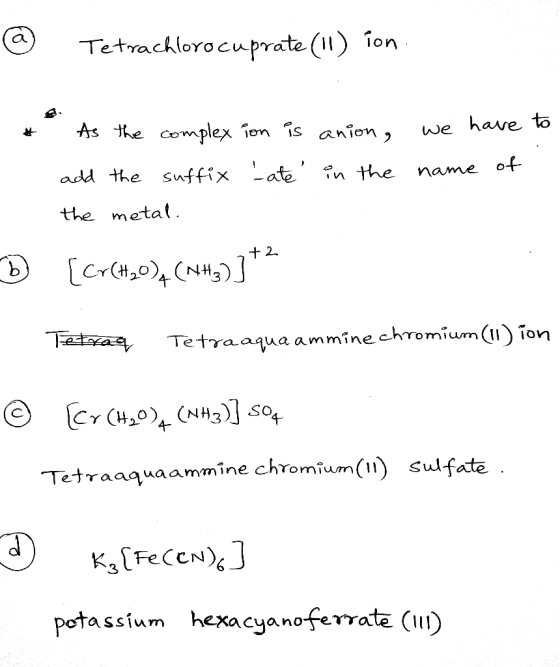
5. Name the following compounds: a) [CuCl4)? b) [Cr(H2O)(NH3)]*2 c) [Cr(H2O) (NH3)]SO4 d) K3 [Fe(CN)6]
Name the following compounds: 5. a) CuCla]2 b) Cr(H20)(NH3)]2 c) [Cr(H2O)4(NH)] SO4 d) K3[Fe(CN)6]
 Name the following compounds: 5. a) CuCla]2 b) Cr(H20)(NH3)]2 c) [Cr(H2O)4(NH)] SO4 d) K3[Fe(CN)6]
Name the following coordination compounds using systematic nomenclature. 1. [Co(H2O)6]Cl2: 2. [Cr(NH3)6](NO3)3: 3. K4[Fe(CN)6]: 4. Na[Au(CN)4]:...
Name the following coordination compounds using systematic nomenclature. 1. [Co(H2O)6]Cl2: 2. [Cr(NH3)6](NO3)3: 3. K4[Fe(CN)6]: 4. Na[Au(CN)4]: 5. [Co(H2O)2(en)2]Cl3: ANSWER 1-5 PLEASE!
Name the coordination compounds 1. [CO(NH3)6]C12 2. [CO(NH3)5Cl]012 3. [Co(H20).]Br3 4. K3[Fe(CN)6] 5. K3[CoF6]. 6. Na4[PtClo]
 Name the coordination
compounds
1. [CO(NH3)6]C12 2. [CO(NH3)5Cl]012 3. [Co(H20).]Br3 4. K3[Fe(CN)6] 5. K3[CoF6]. 6. Na4[PtClo]
Name the coordination
compounds
1. [CO(NH3)6]C12 2. [CO(NH3)5Cl]012 3. [Co(H20).]Br3 4. K3[Fe(CN)6] 5. K3[CoF6]. 6. Na4[PtClo]
Name the following coordination compounds. [Cr(H2O)5Br]F2 Na3[Co(CN)6] [Fe(NH2CH2CH2NH2)2(NO2)2]Cl [Pt(NH3)4Br2][PtBr4]
Name the following coordination compounds. [Cr(H2O)5Br]F2 Na3[Co(CN)6] [Fe(NH2CH2CH2NH2)2(NO2)2]Cl [Pt(NH3)4Br2][PtBr4]
Name the following compound: a) Ca3(PO4)2 b) Ni2O3 c) Fe(OH)3. d) Sn3P2 e) Cr(CN)6 f) Cu3(SO4)3...
Name the following compound: a) Ca3(PO4)2 b) Ni2O3 c) Fe(OH)3. d) Sn3P2 e) Cr(CN)6 f) Cu3(SO4)3 g) CuCl2
Correctly name the following complexes: a). [Co(NH3)6]Br3 b). K3[FeF6] c). [Cu(OH2)4](SO4)
Correctly name the following complexes: a). [Co(NH3)6]Br3 b). K3[FeF6] c). [Cu(OH2)4](SO4)
what is the oxidation state of the following compounds? a.) copper acetate, [Fe(H2O)6](NH4)2(SO4)2 b.) pentaamminechlorocobalt (III)...
what is the oxidation state of the following compounds? a.) copper acetate, [Fe(H2O)6](NH4)2(SO4)2 b.) pentaamminechlorocobalt (III) chloride, [Co(NH3)5Cl]Cl2
21. Which of the following are coordination isomers? (a) cis-[CoCl2(en)2]Cl and trans-[CoCl2(en)2]Cl (b) [Cr(NH3)[Fe(CN) ] and...
 21. Which of the following are coordination isomers? (a) cis-[CoCl2(en)2]Cl and trans-[CoCl2(en)2]Cl (b) [Cr(NH3)[Fe(CN) ] and [Fe(NH3)6][Cr(CN)] (c) [CoBr(NH3)sSO4 and [CrSO4(NH3)s]Br (d) [Co(NO2)(NH3)s]Cl2 and [Cr(ONO)(NH3)s] Cl2 (e) Both (b) and (c) Review your answer (CIRCLE): Are you (1) confident; (2) somewhat confident; or (3) unsure/guessing?
21. Which of the following are coordination isomers? (a) cis-[CoCl2(en)2]Cl and trans-[CoCl2(en)2]Cl (b) [Cr(NH3)[Fe(CN) ] and [Fe(NH3)6][Cr(CN)] (c) [CoBr(NH3)sSO4 and [CrSO4(NH3)s]Br (d) [Co(NO2)(NH3)s]Cl2 and [Cr(ONO)(NH3)s] Cl2 (e) Both (b) and (c) Review your answer (CIRCLE):...
21. Which of the following are coordination isomers? (a) cis-[CoCl2(en)2]Cl and trans-[CoCl2(en)2]Cl (b) [Cr(NH3)[Fe(CN) ] and [Fe(NH3)6][Cr(CN)] (c) [CoBr(NH3)sSO4 and [CrSO4(NH3)s]Br (d) [Co(NO2)(NH3)s]Cl2 and [Cr(ONO)(NH3)s] Cl2 (e) Both (b) and (c) Review your answer (CIRCLE): Are you (1) confident; (2) somewhat confident; or (3) unsure/guessing?
21. Which of the following are coordination isomers? (a) cis-[CoCl2(en)2]Cl and trans-[CoCl2(en)2]Cl (b) [Cr(NH3)[Fe(CN) ] and [Fe(NH3)6][Cr(CN)] (c) [CoBr(NH3)sSO4 and [CrSO4(NH3)s]Br (d) [Co(NO2)(NH3)s]Cl2 and [Cr(ONO)(NH3)s] Cl2 (e) Both (b) and (c) Review your answer (CIRCLE):...
Classify each of the coordination compounds according to the coordination number. 23456 Ba[FeBr4]2Ba[FeBr4]2 [CuCl2]−[CuCl2]− [HgI3]−[HgI3]− K3[CoF6]K3[CoF6]...
Classify each of the coordination compounds according to the coordination number. 23456 Ba[FeBr4]2Ba[FeBr4]2 [CuCl2]−[CuCl2]− [HgI3]−[HgI3]− K3[CoF6]K3[CoF6] [Ag(NH3)2]+[Ag(NH3)2]+ [Zn(CN)4]2−[Zn(CN)4]2− [Fe(CO)5][Fe(CO)5] [Co(SO4)(NH3)5]+[Co(SO4)(NH3)5]+ Answer Bank The oxidation state is −1−1 for the central metal atom in [Ag(CN)2]−[Ag(CN)2]−.
calculuate valence electrons for each complex (a) [Mn(H20)]3+ (d) [Fe(H20).]3+ (b) [Cr(H2O)6]2+ (e) [Co(NH3)4] * (h)...
 calculuate valence electrons for each complex
(a) [Mn(H20)]3+ (d) [Fe(H20).]3+ (b) [Cr(H2O)6]2+ (e) [Co(NH3)4] * (h) [Pd(NH3).]4+ (c) [V(H2O).]2+ (1) [Ni(H2O)]2+ (1) [Re(CN).]3- (g) MoF6
calculuate valence electrons for each complex
(a) [Mn(H20)]3+ (d) [Fe(H20).]3+ (b) [Cr(H2O)6]2+ (e) [Co(NH3)4] * (h) [Pd(NH3).]4+ (c) [V(H2O).]2+ (1) [Ni(H2O)]2+ (1) [Re(CN).]3- (g) MoF6
 Name the following compounds: 5. a) CuCla]2 b) Cr(H20)(NH3)]2 c) [Cr(H2O)4(NH)] SO4 d) K3[Fe(CN)6]
 Name the coordination
compounds
1. [CO(NH3)6]C12 2. [CO(NH3)5Cl]012 3. [Co(H20).]Br3 4. K3[Fe(CN)6] 5. K3[CoF6]. 6. Na4[PtClo]
Name the coordination
compounds
1. [CO(NH3)6]C12 2. [CO(NH3)5Cl]012 3. [Co(H20).]Br3 4. K3[Fe(CN)6] 5. K3[CoF6]. 6. Na4[PtClo]
 21. Which of the following are coordination isomers? (a) cis-[CoCl2(en)2]Cl and trans-[CoCl2(en)2]Cl (b) [Cr(NH3)[Fe(CN) ] and [Fe(NH3)6][Cr(CN)] (c) [CoBr(NH3)sSO4 and [CrSO4(NH3)s]Br (d) [Co(NO2)(NH3)s]Cl2 and [Cr(ONO)(NH3)s] Cl2 (e) Both (b) and (c) Review your answer (CIRCLE): Are you (1) confident; (2) somewhat confident; or (3) unsure/guessing?
21. Which of the following are coordination isomers? (a) cis-[CoCl2(en)2]Cl and trans-[CoCl2(en)2]Cl (b) [Cr(NH3)[Fe(CN) ] and [Fe(NH3)6][Cr(CN)] (c) [CoBr(NH3)sSO4 and [CrSO4(NH3)s]Br (d) [Co(NO2)(NH3)s]Cl2 and [Cr(ONO)(NH3)s] Cl2 (e) Both (b) and (c) Review your answer (CIRCLE):...
21. Which of the following are coordination isomers? (a) cis-[CoCl2(en)2]Cl and trans-[CoCl2(en)2]Cl (b) [Cr(NH3)[Fe(CN) ] and [Fe(NH3)6][Cr(CN)] (c) [CoBr(NH3)sSO4 and [CrSO4(NH3)s]Br (d) [Co(NO2)(NH3)s]Cl2 and [Cr(ONO)(NH3)s] Cl2 (e) Both (b) and (c) Review your answer (CIRCLE): Are you (1) confident; (2) somewhat confident; or (3) unsure/guessing?
21. Which of the following are coordination isomers? (a) cis-[CoCl2(en)2]Cl and trans-[CoCl2(en)2]Cl (b) [Cr(NH3)[Fe(CN) ] and [Fe(NH3)6][Cr(CN)] (c) [CoBr(NH3)sSO4 and [CrSO4(NH3)s]Br (d) [Co(NO2)(NH3)s]Cl2 and [Cr(ONO)(NH3)s] Cl2 (e) Both (b) and (c) Review your answer (CIRCLE):...
 calculuate valence electrons for each complex
(a) [Mn(H20)]3+ (d) [Fe(H20).]3+ (b) [Cr(H2O)6]2+ (e) [Co(NH3)4] * (h) [Pd(NH3).]4+ (c) [V(H2O).]2+ (1) [Ni(H2O)]2+ (1) [Re(CN).]3- (g) MoF6
calculuate valence electrons for each complex
(a) [Mn(H20)]3+ (d) [Fe(H20).]3+ (b) [Cr(H2O)6]2+ (e) [Co(NH3)4] * (h) [Pd(NH3).]4+ (c) [V(H2O).]2+ (1) [Ni(H2O)]2+ (1) [Re(CN).]3- (g) MoF6
Most questions answered within 3 hours.
-
Where is the error in this code sequence?
String s1 = "Hello";
String s2 = "ello";...
asked 10 months ago -
Financial data for Joel de Paris, Inc., for last year
follow:
Joel de Paris, Inc.
Balance...
asked 10 months ago -
Consider this reaction:
Al2(SO4)3 (aq)+ BaCl3
(aq) Al2Cl6 (aq)- +
3BaSO4(s) . What is the...
asked 10 months ago -
Suppose that Savneet is considering increasing her
recent random sample from 20 car rentals to 40...
asked 10 months ago -
Trucks arrive at an unloading terminal at an average rate of 120
per hour.
Trucks arrive...
asked 10 months ago -
Why are methanol and ethanol completely soluble in water while
octanol is not very little soluble....
asked 10 months ago -
A facilities manager at a university reads in a research report
that the mean amount of...
asked 10 months ago -
When the CuSO4 is rehydrated by adding water to the anhydrous
compound, is this an endothermic...
asked 10 months ago -
A ray of sunlight is passing from diamond into crown glass; the
angle of incidence is...
asked 10 months ago -
A block of mass 0.249 kg is placed on top of a light, vertical
spring of...
asked 10 months ago -
how do the kidneys compensate in the presences of acidosis
a) trigger hyperventilate
b) reserve acid...
asked 10 months ago -
Question 501 pts
The rental rate of capital to the firm increases. Which of the
following...
asked 10 months ago