

Homework Answers
2.
A.
B.
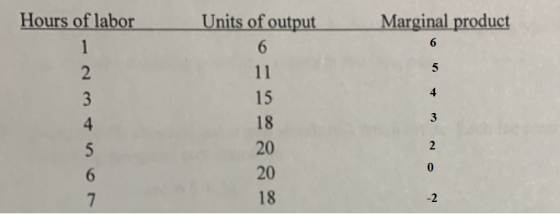
From the above table, it can be Observed that marginal product of labor is decreasing with each additional hours. It shows that diminishing return of labor in the production process. For example, first hour of labor, produces 6 units of product, but second hour of labor, produces 5 units of product and third hour of labor produces 4 units of product and so on... It shows that with each new hour of work, production level decreases. It shows that there is a diminishing return of labor.
C.
Optimal level of labor is applied, when MRAP of labor = wage rate of the labor
On the basis of above rule,
Optimal level of labor = 5 hours
Because, at 5th hour of labor,
MRAP of labor = 2*20 = $40
Wage of the labor = $40
So, optimal level of labor is achieved when work is done for 5 hours.
========
Pl. repost other unanswered questions for their proper answers!
Add Answer to:
2. You are given the following information: Hours of labor Units of output Marginal product 15...
QUESTION 5 The marginal product for labor is given (MP) = 3 – 0.02*L; price of...
QUESTION 5 The marginal product for labor is given (MP) = 3 – 0.02*L; price of the product is $100 and wage = 200. Based on information above, the marginal product of labor at the optimal level of employment is $3 $2 $1.5 $1 2 points QUESTION 6 If the labor elasticity of output is 0.5 and the capital elasticity of output is 0.9, then the production function exhibits constant returns to scale. economies of scale. diseconomies of scale. diminishing...
12. Learning by doing doctrine suggests that: a. MC shifts upward as current output increases b....
 12. Learning by doing doctrine suggests that: a. MC shifts upward as current output increases b. an increase in this period's output will cause future periods' long-run average cost curves to be lower c. The long-run average cost curve to increase at a smaller output d. the Law of Diminishing Returns to be violated e. none of the above 13. If given quantities of soap and shampoo can be produced together at a lower total cost than they could be...
4. A company produces economic analysis reports using hours of labor (L) and computers (K). The...
4. A company produces economic analysis reports using hours of labor (L) and computers (K). The production function is ? = 2?√? Initially, in the short run, they have just 1 computer (K = 1). The wage is $20 per hour, and the cost of capital is $10. a. Derive short run total cost and short run average costs curves, with costs as a function of q. Do these costs curves exhibit economies or diseconomies of scale? Explain. (5) b....
Suppose that a particular firm is in a perfectly competitive constant-cost industry. When it is using...
Suppose that a particular firm is in a perfectly competitive constant-cost industry. When it is using the optimal amount of capital for the long-run, total cost is C(q)=1000+(q2/10), ATC(q)=(1000/q)+q/10, and marginal cost is MC(q)=2q/10. This implies that ATC=MC at a quantity of 100 and a per unit cost of $20. 1. At what quantity is average total cost minimized? 2. What is the long-run competitive equilibrium price? 3. If market demand is QD=12,000-200P and short-run market supply is QS=300P, what...
Q1: The following graph shows the current short-run average total cost (ATC), short-run marginal cost (MC),...
 Q1: The following graph shows the current short-run average total cost (ATC), short-run marginal cost (MC), and long-run average cost (LATC) curves of a typical perfectly competitive firm that uses only labour and physical capital to produce its product and the current market price (PⓇ). S/unit MC ATC LATC B Pa E Q1 Q2 Quantity a) How many units of output would the firm choose to produce in the short run? Explain. b) Is the firm making an economic profit...
1. The demand for a firm’s product is estimated by the equation Q = 20 -...
1. The demand for a firm’s product is estimated by the equation Q = 20 - P, and its total cost function is TC = Q2 + 8Q + 2. Marginal cost is MC = 2Q + 8, and marginal revenue is MR = 20 - 2Q. a. Given this information, what is the firm’s profit-maximizing output and price? b. What is the firm’s profit at this level of output? c. Is the firm operating in a perfectly competitive price...
produce 16000 units of output. What is the cost minimizing combination of capital and labor for...
 produce 16000 units of output. What is the cost minimizing combination of capital and labor for this firm? What is it's minimized cost of producing 16000 units of output? 2.2 Problem 2 In a perfectly competitive market all firms (including potential entrants) have a total cost function given by TC(Q) = 100Q - QP + ', where Q is that firm's output. Therefore, each firm's average cost function is AC(Q) = 100-Q+ Qand each firm's marginal cost function is given...
8. Consider the following Demand (Price and Marginal Revenue) and Cost (Total and Marginal) relationships expressed...
8. Consider the following Demand (Price and Marginal Revenue) and Cost (Total and Marginal) relationships expressed as functions of Q: Price = P(Q) = 310 – 2Q TC = TC(Q) = 3500 + 70Q + Q2 MR = MR(Q) = 310 – 4Q MC = MC(Q) = 70 + 2Q a. What is the profit-maximizing level of output? What is the price at that level? b. Should the firm continue operating in the short run? In the long run? c....
74. If a perfectly competitive firm’s marginal cost of producing and selling the 100th unit of...
74. If a perfectly competitive firm’s marginal cost of producing and selling the 100th unit of good X is $20 and the market price for good X is $30, then the firm will Group of answer choices increase its profits by producing more than 100 units of good X. decrease its profits by producing more than 100 units of good X. increase its profits by producing less than 100 units of good X. maximize its profits by producing exactly 100...
7. Assume that the long-run production function can be expressed as Q-SKL? Where Q is quantity...
 7. Assume that the long-run production function can be expressed as Q-SKL? Where Q is quantity of output, K is the quantity of capital and L is the quantity of labor. If capital is fixed at 10 units in the short run then the short-run production function is: Q=10KL b. Q=50KL? Q=10L? d. 0=50L Q=500KL 8. For a linear total cost function: a. MC will be downward sloping b. MC = AVC c. AVC is upward sloping and linear d....
 12. Learning by doing doctrine suggests that: a. MC shifts upward as current output increases b. an increase in this period's output will cause future periods' long-run average cost curves to be lower c. The long-run average cost curve to increase at a smaller output d. the Law of Diminishing Returns to be violated e. none of the above 13. If given quantities of soap and shampoo can be produced together at a lower total cost than they could be...
 Q1: The following graph shows the current short-run average total cost (ATC), short-run marginal cost (MC), and long-run average cost (LATC) curves of a typical perfectly competitive firm that uses only labour and physical capital to produce its product and the current market price (PⓇ). S/unit MC ATC LATC B Pa E Q1 Q2 Quantity a) How many units of output would the firm choose to produce in the short run? Explain. b) Is the firm making an economic profit...
 produce 16000 units of output. What is the cost minimizing combination of capital and labor for this firm? What is it's minimized cost of producing 16000 units of output? 2.2 Problem 2 In a perfectly competitive market all firms (including potential entrants) have a total cost function given by TC(Q) = 100Q - QP + ', where Q is that firm's output. Therefore, each firm's average cost function is AC(Q) = 100-Q+ Qand each firm's marginal cost function is given...
 7. Assume that the long-run production function can be expressed as Q-SKL? Where Q is quantity of output, K is the quantity of capital and L is the quantity of labor. If capital is fixed at 10 units in the short run then the short-run production function is: Q=10KL b. Q=50KL? Q=10L? d. 0=50L Q=500KL 8. For a linear total cost function: a. MC will be downward sloping b. MC = AVC c. AVC is upward sloping and linear d....
Most questions answered within 3 hours.
-
Where is the error in this code sequence?
String s1 = "Hello";
String s2 = "ello";...
asked 10 months ago -
Financial data for Joel de Paris, Inc., for last year
follow:
Joel de Paris, Inc.
Balance...
asked 10 months ago -
Consider this reaction:
Al2(SO4)3 (aq)+ BaCl3
(aq) Al2Cl6 (aq)- +
3BaSO4(s) . What is the...
asked 10 months ago -
Suppose that Savneet is considering increasing her
recent random sample from 20 car rentals to 40...
asked 10 months ago -
Trucks arrive at an unloading terminal at an average rate of 120
per hour.
Trucks arrive...
asked 10 months ago -
Why are methanol and ethanol completely soluble in water while
octanol is not very little soluble....
asked 10 months ago -
A facilities manager at a university reads in a research report
that the mean amount of...
asked 10 months ago -
When the CuSO4 is rehydrated by adding water to the anhydrous
compound, is this an endothermic...
asked 10 months ago -
A ray of sunlight is passing from diamond into crown glass; the
angle of incidence is...
asked 10 months ago -
A block of mass 0.249 kg is placed on top of a light, vertical
spring of...
asked 10 months ago -
how do the kidneys compensate in the presences of acidosis
a) trigger hyperventilate
b) reserve acid...
asked 10 months ago -
Question 501 pts
The rental rate of capital to the firm increases. Which of the
following...
asked 10 months ago