Can you please draw it and explain
Homework Answers

Add Answer to:
Can you please draw it and explain
Which of the following compounds is the product of...
can you please help for these three questions please? thank you! 18. Which will be the...
 can you please help for these three questions please? thank
you!
18. Which will be the major product of the following E2 reaction? NaOH Br CH3 H3C H a) b) c) Нас d) H3C CH3 H3 H3C 3 20. Which would not be a good method to prepare compound A? O A 1. BH3 OH РСС b) 2. H202, OH 1, H+, H2O 2. РСС H2SO4, H20 O 28. How many different protons (including the H of the OH) are...
can you please help for these three questions please? thank
you!
18. Which will be the major product of the following E2 reaction? NaOH Br CH3 H3C H a) b) c) Нас d) H3C CH3 H3 H3C 3 20. Which would not be a good method to prepare compound A? O A 1. BH3 OH РСС b) 2. H202, OH 1, H+, H2O 2. РСС H2SO4, H20 O 28. How many different protons (including the H of the OH) are...
Organic Chemistry please help asap 70. What nucleophiles wou cleophiles would form the following compounds as...
 Organic Chemistry please help asap
70. What nucleophiles wou cleophiles would form the following compounds as a result of reacting with l-iodobutane? OH SH 11. Draw (R)-2-bromopentane + CHO b. (R)-3-bromo-3-methylheptane + CH,OH c. benzyl chloride + CH CH OH te tollowing reactions: if the products can exist as stereoisomers, show what striscmers are obtained d. allyl chloride + CHOH e. 1-bromo-2-butene + CHO 1. l-bromo-2-butene + CH OH the products obtained from the solvolysis of each of the following...
Organic Chemistry please help asap
70. What nucleophiles wou cleophiles would form the following compounds as a result of reacting with l-iodobutane? OH SH 11. Draw (R)-2-bromopentane + CHO b. (R)-3-bromo-3-methylheptane + CH,OH c. benzyl chloride + CH CH OH te tollowing reactions: if the products can exist as stereoisomers, show what striscmers are obtained d. allyl chloride + CHOH e. 1-bromo-2-butene + CHO 1. l-bromo-2-butene + CH OH the products obtained from the solvolysis of each of the following...
10) Which one of the following correctly describes the reaction below? Draw the product СН3 H-+-Br NaSCHE ethanol w...
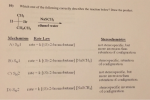 10) Which one of the following correctly describes the reaction below? Draw the product СН3 H-+-Br NaSCHE ethanol water CH2CH3 Mechanism Rate Law A) SNI rate = k [(S)-2-bromobutane) Stereochemistry not stereospecific, but more inversion than retention of configuration B) Syl rate = k [(S)-2-bromobutane] [NSCH] stereospecific, retention of configuration C) SN? rate = k [(S)-2-bromobutane] not stereospecific, but more inversion than retention of configuration D) Sy? rate = k [(S)-2-bromobutane) [NSCH] stereospecific inversion of configuration
Draw the coupling product of the Pd(0)-catalyzed Suzuki reaction between the following compounds. Show the stereochemistry...
 Draw the coupling product of the Pd(0)-catalyzed Suzuki reaction
between the following compounds. Show the stereochemistry of the
product.
Show he stareog ermistry of the prooicaon between the folowing compounds. Draw the coupling product of the Pd(O)-catalyzed Suzuki reaction between the following compounds. Show the stereochemistry of the product. eproductatalyzed Suzuki H3C CH3 OH Pd(PPh,), Br CH2 CH2CH2OH
Draw the coupling product of the Pd(0)-catalyzed Suzuki reaction
between the following compounds. Show the stereochemistry of the
product.
Show he stareog ermistry of the prooicaon between the folowing compounds. Draw the coupling product of the Pd(O)-catalyzed Suzuki reaction between the following compounds. Show the stereochemistry of the product. eproductatalyzed Suzuki H3C CH3 OH Pd(PPh,), Br CH2 CH2CH2OH
Name each of the following compounds, which contain a functional group. 3. Give the product for...
 Name each of the following compounds, which contain a functional
group.
3. Give the product for each reaction. For
no reaction, write N.R.
e. f. Br CH3 O HO Br g. CH3CH2NH2 + HCI [H] h. CH3CH2OH + CH3CH2CH2-C-OH [H] i. CH3CH2CH2CH2-C-OH + CH3NH2
Name each of the following compounds, which contain a functional
group.
3. Give the product for each reaction. For
no reaction, write N.R.
e. f. Br CH3 O HO Br g. CH3CH2NH2 + HCI [H] h. CH3CH2OH + CH3CH2CH2-C-OH [H] i. CH3CH2CH2CH2-C-OH + CH3NH2
Махwell presented by Sapling Learning Draw the correct product for the following reaction. (If there is...
 Махwell presented by Sapling Learning Draw the correct product for the following reaction. (If there is no reaction, draw the starting material.) K,Cr,O,/H,SO, ÓH Draw the major organic product(s) of the following reaction (multiple products may be drawn in one box): он HBr Classify the following transformation as a reduction, oxidation, or neither CH3 CH3 он Cна CH2 CH CH2 CH H3C Hас CH2 :0: reduction oxidation redox neutral
What is the product of the following reaction? — н ннн н-с-с-С=С + H2O H,SO, Hн...
 What is the product of the following reaction? — н ннн н-с-с-С=С + H2O H,SO, Hн Hн ОН ОН ОН ОН What is the major product formed in the following reaction? сна 3 сні H,SO, Heat нас он 86 39 — 42 45 ОН ОН What product is formed in the following reaction? CH3 H3C-C-OH [O] CH3 No Reaction What product forms in the following reaction? 30 > 33 + HBT ✓ 36 Ono reaction 39 Br 42 45 Br...
1 9. Arrange the following in ng compounds in increasing (weakest to strongest) order of basicity. NH2 NH2 NO2 E. None of the above What is the product of the following sequence? 10. H3C CH3 OH о...
 1 9. Arrange the following in ng compounds in increasing (weakest to strongest) order of basicity. NH2 NH2 NO2 E. None of the above What is the product of the following sequence? 10. H3C CH3 OH он Na V. A I What is the major product for the following Reaction? 11. Pd(OAc)h PPhy Et N NO2 NO2 NO2 C.Ⅲ A. I D. IV V. 12. Predict the product for the following reaction. Br 1. NaNs 2. LiAIH4 3. H20
1...
1 9. Arrange the following in ng compounds in increasing (weakest to strongest) order of basicity. NH2 NH2 NO2 E. None of the above What is the product of the following sequence? 10. H3C CH3 OH он Na V. A I What is the major product for the following Reaction? 11. Pd(OAc)h PPhy Et N NO2 NO2 NO2 C.Ⅲ A. I D. IV V. 12. Predict the product for the following reaction. Br 1. NaNs 2. LiAIH4 3. H20
1...
please explain the work please explain the work 8. Consider isomeric compounds Y and Z: OTS H3C H3C, нс Сн, HECCH Z a. D...
 please explain the work
8. Consider isomeric compounds Y and Z: OTS H3C H3C, нс Сн, HECCH Z a. Draw the lowest-energy chair conformer of each isomer. b. Which compound would you expect to react at a faster rate in the E1 reaction? Briefly explain your answer. Hint: Think about the mechanism in terms of a reaction coordinate diagram. 9. Propose a synthesis for each of the following compounds using the indicated starting material. You may...
please explain the work
please explain the work
8. Consider isomeric compounds Y and Z: OTS H3C H3C, нс Сн, HECCH Z a. Draw the lowest-energy chair conformer of each isomer. b. Which compound would you expect to react at a faster rate in the E1 reaction? Briefly explain your answer. Hint: Think about the mechanism in terms of a reaction coordinate diagram. 9. Propose a synthesis for each of the following compounds using the indicated starting material. You may...
Using the specified starting material and any other reagents, show how each of the following compounds...
 Using the specified starting material and any other reagents,
show how each of the following compounds can be
prepared:
a) CH3-CH2-CH2-OH ---------> H3C-CC-H
B)CHCH------>
CH3-CH3-C-(Cl)2-CH3
c) HCCH -------->
CH2-CH2-CH(Br)-CH3
Using the specified starting material and any other reagents,
show how each of the following compounds can be
prepared:
a) CH3-CH2-CH2-OH ---------> H3C-CC-H
B)CHCH------>
CH3-CH3-C-(Cl)2-CH3
c) HCCH -------->
CH2-CH2-CH(Br)-CH3
 can you please help for these three questions please? thank
you!
18. Which will be the major product of the following E2 reaction? NaOH Br CH3 H3C H a) b) c) Нас d) H3C CH3 H3 H3C 3 20. Which would not be a good method to prepare compound A? O A 1. BH3 OH РСС b) 2. H202, OH 1, H+, H2O 2. РСС H2SO4, H20 O 28. How many different protons (including the H of the OH) are...
can you please help for these three questions please? thank
you!
18. Which will be the major product of the following E2 reaction? NaOH Br CH3 H3C H a) b) c) Нас d) H3C CH3 H3 H3C 3 20. Which would not be a good method to prepare compound A? O A 1. BH3 OH РСС b) 2. H202, OH 1, H+, H2O 2. РСС H2SO4, H20 O 28. How many different protons (including the H of the OH) are...
 Organic Chemistry please help asap
70. What nucleophiles wou cleophiles would form the following compounds as a result of reacting with l-iodobutane? OH SH 11. Draw (R)-2-bromopentane + CHO b. (R)-3-bromo-3-methylheptane + CH,OH c. benzyl chloride + CH CH OH te tollowing reactions: if the products can exist as stereoisomers, show what striscmers are obtained d. allyl chloride + CHOH e. 1-bromo-2-butene + CHO 1. l-bromo-2-butene + CH OH the products obtained from the solvolysis of each of the following...
Organic Chemistry please help asap
70. What nucleophiles wou cleophiles would form the following compounds as a result of reacting with l-iodobutane? OH SH 11. Draw (R)-2-bromopentane + CHO b. (R)-3-bromo-3-methylheptane + CH,OH c. benzyl chloride + CH CH OH te tollowing reactions: if the products can exist as stereoisomers, show what striscmers are obtained d. allyl chloride + CHOH e. 1-bromo-2-butene + CHO 1. l-bromo-2-butene + CH OH the products obtained from the solvolysis of each of the following...
 10) Which one of the following correctly describes the reaction below? Draw the product СН3 H-+-Br NaSCHE ethanol water CH2CH3 Mechanism Rate Law A) SNI rate = k [(S)-2-bromobutane) Stereochemistry not stereospecific, but more inversion than retention of configuration B) Syl rate = k [(S)-2-bromobutane] [NSCH] stereospecific, retention of configuration C) SN? rate = k [(S)-2-bromobutane] not stereospecific, but more inversion than retention of configuration D) Sy? rate = k [(S)-2-bromobutane) [NSCH] stereospecific inversion of configuration
 Draw the coupling product of the Pd(0)-catalyzed Suzuki reaction
between the following compounds. Show the stereochemistry of the
product.
Show he stareog ermistry of the prooicaon between the folowing compounds. Draw the coupling product of the Pd(O)-catalyzed Suzuki reaction between the following compounds. Show the stereochemistry of the product. eproductatalyzed Suzuki H3C CH3 OH Pd(PPh,), Br CH2 CH2CH2OH
Draw the coupling product of the Pd(0)-catalyzed Suzuki reaction
between the following compounds. Show the stereochemistry of the
product.
Show he stareog ermistry of the prooicaon between the folowing compounds. Draw the coupling product of the Pd(O)-catalyzed Suzuki reaction between the following compounds. Show the stereochemistry of the product. eproductatalyzed Suzuki H3C CH3 OH Pd(PPh,), Br CH2 CH2CH2OH
 Name each of the following compounds, which contain a functional
group.
3. Give the product for each reaction. For
no reaction, write N.R.
e. f. Br CH3 O HO Br g. CH3CH2NH2 + HCI [H] h. CH3CH2OH + CH3CH2CH2-C-OH [H] i. CH3CH2CH2CH2-C-OH + CH3NH2
Name each of the following compounds, which contain a functional
group.
3. Give the product for each reaction. For
no reaction, write N.R.
e. f. Br CH3 O HO Br g. CH3CH2NH2 + HCI [H] h. CH3CH2OH + CH3CH2CH2-C-OH [H] i. CH3CH2CH2CH2-C-OH + CH3NH2
 Махwell presented by Sapling Learning Draw the correct product for the following reaction. (If there is no reaction, draw the starting material.) K,Cr,O,/H,SO, ÓH Draw the major organic product(s) of the following reaction (multiple products may be drawn in one box): он HBr Classify the following transformation as a reduction, oxidation, or neither CH3 CH3 он Cна CH2 CH CH2 CH H3C Hас CH2 :0: reduction oxidation redox neutral
 What is the product of the following reaction? — н ннн н-с-с-С=С + H2O H,SO, Hн Hн ОН ОН ОН ОН What is the major product formed in the following reaction? сна 3 сні H,SO, Heat нас он 86 39 — 42 45 ОН ОН What product is formed in the following reaction? CH3 H3C-C-OH [O] CH3 No Reaction What product forms in the following reaction? 30 > 33 + HBT ✓ 36 Ono reaction 39 Br 42 45 Br...
 1 9. Arrange the following in ng compounds in increasing (weakest to strongest) order of basicity. NH2 NH2 NO2 E. None of the above What is the product of the following sequence? 10. H3C CH3 OH он Na V. A I What is the major product for the following Reaction? 11. Pd(OAc)h PPhy Et N NO2 NO2 NO2 C.Ⅲ A. I D. IV V. 12. Predict the product for the following reaction. Br 1. NaNs 2. LiAIH4 3. H20
1...
1 9. Arrange the following in ng compounds in increasing (weakest to strongest) order of basicity. NH2 NH2 NO2 E. None of the above What is the product of the following sequence? 10. H3C CH3 OH он Na V. A I What is the major product for the following Reaction? 11. Pd(OAc)h PPhy Et N NO2 NO2 NO2 C.Ⅲ A. I D. IV V. 12. Predict the product for the following reaction. Br 1. NaNs 2. LiAIH4 3. H20
1...
 please explain the work
8. Consider isomeric compounds Y and Z: OTS H3C H3C, нс Сн, HECCH Z a. Draw the lowest-energy chair conformer of each isomer. b. Which compound would you expect to react at a faster rate in the E1 reaction? Briefly explain your answer. Hint: Think about the mechanism in terms of a reaction coordinate diagram. 9. Propose a synthesis for each of the following compounds using the indicated starting material. You may...
please explain the work
please explain the work
8. Consider isomeric compounds Y and Z: OTS H3C H3C, нс Сн, HECCH Z a. Draw the lowest-energy chair conformer of each isomer. b. Which compound would you expect to react at a faster rate in the E1 reaction? Briefly explain your answer. Hint: Think about the mechanism in terms of a reaction coordinate diagram. 9. Propose a synthesis for each of the following compounds using the indicated starting material. You may...
 Using the specified starting material and any other reagents,
show how each of the following compounds can be
prepared:
a) CH3-CH2-CH2-OH ---------> H3C-CC-H
B)CHCH------>
CH3-CH3-C-(Cl)2-CH3
c) HCCH -------->
CH2-CH2-CH(Br)-CH3
Using the specified starting material and any other reagents,
show how each of the following compounds can be
prepared:
a) CH3-CH2-CH2-OH ---------> H3C-CC-H
B)CHCH------>
CH3-CH3-C-(Cl)2-CH3
c) HCCH -------->
CH2-CH2-CH(Br)-CH3
Most questions answered within 3 hours.
-
Where is the error in this code sequence?
String s1 = "Hello";
String s2 = "ello";...
asked 11 months ago -
Financial data for Joel de Paris, Inc., for last year
follow:
Joel de Paris, Inc.
Balance...
asked 11 months ago -
Consider this reaction:
Al2(SO4)3 (aq)+ BaCl3
(aq) Al2Cl6 (aq)- +
3BaSO4(s) . What is the...
asked 11 months ago -
Suppose that Savneet is considering increasing her
recent random sample from 20 car rentals to 40...
asked 11 months ago -
Trucks arrive at an unloading terminal at an average rate of 120
per hour.
Trucks arrive...
asked 11 months ago -
Why are methanol and ethanol completely soluble in water while
octanol is not very little soluble....
asked 11 months ago -
A facilities manager at a university reads in a research report
that the mean amount of...
asked 11 months ago -
When the CuSO4 is rehydrated by adding water to the anhydrous
compound, is this an endothermic...
asked 11 months ago -
A ray of sunlight is passing from diamond into crown glass; the
angle of incidence is...
asked 11 months ago -
A block of mass 0.249 kg is placed on top of a light, vertical
spring of...
asked 11 months ago -
how do the kidneys compensate in the presences of acidosis
a) trigger hyperventilate
b) reserve acid...
asked 11 months ago -
Question 501 pts
The rental rate of capital to the firm increases. Which of the
following...
asked 11 months ago