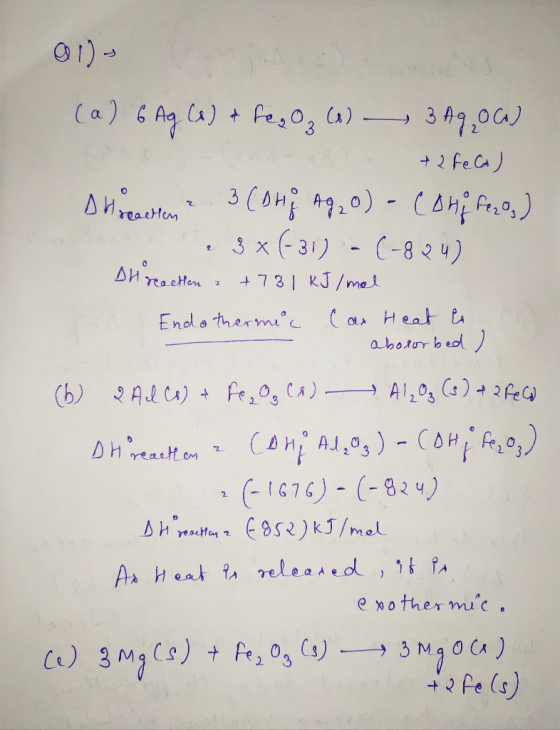
1. Which reaction(s) is/are exothermic? Select all that apply. ΔHf° in kJ/mol at 25°C MgO -601...
1. Which reaction(s) is/are exothermic? Select all that apply.
ΔHf° in kJ/mol at 25°C
|
MgO |
-601 |
|
Fe2O3(s) |
-824 |
|
Ag2O (s) |
-31 |
|
Al2O3(s) |
-1676 |
Group of answer choices
a. 6Ag(s) + Fe2O3(s) --> 3Ag2O(s) + 2Fe(s)
b. 2Al(s) + Fe2O3(s) --> Al2O3(s) + 2Fe(s)
c. 3Mg(s) + Fe2O3(s) --> 3MgO(s) + 2Fe(s)
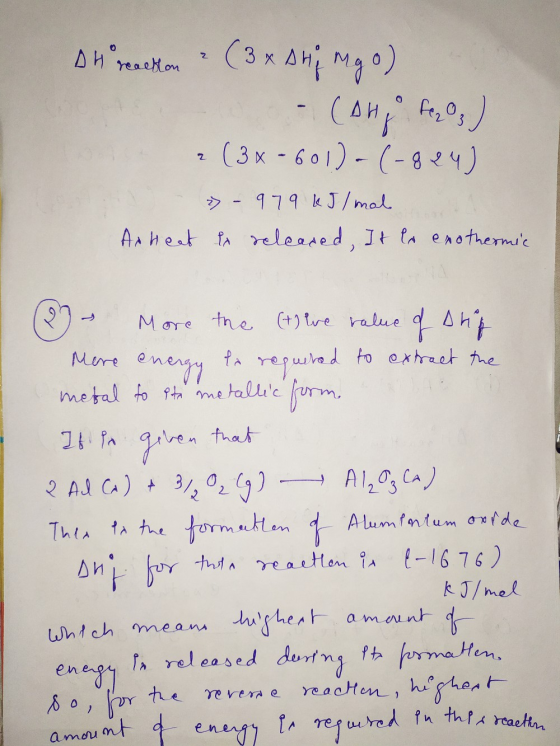
2. Which metal requires the most energy to extract (i.e. return to it's metallic form) from it's ore?
|
Reaction |
ΔHf° kJ/mol metal oxide |
|
2Au(s) + 3/2 O2(g) --> Au2O3(s) |
+131 |
|
2Ag(s) + 1/2 O2(g) --> Ag2O (s) |
-31 |
|
Cu(s) + 1/2 O2(g) --> CuO(s) |
-157 |
|
Pb(s) + 1/2 O2(g) --> PbO(s) |
-217 |
|
Sn(s) + O2(g) --> SnO2(s) |
-578 |
|
2Fe(s) + 3/2 O2(g) --> Fe2O3(s) |
-824 |
|
2Al(s) + 3/2 O2(g) --> Al2O3(s) |
-1676 |
Group of answer choices
a. aluminum
b. gold
c. lead
d. iron
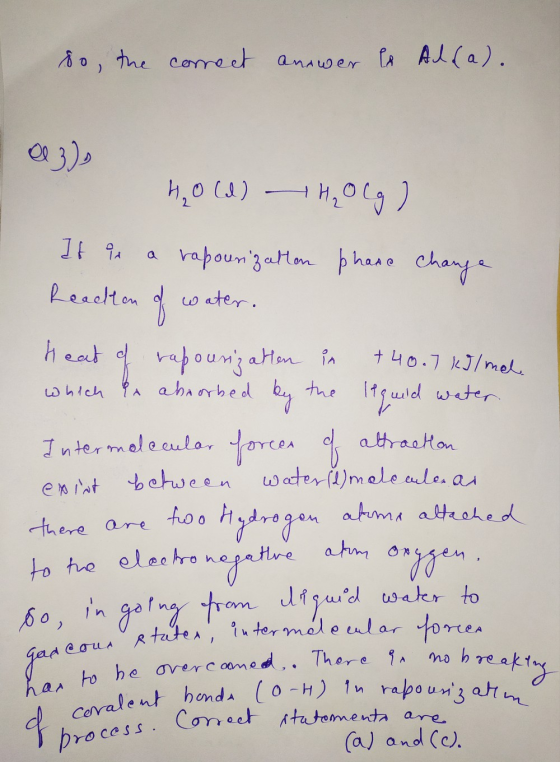
3. Which of the following statements are true about making H2O(g) from H2O(l)? Select all that apply.
Group of answer choices
a. The process requires the transfer of +40.7 kJ/mol to the liquid water.
b. The process involves breaking covalent bonds O-H bonds. Therefore you can use bond energies to determine the heat of the reaction.
c. The number of intermolecular attractions between water molecules decreases in the process.
Homework Answers
Add Answer to:
1. Which reaction(s) is/are exothermic? Select all that
apply.
ΔHf° in kJ/mol at 25°C
MgO
-601...
Given that: 2Al(s)+(3/2)O2(g)--->Al2O3(s) change in H(rxn)= -1601 kJ/mol 2Fe(s)+(3/2)O2(g)--->Fe2O3(s) change in H(rxn)= -821 kJ/mol Calculate the standard enthalpy change for the following reaction: 2Al(s)+Fe2O3(s)--->2Fe(s)+Al2O3(s)
Given that: 2Al(s)+(3/2)O2(g)--->Al2O3(s) change in H(rxn)= -1601 kJ/mol 2Fe(s)+(3/2)O2(g)--->Fe2O3(s) change in H(rxn)= -821 kJ/mol Calculate the standard enthalpy change for the following reaction: 2Al(s)+Fe2O3(s)--->2Fe(s)+Al2O3(s) _______kJ
C Using the heats of formation below, calculate the heat of reaction for the following reaction:...
 C Using the heats of formation below, calculate the heat of reaction for the following reaction: CH4(g) + H2O(g) → C2H5OH(E) AH® (kJ/mol) C2H4(g) 52.26 H2O(g) -241.8 C2H5OH(E) -235.1 kJ d Using the heats of formation below, calculate the heat of reaction for the following reaction: Fe2O3(s) + 2Al(s) - A1203(s) + 2Fe(s) AH(kJ/mol) Fe2O3(s) -824.2 Al(s) 0 Al2O3(s) -1676 Fe(s) 0 KJ
Be sure to answer all parts. Given that 2Al(s) + 3 2 O2(g) → Al2O3(s) ΔH...
Be sure to answer all parts. Given that 2Al(s) + 3 2 O2(g) → Al2O3(s) ΔH o rxn = −1601 kJ/mol and 2Fe(s) + 3 2 O2(g) → Fe2O3(s) ΔH o rxn = −821 kJ/mol calculate the standard enthalpy change for the following reaction: 2Al(s) + Fe2O3(s) → 2Fe(s) + Al2O3(s) Enter your answer in scientific notation.
10.Calculate the standard enthalpy change for the reaction 2Al(s) + Fe2O3(s) →2Fe(s) + Al2O3(s) given that...
Calculate the standard enthalpy change for the reaction 2Al(s)+Fe2O3(s) → 2Fe(s)+Al2O3(s)given that2 Al(s)+ 3/2O2(g) → Al2O3(s) ΔHrxn°=-1669.8 kJ/mol2 Fe(s)+3/2O2(g) → Fe2O3(s) ΔHrxn°=-822.2 kJ / mol
1) What is the ΔrG° for the following reaction (in kJ mol-1)? 2 Al (s) +...
1) What is the ΔrG° for the following reaction (in kJ mol-1)? 2 Al (s) + Fe2O3 (s) ⇌ Al2O3 (s) + 2 Fe (s) 2) What is the ΔrG° for the following reaction (in kJ mol-1)? C6H12O6 (s, glucose) + 6 O2 (g) ⇌ 6 CO2 (g) + 6 H2O (l) 3) What is the ΔrG for the following reaction (in kJ mol-1) at 298 K? 2 Si (s) + 3 H2 (g) ⇌ Si2H6 (g) The conditions for...
Calculate ΔHf for HCN(g) at 25°C, given the following related reaction at 25°C, 2 NH3(g) +...
Calculate ΔHf for HCN(g) at 25°C, given the following related reaction at 25°C, 2 NH3(g) + 3 O2(g) + 2 CH4(g) ---> 2 HCN(g) + 6 H2O(g); ΔHrxn = -870.8 kJ and the heats of formation of some species are ΔHf = -80.3 kJ/mol for NH3(g), -74.6 kJ/mol for CH4, and -241.8 kJ/mol for H2O(g). Answers are in kJ/mol.
For which process will AH° and AG be expected to be most similar? 2Al(s) + Fe2O3(s)...
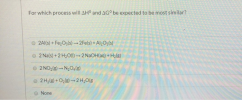 For which process will AH° and AG be expected to be most similar? 2Al(s) + Fe2O3(s) — 2Fe(s) + Al2O3(s) 2 Na(s) + 2 H2O(l) — 2NaOH(aq) + H2(g) OZN021312046 2 NO2(g) → N,04() 2H2(g) + O2(g) → 2 H2018 None
Consider the reaction Fe2O3(s) + 2Al(s)Al2O3(s) + 2Fe(s) for which H° = -851.5 kJ and S° = -37.00 J/K at 298.15 K. (1) C...
Consider the reaction Fe2O3(s) + 2Al(s)Al2O3(s) + 2Fe(s) for which H° = -851.5 kJ and S° = -37.00 J/K at 298.15 K. (1) Calculate the entropy change of the UNIVERSE when 2.108 moles of Fe2O3(s) react under standard conditions at 298.15 K. Suniverse = J/K (2) Is this reaction reactant or product favored under standard conditions? (3) If the reaction is product favored, is it enthalpy favored, entropy favored, or favored by both enthalpy and entropy? If the reaction is...
Given 2Al(s) + (3/2)O2(g) → Al2O3(s), AH°f = –1,670 kJ/mol for Al2O3 (s). Determine AH° for...
 Given 2Al(s) + (3/2)O2(g) → Al2O3(s), AH°f = –1,670 kJ/mol for Al2O3 (s). Determine AH° for the reaction 3Al2O3(s) →6Al(s) + (9/2)02(g). Write answer to three significant figures. Numeric Response
1. The highly exothermic thermite reaction, in which aluminum reduces iron (III) oxide to elemental iron,...
1. The highly exothermic thermite reaction, in which aluminum reduces iron (III) oxide to elemental iron, has been used by railroad repair crews to weld rails together. 2Al(s) + Fe2O3(s) → 2Fe(s) + Al2O3(s) ΔHrxn= -850 kJ How many moles of iron are formed when 335 kJ of heat is released? 2. Which element has the most metallic character? A. Sb B. p C. N D. Bi
 C Using the heats of formation below, calculate the heat of reaction for the following reaction: CH4(g) + H2O(g) → C2H5OH(E) AH® (kJ/mol) C2H4(g) 52.26 H2O(g) -241.8 C2H5OH(E) -235.1 kJ d Using the heats of formation below, calculate the heat of reaction for the following reaction: Fe2O3(s) + 2Al(s) - A1203(s) + 2Fe(s) AH(kJ/mol) Fe2O3(s) -824.2 Al(s) 0 Al2O3(s) -1676 Fe(s) 0 KJ
 For which process will AH° and AG be expected to be most similar? 2Al(s) + Fe2O3(s) — 2Fe(s) + Al2O3(s) 2 Na(s) + 2 H2O(l) — 2NaOH(aq) + H2(g) OZN021312046 2 NO2(g) → N,04() 2H2(g) + O2(g) → 2 H2018 None
 Given 2Al(s) + (3/2)O2(g) → Al2O3(s), AH°f = –1,670 kJ/mol for Al2O3 (s). Determine AH° for the reaction 3Al2O3(s) →6Al(s) + (9/2)02(g). Write answer to three significant figures. Numeric Response
Most questions answered within 3 hours.
-
Where is the error in this code sequence?
String s1 = "Hello";
String s2 = "ello";...
asked 10 months ago -
Financial data for Joel de Paris, Inc., for last year
follow:
Joel de Paris, Inc.
Balance...
asked 10 months ago -
Consider this reaction:
Al2(SO4)3 (aq)+ BaCl3
(aq) Al2Cl6 (aq)- +
3BaSO4(s) . What is the...
asked 10 months ago -
Suppose that Savneet is considering increasing her
recent random sample from 20 car rentals to 40...
asked 10 months ago -
Trucks arrive at an unloading terminal at an average rate of 120
per hour.
Trucks arrive...
asked 10 months ago -
Why are methanol and ethanol completely soluble in water while
octanol is not very little soluble....
asked 10 months ago -
A facilities manager at a university reads in a research report
that the mean amount of...
asked 10 months ago -
When the CuSO4 is rehydrated by adding water to the anhydrous
compound, is this an endothermic...
asked 10 months ago -
A ray of sunlight is passing from diamond into crown glass; the
angle of incidence is...
asked 10 months ago -
A block of mass 0.249 kg is placed on top of a light, vertical
spring of...
asked 10 months ago -
how do the kidneys compensate in the presences of acidosis
a) trigger hyperventilate
b) reserve acid...
asked 10 months ago -
Question 501 pts
The rental rate of capital to the firm increases. Which of the
following...
asked 10 months ago