The reaction of Cl2 with CH4 to produce methyl chloride is an example of a/an Multiple...
The reaction of Cl2 with CH4 to produce methyl chloride is an example of a/an
Multiple Choice
-
free radical reaction.
-
addition reaction.
-
reduction reaction.
-
ester hydrolysis.
-
polymerization
Homework Answers
 please hit thumbs up ....thank
you
please hit thumbs up ....thank
you
Add Answer to:
The reaction of Cl2 with CH4 to produce
methyl chloride is an example of a/an
Multiple...
The reaction of methyl chloride with aqueous sodium hydroxide to produce methanol and chloride ion is...
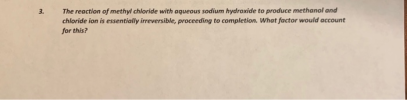 The reaction of methyl chloride with aqueous sodium hydroxide to produce methanol and chloride ion is essentially irreversible, proceeding to completion. What factor would account for this?
The reaction of methyl chloride with aqueous sodium hydroxide to produce methanol and chloride ion is...
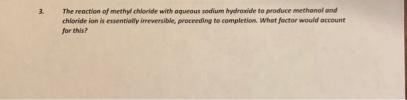 The reaction of methyl chloride with aqueous sodium hydroxide to produce methanol and chloride ion is essentially irreversible, proceeding to completion. What factor would account for this?
A reaction of 2-methyl-2-butene with NBS and heat forms both 1-bromo-2-methyl-2-butene and 3-bromo-2-methyl-1-butene. The reason for...
A reaction of 2-methyl-2-butene with NBS and heat forms both 1-bromo-2-methyl-2-butene and 3-bromo-2-methyl-1-butene. The reason for the formation of multiple products is: a)Markovnikov and Anti-markovnikov addition b)rearrangement of the radical by hydride shift c)resonance structures of the radical d) dibromination products
Consider the following chemical reaction: CH4 (g) + Cl2(g) + CCl4 (1) + CCl4 (I) +...
 Consider the following chemical reaction: CH4 (g) + Cl2(g) + CCl4 (1) + CCl4 (I) + HCl (g) Identify the type of chemical reaction that this is classified as: oxidation-reduction (redox) O precipitation + acid-base precipitation + redox precipitation acid-base
12) The first-order rate constant for the reaction of methyl chloride (CH3Cl) with water to produce...
12) The first-order rate constant for the reaction of methyl chloride (CH3Cl) with water to produce methanol (CH3OH) and hydrochloric acid (HCl) is 3.32 × 10^−10 s^−1 at 25°C. Calculate the rate constant at 50.1°C if the activation energy is 116 kJ/mol. _____ × 10^___s^-1 (Enter your answer in scientific notation.)
The industrial degreasing solvent methylene chloride,CH2Cl2, is prepared from methane by reaction with chlorine: CH4(g)+2Cl2(g)?CH2Cl2(g)+2HCl(g) Use...
The industrial degreasing solvent methylene chloride,CH2Cl2, is prepared from methane by reaction with chlorine: CH4(g)+2Cl2(g)?CH2Cl2(g)+2HCl(g) Use the following data to calculate ? H? in kilojoules for the reaction: CH4(g)+Cl2(g)?CH3Cl(g)+HCl(g)?H?=?98.3kJCH3Cl(g)+Cl2(g)?CH2Cl2(g)+HCl(g)?H?=?104kJ Express your answer using three significant figures.
can someone tell me which ones are correct, and the correct anwser? What is the correct...
 can someone tell me which ones are correct, and the correct
anwser?
What is the correct nucleophile for the reaction? HN ribose 0.01:03 ATP NH3 CH3NK2 NH2 Move to Archive ® Saved What is the product formed by hydrolysis of the following lactone with acid? Multiple Choice Move to Archive ® How can you convert a carboxylic acid into an acid chloride? Multiple Choice React with sodium chloride. O React with Cl2 and FeCl3. Heat with hydrochloric acid. React with...
can someone tell me which ones are correct, and the correct
anwser?
What is the correct nucleophile for the reaction? HN ribose 0.01:03 ATP NH3 CH3NK2 NH2 Move to Archive ® Saved What is the product formed by hydrolysis of the following lactone with acid? Multiple Choice Move to Archive ® How can you convert a carboxylic acid into an acid chloride? Multiple Choice React with sodium chloride. O React with Cl2 and FeCl3. Heat with hydrochloric acid. React with...
The overall reaction to produce chloroform from methane is CH4(g) + 3Cl2(g) ---> CHCl3(l) + 3HCl(g)....
The overall reaction to produce chloroform from methane is CH4(g) + 3Cl2(g) ---> CHCl3(l) + 3HCl(g). Use the following intermediate reactions to calculate the enthalpy of the reaction, Hrxn. 1/2 H2(g) + 1/2 Cl2(g) ---> HCl(g) Hrxn = -92.3 kj C(s) + 2H2(g) ----> CH4(g) Hrxn = -74.8 kj C(s) + 1/2 H2(g) + 3/2 Cl2(g) ----> CHCl3(l) Hrxn = -134.5 kj
2. Hydrogen chloride adds ionically to alkenes. In each case, predict the course of the reaction...
2. Hydrogen chloride adds ionically to alkenes. In each case, predict the course of the reaction of HCl with the following hydrocarbons by writing the structure of the product: (a) 1-butene, (b) 2- methylpropene, (c) 1-methyl-1-phenylethene. 3. Predict the course of the reaction of HBr with the substrates listed in Question 2 by providing the structure of the organic product. Assume that a free-radical process applies in all cases.
Use the bond energies below to estimate AH for the following reaction: CH4 (g) + Cl2...
Use the bond energies below to estimate AH for the following reaction: CH4 (g) + Cl2 (g) - CH3CI (g) + HCl (g) Bond Energies (kJ/mole) single bonds. multiple bonds H C. Cl H. 432. C=O 799 C. 412. 346. C=C.602 O. 459. 358. 142 C=C 835 Cl 431. 328. 242. O=O 494
 The reaction of methyl chloride with aqueous sodium hydroxide to produce methanol and chloride ion is essentially irreversible, proceeding to completion. What factor would account for this?
 The reaction of methyl chloride with aqueous sodium hydroxide to produce methanol and chloride ion is essentially irreversible, proceeding to completion. What factor would account for this?
 Consider the following chemical reaction: CH4 (g) + Cl2(g) + CCl4 (1) + CCl4 (I) + HCl (g) Identify the type of chemical reaction that this is classified as: oxidation-reduction (redox) O precipitation + acid-base precipitation + redox precipitation acid-base
 can someone tell me which ones are correct, and the correct
anwser?
What is the correct nucleophile for the reaction? HN ribose 0.01:03 ATP NH3 CH3NK2 NH2 Move to Archive ® Saved What is the product formed by hydrolysis of the following lactone with acid? Multiple Choice Move to Archive ® How can you convert a carboxylic acid into an acid chloride? Multiple Choice React with sodium chloride. O React with Cl2 and FeCl3. Heat with hydrochloric acid. React with...
can someone tell me which ones are correct, and the correct
anwser?
What is the correct nucleophile for the reaction? HN ribose 0.01:03 ATP NH3 CH3NK2 NH2 Move to Archive ® Saved What is the product formed by hydrolysis of the following lactone with acid? Multiple Choice Move to Archive ® How can you convert a carboxylic acid into an acid chloride? Multiple Choice React with sodium chloride. O React with Cl2 and FeCl3. Heat with hydrochloric acid. React with...
Most questions answered within 3 hours.
-
Where is the error in this code sequence?
String s1 = "Hello";
String s2 = "ello";...
asked 11 months ago -
Financial data for Joel de Paris, Inc., for last year
follow:
Joel de Paris, Inc.
Balance...
asked 11 months ago -
Consider this reaction:
Al2(SO4)3 (aq)+ BaCl3
(aq) Al2Cl6 (aq)- +
3BaSO4(s) . What is the...
asked 11 months ago -
Suppose that Savneet is considering increasing her
recent random sample from 20 car rentals to 40...
asked 11 months ago -
Trucks arrive at an unloading terminal at an average rate of 120
per hour.
Trucks arrive...
asked 11 months ago -
Why are methanol and ethanol completely soluble in water while
octanol is not very little soluble....
asked 11 months ago -
A facilities manager at a university reads in a research report
that the mean amount of...
asked 11 months ago -
When the CuSO4 is rehydrated by adding water to the anhydrous
compound, is this an endothermic...
asked 11 months ago -
A ray of sunlight is passing from diamond into crown glass; the
angle of incidence is...
asked 11 months ago -
A block of mass 0.249 kg is placed on top of a light, vertical
spring of...
asked 11 months ago -
how do the kidneys compensate in the presences of acidosis
a) trigger hyperventilate
b) reserve acid...
asked 11 months ago -
Question 501 pts
The rental rate of capital to the firm increases. Which of the
following...
asked 11 months ago