
Homework Answers
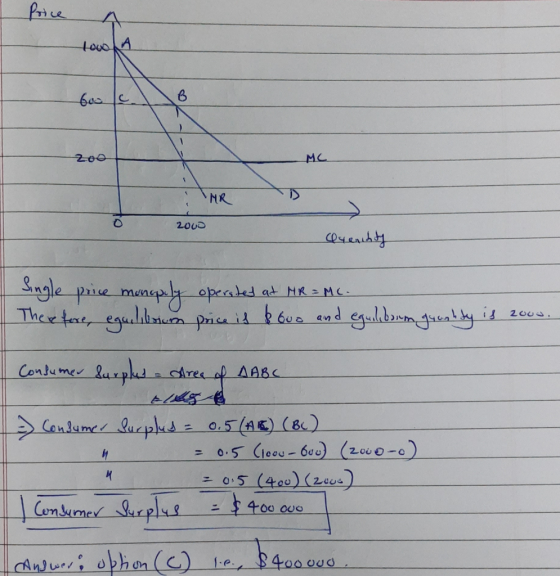
Add Answer to:
QUESTION 57 The following figure depicts the downward sloping market demand D curve for five day...
UIZ 11Suructions Question 3 2 pts The following figure depicts a generalized downward-sloping market demand (D)...
 UIZ 11Suructions Question 3 2 pts The following figure depicts a generalized downward-sloping market demand (D) curve for a product. It also shows the firm's relevant marginal revenue (MR) curve and marginal cost (MC) curve. Use this figure to answer the next six questions Price $10 10 + 20 + 30 40 + 50 + 60 Quantity If the firm can price discriminate perfectly, what would the producer surplus be? $120 $0 $160 500 O $40
Suppose a firm has market power and faces a downward-sloping demand curve for its product, and...
Suppose a firm has market power and faces a downward-sloping demand curve for its product, and its marginal cost curve is upward sloping. If the firm reduces its price, then A. producer surplus increases due to new buyers, but the producer surplus from existing customers declines due to the lower price. B. the sum of producer and consumer surplus remains the same, but surplus value is transferred from the producer to consumers. C. the change in producer surplus is transferred...
57. A profit-maximizing monopolist faces a downward-sloping demand curve that has a constant elasticity of -3....
 57. A profit-maximizing monopolist faces a downward-sloping demand curve that has a constant elasticity of -3. The firm finds it optimal to charge a price of $12 for its output. What is its marginal cost at this level of output?
1. Answer the following questions: a. Why is the demand curve for a monopolist downward-sloping, while...
 1. Answer the following questions:
a. Why is the demand curve for a monopolist downward-sloping,
while the demand curve for the perfectly competitive firm is
horizontal?
b. Suppose a perfectly competitive industry is suddenly
transformed to a monopoly industry. What will happen to price,
output, consumer and producer surplus, and deadweight loss?
c. If the wireless phone industry is dominated by four large
firms, each with 20% of market share, and 2 small firms, each with
10% market share, what...
1. Answer the following questions:
a. Why is the demand curve for a monopolist downward-sloping,
while the demand curve for the perfectly competitive firm is
horizontal?
b. Suppose a perfectly competitive industry is suddenly
transformed to a monopoly industry. What will happen to price,
output, consumer and producer surplus, and deadweight loss?
c. If the wireless phone industry is dominated by four large
firms, each with 20% of market share, and 2 small firms, each with
10% market share, what...
1) Consider a normal market with a downward-sloping demand curve and an upward-sloping supply curve. Which...
 1) Consider a normal market with a downward-sloping demand curve and an upward-sloping supply curve. Which of the following cases would definitely result in a decrease in consumer surplus? For each case, assume that the market is initially in equilibrium and that everything else is held constant except for the change described in the case Case 1: The supply curve shifts to the left. Case 2: The supp Case 3: The government imposes a binding price ceiling. Case 4: The...
SOVO Help Save & EXIT Which of the following characteristics lead to a downward-sloping demand curve?...
 SOVO Help Save & EXIT Which of the following characteristics lead to a downward-sloping demand curve? Instructions: You may select more than one answer. Click the box with a check mark for correct answers and click to empty the box for the wrong answers. An increase in purchasing power as market price decreases Diminishing marginal utility Increasing opportunity costs Increasing marginal benefit Diminishing preferences for a particular good A decline in the price of a related good How is a...
The following figure illustrates a standard market-demand curve and market-supply curve, with price per unit measured...
 The following figure illustrates a standard market-demand curve and market-supply curve, with price per unit measured on the vertical axis and quantity measured on the horizontal axis. Price Demand Supply 0 1 2 3 4 5 6 7 8 9 10 Quantity Figure Description: Quantity demanded and quantity supplied is measured on the horizontal axis and price per unit is measured on the vertical axis. One downward sloping demand curve is provided and is labeled Demand. One upward sloping supply...
2. If a firm faces a downward-sloping demand curve, then: a. the firm could be either...
 2. If a firm faces a downward-sloping demand curve,
then:
a. the firm could be either a perfectly competitive firm or an
imperfectly firm.
b. the firm’s marginal revenue from selling an additional unit
of output is less than price.
c. it is a perfectly competitive firm.
d. the firm’s production process exhibits economies of
scale.
3,
Refer to the figure below. Price εκ Ο Q2 Q3 Q3 Quantity When the market is unregulated, producer surplus is represented by the...
2. If a firm faces a downward-sloping demand curve,
then:
a. the firm could be either a perfectly competitive firm or an
imperfectly firm.
b. the firm’s marginal revenue from selling an additional unit
of output is less than price.
c. it is a perfectly competitive firm.
d. the firm’s production process exhibits economies of
scale.
3,
Refer to the figure below. Price εκ Ο Q2 Q3 Q3 Quantity When the market is unregulated, producer surplus is represented by the...
Suppose a firm is a monopoly. Its marginal cost curve is flat, and its average cost...
 Suppose a firm is a monopoly. Its marginal cost curve is flat,
and its average cost curve is downward sloping (because it has a
fixed cost).
1.) Using the point drawing
tool,
indicate the monopoly's profit-maximizing price and quantity in
the figure if it cannot price discriminate. Label this point
'e 1e1.'
2.) Using the rectangle drawing
tool,
indicate the monopoly's losses at the no price discrimination
profit-maximizing price and quantity. Label this rectangle
'Losses 1Losses1.'
3.) Using the point...
Suppose a firm is a monopoly. Its marginal cost curve is flat,
and its average cost curve is downward sloping (because it has a
fixed cost).
1.) Using the point drawing
tool,
indicate the monopoly's profit-maximizing price and quantity in
the figure if it cannot price discriminate. Label this point
'e 1e1.'
2.) Using the rectangle drawing
tool,
indicate the monopoly's losses at the no price discrimination
profit-maximizing price and quantity. Label this rectangle
'Losses 1Losses1.'
3.) Using the point...
QUESTION 2 The demand curve faced by a monopolistically competitive firm is: flat. kinked. upward-sloping. downward-sloping...
 QUESTION 2 The demand curve faced by a monopolistically competitive firm is: flat. kinked. upward-sloping. downward-sloping QUESTION 3 Without a product differentiation, the demand curve for a monopolistically competitive firm would look like that of: O a monopoly firm. O a perfectly competitive firm. an oligopoly firm. a duopoly firm. QUESTION 4 Aside from advertising, how can monopolistically competitive firms increase demand for their products?! government edict. increasing its price. decreasing its price. Increasing the number of locations where it...
 UIZ 11Suructions Question 3 2 pts The following figure depicts a generalized downward-sloping market demand (D) curve for a product. It also shows the firm's relevant marginal revenue (MR) curve and marginal cost (MC) curve. Use this figure to answer the next six questions Price $10 10 + 20 + 30 40 + 50 + 60 Quantity If the firm can price discriminate perfectly, what would the producer surplus be? $120 $0 $160 500 O $40
 57. A profit-maximizing monopolist faces a downward-sloping demand curve that has a constant elasticity of -3. The firm finds it optimal to charge a price of $12 for its output. What is its marginal cost at this level of output?
 1. Answer the following questions:
a. Why is the demand curve for a monopolist downward-sloping,
while the demand curve for the perfectly competitive firm is
horizontal?
b. Suppose a perfectly competitive industry is suddenly
transformed to a monopoly industry. What will happen to price,
output, consumer and producer surplus, and deadweight loss?
c. If the wireless phone industry is dominated by four large
firms, each with 20% of market share, and 2 small firms, each with
10% market share, what...
1. Answer the following questions:
a. Why is the demand curve for a monopolist downward-sloping,
while the demand curve for the perfectly competitive firm is
horizontal?
b. Suppose a perfectly competitive industry is suddenly
transformed to a monopoly industry. What will happen to price,
output, consumer and producer surplus, and deadweight loss?
c. If the wireless phone industry is dominated by four large
firms, each with 20% of market share, and 2 small firms, each with
10% market share, what...
 1) Consider a normal market with a downward-sloping demand curve and an upward-sloping supply curve. Which of the following cases would definitely result in a decrease in consumer surplus? For each case, assume that the market is initially in equilibrium and that everything else is held constant except for the change described in the case Case 1: The supply curve shifts to the left. Case 2: The supp Case 3: The government imposes a binding price ceiling. Case 4: The...
 SOVO Help Save & EXIT Which of the following characteristics lead to a downward-sloping demand curve? Instructions: You may select more than one answer. Click the box with a check mark for correct answers and click to empty the box for the wrong answers. An increase in purchasing power as market price decreases Diminishing marginal utility Increasing opportunity costs Increasing marginal benefit Diminishing preferences for a particular good A decline in the price of a related good How is a...
 The following figure illustrates a standard market-demand curve and market-supply curve, with price per unit measured on the vertical axis and quantity measured on the horizontal axis. Price Demand Supply 0 1 2 3 4 5 6 7 8 9 10 Quantity Figure Description: Quantity demanded and quantity supplied is measured on the horizontal axis and price per unit is measured on the vertical axis. One downward sloping demand curve is provided and is labeled Demand. One upward sloping supply...
 2. If a firm faces a downward-sloping demand curve,
then:
a. the firm could be either a perfectly competitive firm or an
imperfectly firm.
b. the firm’s marginal revenue from selling an additional unit
of output is less than price.
c. it is a perfectly competitive firm.
d. the firm’s production process exhibits economies of
scale.
3,
Refer to the figure below. Price εκ Ο Q2 Q3 Q3 Quantity When the market is unregulated, producer surplus is represented by the...
2. If a firm faces a downward-sloping demand curve,
then:
a. the firm could be either a perfectly competitive firm or an
imperfectly firm.
b. the firm’s marginal revenue from selling an additional unit
of output is less than price.
c. it is a perfectly competitive firm.
d. the firm’s production process exhibits economies of
scale.
3,
Refer to the figure below. Price εκ Ο Q2 Q3 Q3 Quantity When the market is unregulated, producer surplus is represented by the...
 Suppose a firm is a monopoly. Its marginal cost curve is flat,
and its average cost curve is downward sloping (because it has a
fixed cost).
1.) Using the point drawing
tool,
indicate the monopoly's profit-maximizing price and quantity in
the figure if it cannot price discriminate. Label this point
'e 1e1.'
2.) Using the rectangle drawing
tool,
indicate the monopoly's losses at the no price discrimination
profit-maximizing price and quantity. Label this rectangle
'Losses 1Losses1.'
3.) Using the point...
Suppose a firm is a monopoly. Its marginal cost curve is flat,
and its average cost curve is downward sloping (because it has a
fixed cost).
1.) Using the point drawing
tool,
indicate the monopoly's profit-maximizing price and quantity in
the figure if it cannot price discriminate. Label this point
'e 1e1.'
2.) Using the rectangle drawing
tool,
indicate the monopoly's losses at the no price discrimination
profit-maximizing price and quantity. Label this rectangle
'Losses 1Losses1.'
3.) Using the point...
 QUESTION 2 The demand curve faced by a monopolistically competitive firm is: flat. kinked. upward-sloping. downward-sloping QUESTION 3 Without a product differentiation, the demand curve for a monopolistically competitive firm would look like that of: O a monopoly firm. O a perfectly competitive firm. an oligopoly firm. a duopoly firm. QUESTION 4 Aside from advertising, how can monopolistically competitive firms increase demand for their products?! government edict. increasing its price. decreasing its price. Increasing the number of locations where it...
Most questions answered within 3 hours.
-
Where is the error in this code sequence?
String s1 = "Hello";
String s2 = "ello";...
asked 10 months ago -
Financial data for Joel de Paris, Inc., for last year
follow:
Joel de Paris, Inc.
Balance...
asked 10 months ago -
Consider this reaction:
Al2(SO4)3 (aq)+ BaCl3
(aq) Al2Cl6 (aq)- +
3BaSO4(s) . What is the...
asked 10 months ago -
Suppose that Savneet is considering increasing her
recent random sample from 20 car rentals to 40...
asked 10 months ago -
Trucks arrive at an unloading terminal at an average rate of 120
per hour.
Trucks arrive...
asked 10 months ago -
Why are methanol and ethanol completely soluble in water while
octanol is not very little soluble....
asked 10 months ago -
A facilities manager at a university reads in a research report
that the mean amount of...
asked 10 months ago -
When the CuSO4 is rehydrated by adding water to the anhydrous
compound, is this an endothermic...
asked 10 months ago -
A ray of sunlight is passing from diamond into crown glass; the
angle of incidence is...
asked 10 months ago -
A block of mass 0.249 kg is placed on top of a light, vertical
spring of...
asked 10 months ago -
how do the kidneys compensate in the presences of acidosis
a) trigger hyperventilate
b) reserve acid...
asked 10 months ago -
Question 501 pts
The rental rate of capital to the firm increases. Which of the
following...
asked 10 months ago