
Homework Answers
Add Answer to:
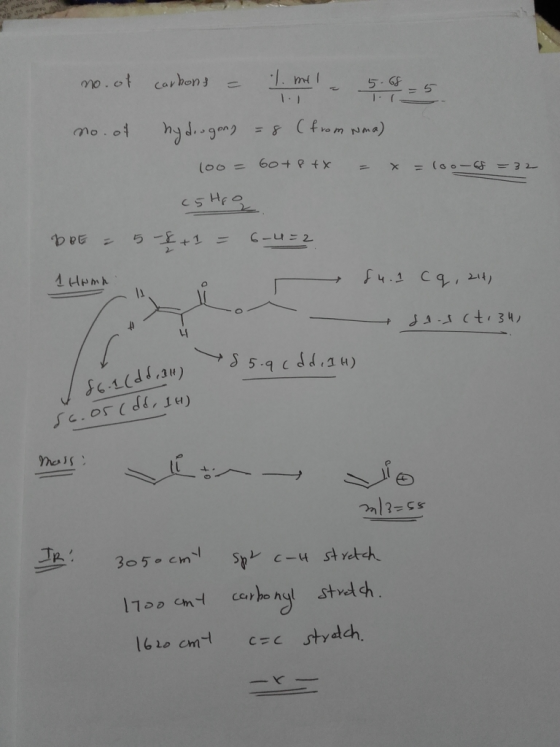
give the structure.
COMPOUND 149 PARED PROGRAM TEL TRANSIT TITI 10 11 Mass Data: of base...
Structure of the spectrum COMPOUND 112 D SPECOGRAM 3000 2500 2000 100 ta0 CMnoe o00 12...
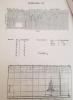 Structure of the spectrum
COMPOUND 112 D SPECOGRAM 3000 2500 2000 100 ta0 CMnoe o00 12 La 15 MCRONS Mass Data: m/e % of base peak Isotope abundance: % of parent peak m/e 27 34 88 (P) 100 4.50 28 7 89 (P+1) 29 90 (P+2) 0.52 39 15 41 42 42 12 43 100 C4H O 45 13 73 25 88 10 w JUU and 1400-1300 S PERCENT RANSMITTANCE on 8
Structure of the spectrum
COMPOUND 112 D SPECOGRAM 3000 2500 2000 100 ta0 CMnoe o00 12 La 15 MCRONS Mass Data: m/e % of base peak Isotope abundance: % of parent peak m/e 27 34 88 (P) 100 4.50 28 7 89 (P+1) 29 90 (P+2) 0.52 39 15 41 42 42 12 43 100 C4H O 45 13 73 25 88 10 w JUU and 1400-1300 S PERCENT RANSMITTANCE on 8
5. Identify the base peak in your mass spectrum. 6. Are there other significant isotope patterns...
 5. Identify the base peak in your mass spectrum. 6. Are there other significant isotope patterns in your mass spectrum? If so, what do they indicate? 7. Provide at least one fragment (not the parent ion) that was useful in determining (or confirming) the structure of the unknown and briefly explain how it was useful. Compound 14 is a liquid (b.p. 85") which finds its greatest application as an aprotic solvent UV-transparent; IR-liquid fim. MASS SPECTRAL DATA 99 100 Mass...
2. (3 points) Based on the spectral data provided, (a) determine the structure of the unknown compound (C6H120; (b)...
 2. (3 points) Based on the spectral data provided, (a) determine the structure of the unknown compound (C6H120; (b) assign ALL major peaks in the mass spec (if there is an molecular ion, base peak, alpha- cleavage or McLafferty rearrangement label the signal as such) and IR that led to the identification of your compound. L00 s000 4500 200e a00 sVENEPI 100 80 60- 40- 20 120 110 100 90 80 70 60 50 40 30 20 10 m/z Relative...
8. Use the spectral data below to propose structure(s) for the compound labeled Y, which can...
 8. Use the spectral data below to propose structure(s) for the compound labeled Y, which can be identified from the MS, IR, spectra presented below. (2 pts) a) Determine the molecular formula (MF = C.H. e) from the molecular ion on the MS using the Rule 13 where (MW/13) En+r. Since the M+2 peak is approximately 1/3 of the intensity of the molecular peak, this is an indication that the compound contain a cl _atom. Make the necessary substitution for...
8. Give several pieces of data you gathered from the IR spectrum that aided in determining...
 8. Give several pieces of data you gathered from the IR spectrum that aided in determining (or confirming) the structure of your unknown. For example, you might mention the presence (or absence) of certain definitive peaks (include wavenumbers). Do NOT use anything from the fingerprint region. 9. Fill in the table below with the information on each unique 1H-NMR signal. You may treat all aromatic protons as a single signal if that helps. Peak Chemical Shift (8) # of *10...
I am not understanding this assignment at all. Any assistance is very much appreciated. Mass Spectrum: Molecular Ion m/z value and structure of the Molecular Ion. Base Peak m/z value and structure of...
 I am not understanding this assignment at all. Any assistance is
very much appreciated.
Mass Spectrum:
Molecular Ion m/z value and structure of the Molecular Ion.
Base Peak m/z value and structure of that ion
One other significant peak m/z value and structure of that
ion
C13 NMR Spectrum-- Draw Structure of Compound
on the C13 NMR spectrum and identify each signal with the
appropriate Carbon.
Proton NMR Spectrum-- Draw Structure of
Compound on the Proton NMR spectrum and identify...
I am not understanding this assignment at all. Any assistance is
very much appreciated.
Mass Spectrum:
Molecular Ion m/z value and structure of the Molecular Ion.
Base Peak m/z value and structure of that ion
One other significant peak m/z value and structure of that
ion
C13 NMR Spectrum-- Draw Structure of Compound
on the C13 NMR spectrum and identify each signal with the
appropriate Carbon.
Proton NMR Spectrum-- Draw Structure of
Compound on the Proton NMR spectrum and identify...
Propose a reasonable structure for this compound based on the mass spec, IR, and NMR data....
 Propose a reasonable structure for this compound based on the mass spec, IR, and NMR data. 100 Relative Intensity M+ 10 20 30 40 60 70 80 90 50 m/z LUU TRINETTRICET 4000 3000 2000 cm1 1500 1000 500 ЗН Зн 2H тттттттттттттттттт 11 10 9 8 7 6 5 4 ppm 200 180 160 140 120 80 60 40 20 100 ppm
Consider the data provided in appendix B containing the mass spectrum, the IR spectrum and the...
 Consider the data provided in appendix B containing the mass spectrum, the IR spectrum and the 'H NMR of an unknown compound. Determine the structure of this compound base on the data provided. (Make sure to show your work). 100 80 117 M 60 abundance 40 20 . = . 0 10 20 30 40 50 60 70 80 90 100 110 120 130' 140' 150 160 3.5 wavelength (um) 5.5 4.5 6 7 8 9 10 11 12 13...
Question 4 Consider the data provided in appendix B containing the mass spectrum, the IR spectrum...
 Question 4 Consider the data provided in appendix B containing the mass spectrum, the IR spectrum and the 'H NMR of an unknown compound. Determine the structure of this compound base on the data provided. 100 117 M 80 60 abundance 40 20 0 10 20 30 40 50 60 70 100 110 120 130 140 150 160 80 90 ml 3 wavelength cm S 5.5 6 3.5 4.5 7 8 9 10 11 12 13 14 15 16 20...
Question 4 Consider the data provided in appendix B containing the mass spectrum, the IR spectrum...
 Question 4 Consider the data provided in appendix B containing the mass spectrum, the IR spectrum and the 'H NMR of an unknown compound. Determine the structure of this compound base on the data provided. (Make sure to show your work). Appendix B (question 4) 100 80 117 M 60 abundance 40 20 0 10 .. 60 20 30 40 50 70 80 90 100 110 120 130 140 150 160 3.5 4 4.5 wavelength (m) 5 5.5 6 8...
 Structure of the spectrum
COMPOUND 112 D SPECOGRAM 3000 2500 2000 100 ta0 CMnoe o00 12 La 15 MCRONS Mass Data: m/e % of base peak Isotope abundance: % of parent peak m/e 27 34 88 (P) 100 4.50 28 7 89 (P+1) 29 90 (P+2) 0.52 39 15 41 42 42 12 43 100 C4H O 45 13 73 25 88 10 w JUU and 1400-1300 S PERCENT RANSMITTANCE on 8
Structure of the spectrum
COMPOUND 112 D SPECOGRAM 3000 2500 2000 100 ta0 CMnoe o00 12 La 15 MCRONS Mass Data: m/e % of base peak Isotope abundance: % of parent peak m/e 27 34 88 (P) 100 4.50 28 7 89 (P+1) 29 90 (P+2) 0.52 39 15 41 42 42 12 43 100 C4H O 45 13 73 25 88 10 w JUU and 1400-1300 S PERCENT RANSMITTANCE on 8
 5. Identify the base peak in your mass spectrum. 6. Are there other significant isotope patterns in your mass spectrum? If so, what do they indicate? 7. Provide at least one fragment (not the parent ion) that was useful in determining (or confirming) the structure of the unknown and briefly explain how it was useful. Compound 14 is a liquid (b.p. 85") which finds its greatest application as an aprotic solvent UV-transparent; IR-liquid fim. MASS SPECTRAL DATA 99 100 Mass...
 2. (3 points) Based on the spectral data provided, (a) determine the structure of the unknown compound (C6H120; (b) assign ALL major peaks in the mass spec (if there is an molecular ion, base peak, alpha- cleavage or McLafferty rearrangement label the signal as such) and IR that led to the identification of your compound. L00 s000 4500 200e a00 sVENEPI 100 80 60- 40- 20 120 110 100 90 80 70 60 50 40 30 20 10 m/z Relative...
 8. Use the spectral data below to propose structure(s) for the compound labeled Y, which can be identified from the MS, IR, spectra presented below. (2 pts) a) Determine the molecular formula (MF = C.H. e) from the molecular ion on the MS using the Rule 13 where (MW/13) En+r. Since the M+2 peak is approximately 1/3 of the intensity of the molecular peak, this is an indication that the compound contain a cl _atom. Make the necessary substitution for...
 8. Give several pieces of data you gathered from the IR spectrum that aided in determining (or confirming) the structure of your unknown. For example, you might mention the presence (or absence) of certain definitive peaks (include wavenumbers). Do NOT use anything from the fingerprint region. 9. Fill in the table below with the information on each unique 1H-NMR signal. You may treat all aromatic protons as a single signal if that helps. Peak Chemical Shift (8) # of *10...
 I am not understanding this assignment at all. Any assistance is
very much appreciated.
Mass Spectrum:
Molecular Ion m/z value and structure of the Molecular Ion.
Base Peak m/z value and structure of that ion
One other significant peak m/z value and structure of that
ion
C13 NMR Spectrum-- Draw Structure of Compound
on the C13 NMR spectrum and identify each signal with the
appropriate Carbon.
Proton NMR Spectrum-- Draw Structure of
Compound on the Proton NMR spectrum and identify...
I am not understanding this assignment at all. Any assistance is
very much appreciated.
Mass Spectrum:
Molecular Ion m/z value and structure of the Molecular Ion.
Base Peak m/z value and structure of that ion
One other significant peak m/z value and structure of that
ion
C13 NMR Spectrum-- Draw Structure of Compound
on the C13 NMR spectrum and identify each signal with the
appropriate Carbon.
Proton NMR Spectrum-- Draw Structure of
Compound on the Proton NMR spectrum and identify...
 Propose a reasonable structure for this compound based on the mass spec, IR, and NMR data. 100 Relative Intensity M+ 10 20 30 40 60 70 80 90 50 m/z LUU TRINETTRICET 4000 3000 2000 cm1 1500 1000 500 ЗН Зн 2H тттттттттттттттттт 11 10 9 8 7 6 5 4 ppm 200 180 160 140 120 80 60 40 20 100 ppm
 Consider the data provided in appendix B containing the mass spectrum, the IR spectrum and the 'H NMR of an unknown compound. Determine the structure of this compound base on the data provided. (Make sure to show your work). 100 80 117 M 60 abundance 40 20 . = . 0 10 20 30 40 50 60 70 80 90 100 110 120 130' 140' 150 160 3.5 wavelength (um) 5.5 4.5 6 7 8 9 10 11 12 13...
 Question 4 Consider the data provided in appendix B containing the mass spectrum, the IR spectrum and the 'H NMR of an unknown compound. Determine the structure of this compound base on the data provided. 100 117 M 80 60 abundance 40 20 0 10 20 30 40 50 60 70 100 110 120 130 140 150 160 80 90 ml 3 wavelength cm S 5.5 6 3.5 4.5 7 8 9 10 11 12 13 14 15 16 20...
 Question 4 Consider the data provided in appendix B containing the mass spectrum, the IR spectrum and the 'H NMR of an unknown compound. Determine the structure of this compound base on the data provided. (Make sure to show your work). Appendix B (question 4) 100 80 117 M 60 abundance 40 20 0 10 .. 60 20 30 40 50 70 80 90 100 110 120 130 140 150 160 3.5 4 4.5 wavelength (m) 5 5.5 6 8...
Most questions answered within 3 hours.
-
Where is the error in this code sequence?
String s1 = "Hello";
String s2 = "ello";...
asked 10 months ago -
Financial data for Joel de Paris, Inc., for last year
follow:
Joel de Paris, Inc.
Balance...
asked 10 months ago -
Consider this reaction:
Al2(SO4)3 (aq)+ BaCl3
(aq) Al2Cl6 (aq)- +
3BaSO4(s) . What is the...
asked 10 months ago -
Suppose that Savneet is considering increasing her
recent random sample from 20 car rentals to 40...
asked 10 months ago -
Trucks arrive at an unloading terminal at an average rate of 120
per hour.
Trucks arrive...
asked 10 months ago -
Why are methanol and ethanol completely soluble in water while
octanol is not very little soluble....
asked 10 months ago -
A facilities manager at a university reads in a research report
that the mean amount of...
asked 10 months ago -
When the CuSO4 is rehydrated by adding water to the anhydrous
compound, is this an endothermic...
asked 10 months ago -
A ray of sunlight is passing from diamond into crown glass; the
angle of incidence is...
asked 10 months ago -
A block of mass 0.249 kg is placed on top of a light, vertical
spring of...
asked 10 months ago -
how do the kidneys compensate in the presences of acidosis
a) trigger hyperventilate
b) reserve acid...
asked 10 months ago -
Question 501 pts
The rental rate of capital to the firm increases. Which of the
following...
asked 10 months ago