
Homework Answers
Add Answer to:
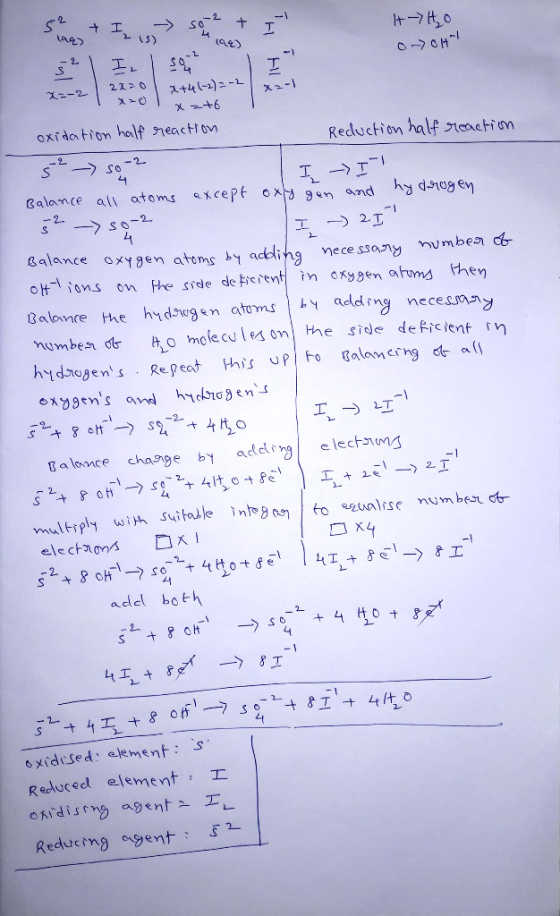
4) S2 Cag) + ICs) Sou? Caq) + I Cag) In basic solution, what's oxidized I...
QUESTION 4 AD + BC? What basic type of reaction is illustrated by the general equation...
 QUESTION 4 AD + BC? What basic type of reaction is illustrated by the general equation AB + CD a. Decomposition b. Exchange O c. Single-replacement Od. Combination QUESTION 5 Which of the following statements concerning redox reactions is incorrect? a. The oxidizing agent loses electrons. b. The substance oxidized loses electrons. c. The oxidizing agent is the substance reduced. d. The reducing agent is the substance oxidized. QUESTION 6 Which of the following will influence all reaction rates? a....
Activity Series for Metals following redox reactions, which take place in a basic solution. 3. Balance...
 Activity Series for Metals following redox reactions, which take place in a basic solution. 3. Balance the Bromine water was added dropwise to test tubes containing aqueous solutions of bromide, chloride, and iodide. Iodide was oxidized to iodine; bromide and chloride gave no reaction. Arrange Br2, Cl2.12 in order of their strength as an oxidizing agent. 4. Strongest oxidizing agent: 5. (optional) Consider the following redox equation: 2K1 + Cl2 → 12 + 2KCI Identify the reactant undergoing: (a) oxidation...
SiCl4(l) + 2 H2O(l) → 4 HCl(aq) + SiO2(s) So I thought that SiCL_4 was the...
SiCl4(l) + 2 H2O(l) → 4 HCl(aq) + SiO2(s) So I thought that SiCL_4 was the oxidized/reducing agent and that H_2O was the reduced/oxidizing agent. Can someone explain to me why this is not oxidation-reduction reaction?
Complete and balance the reaction in acidic solution. equation: ZnS+NO−3⟶Zn2++S+NOZnS+NO3−⟶Zn2++S+NO Which element is oxidized? SS NN...
Complete and balance the reaction in acidic solution. equation: ZnS+NO−3⟶Zn2++S+NOZnS+NO3−⟶Zn2++S+NO Which element is oxidized? SS NN ZnZn Which element is reduced? SS NN ZnZn Which species is the oxidizing agent? ZnSZnS NO−3NO3− Zn2+Zn2+ Which species is the reducing agent? ZnSZnS NO−3NO3− Zn2+
Oxidation reduction reaction 4. Substances A, B, C can all act as oxidizing agents. In solution,...
 Oxidation reduction reaction
4. Substances A, B, C can all act as oxidizing agents. In solution, A is green, B is red, and C is yellow. I C ions, al ions, the color remains red. n the reactions in which they participate, they are reduced to A, B, and Il of which are colorless. When solution B is mixed with one containing C Which species is oxidized? Which species is reduced? When a solution of B is mixed with a...
Oxidation reduction reaction
4. Substances A, B, C can all act as oxidizing agents. In solution, A is green, B is red, and C is yellow. I C ions, al ions, the color remains red. n the reactions in which they participate, they are reduced to A, B, and Il of which are colorless. When solution B is mixed with one containing C Which species is oxidized? Which species is reduced? When a solution of B is mixed with a...
The concentration of hydrogen peroxide solution can be determined by titration against a standardized solution or...
 The concentration of hydrogen peroxide solution can be determined by titration against a standardized solution or potassium permanganate in acidic medium according to the following equation: 2MnO4 + 5H2O2 + 6H* -----> 502 + 2Mn+2 + 8H2O What is being oxidized? What is being reduced? What is the oxidizing agent? What is the reducing agent? If 36.44 mL of a 0.01652 M KMnO4 solution are required to oxidize 25.00 mL of a H2O2 solution, calculate the molarity of the H2O2...
Pes04./120- Which element is oxidized (Reducing agent), and which is reduced (Oxidizing agent) in the following...
 Pes04./120- Which element is oxidized (Reducing agent), and which is reduced (Oxidizing agent) in the following reactions? a) Cl2 + 2NaBr → 2NaCl + Br2 b) Zn + Cl2 → Zn Cl2 c) Fe2O3 + 3C0 2Fe + 3CO2 4. Calculate the following quantities: a) Molarity of a solution that contains 0.0225 mol Na2SO4 in 400 ml solution b) Moles of HNO3 in 45.0 ml of 2.50 M solution of nitric acid c) Milliliters of 2.00 M Ca(OH)2 solution needed...
1. (4 points) For the following redox reaction. State what gets reduced and oxidized. State what...
 1. (4 points) For the following redox reaction. State what gets reduced and oxidized. State what the oxidizing and reducing agents are. Cl2 2KI2KCl 12
For the following redox reaction: Cu(s) + HNO3(aq) → Cu2+(aq) + NO(g) a) Assign oxidation states...
For the following redox reaction: Cu(s) + HNO3(aq) → Cu2+(aq) + NO(g) a) Assign oxidation states to each of the elements in the reaction. b) Tell what is being oxidized, what is being reduced, what is the oxidizing agent and what is the reducing agent. c) Use the half-reaction method to balance the reaction as if it were taking place in acidic solution. d) Then balance the reaction as if it were taking place in basic solution. You do not...
1. A 75.0-mL sample of 0.200 M Lead(II) nitrate, Pb(NO3)2, is reacted with 75.0 mL of...
1. A 75.0-mL sample of 0.200 M Lead(II) nitrate, Pb(NO3)2, is reacted with 75.0 mL of 0.450 M KI solution and the following precipitation reaction occurs. Pb(NO3)2(aq) + 2KI(aq) → PbI2(s) + 2KNO3(aq) (a) Determine the limiting reactant. (b) How many grams of PbI2 will be formed if the yield is 100%? (c) What is the percent yield if 6.45 g of PbI2 were obtained? (2) K2Cr2O7(aq) + FeCl2(aq) → CrCl3(aq) + Fe(NO3)3(aq) (a) Determine the net ionic reactions and...
 QUESTION 4 AD + BC? What basic type of reaction is illustrated by the general equation AB + CD a. Decomposition b. Exchange O c. Single-replacement Od. Combination QUESTION 5 Which of the following statements concerning redox reactions is incorrect? a. The oxidizing agent loses electrons. b. The substance oxidized loses electrons. c. The oxidizing agent is the substance reduced. d. The reducing agent is the substance oxidized. QUESTION 6 Which of the following will influence all reaction rates? a....
 Activity Series for Metals following redox reactions, which take place in a basic solution. 3. Balance the Bromine water was added dropwise to test tubes containing aqueous solutions of bromide, chloride, and iodide. Iodide was oxidized to iodine; bromide and chloride gave no reaction. Arrange Br2, Cl2.12 in order of their strength as an oxidizing agent. 4. Strongest oxidizing agent: 5. (optional) Consider the following redox equation: 2K1 + Cl2 → 12 + 2KCI Identify the reactant undergoing: (a) oxidation...
 Oxidation reduction reaction
4. Substances A, B, C can all act as oxidizing agents. In solution, A is green, B is red, and C is yellow. I C ions, al ions, the color remains red. n the reactions in which they participate, they are reduced to A, B, and Il of which are colorless. When solution B is mixed with one containing C Which species is oxidized? Which species is reduced? When a solution of B is mixed with a...
Oxidation reduction reaction
4. Substances A, B, C can all act as oxidizing agents. In solution, A is green, B is red, and C is yellow. I C ions, al ions, the color remains red. n the reactions in which they participate, they are reduced to A, B, and Il of which are colorless. When solution B is mixed with one containing C Which species is oxidized? Which species is reduced? When a solution of B is mixed with a...
 The concentration of hydrogen peroxide solution can be determined by titration against a standardized solution or potassium permanganate in acidic medium according to the following equation: 2MnO4 + 5H2O2 + 6H* -----> 502 + 2Mn+2 + 8H2O What is being oxidized? What is being reduced? What is the oxidizing agent? What is the reducing agent? If 36.44 mL of a 0.01652 M KMnO4 solution are required to oxidize 25.00 mL of a H2O2 solution, calculate the molarity of the H2O2...
 Pes04./120- Which element is oxidized (Reducing agent), and which is reduced (Oxidizing agent) in the following reactions? a) Cl2 + 2NaBr → 2NaCl + Br2 b) Zn + Cl2 → Zn Cl2 c) Fe2O3 + 3C0 2Fe + 3CO2 4. Calculate the following quantities: a) Molarity of a solution that contains 0.0225 mol Na2SO4 in 400 ml solution b) Moles of HNO3 in 45.0 ml of 2.50 M solution of nitric acid c) Milliliters of 2.00 M Ca(OH)2 solution needed...
 1. (4 points) For the following redox reaction. State what gets reduced and oxidized. State what the oxidizing and reducing agents are. Cl2 2KI2KCl 12
Most questions answered within 3 hours.
-
Where is the error in this code sequence?
String s1 = "Hello";
String s2 = "ello";...
asked 10 months ago -
Financial data for Joel de Paris, Inc., for last year
follow:
Joel de Paris, Inc.
Balance...
asked 10 months ago -
Consider this reaction:
Al2(SO4)3 (aq)+ BaCl3
(aq) Al2Cl6 (aq)- +
3BaSO4(s) . What is the...
asked 10 months ago -
Suppose that Savneet is considering increasing her
recent random sample from 20 car rentals to 40...
asked 10 months ago -
Trucks arrive at an unloading terminal at an average rate of 120
per hour.
Trucks arrive...
asked 10 months ago -
Why are methanol and ethanol completely soluble in water while
octanol is not very little soluble....
asked 10 months ago -
A facilities manager at a university reads in a research report
that the mean amount of...
asked 10 months ago -
When the CuSO4 is rehydrated by adding water to the anhydrous
compound, is this an endothermic...
asked 10 months ago -
A ray of sunlight is passing from diamond into crown glass; the
angle of incidence is...
asked 10 months ago -
A block of mass 0.249 kg is placed on top of a light, vertical
spring of...
asked 10 months ago -
how do the kidneys compensate in the presences of acidosis
a) trigger hyperventilate
b) reserve acid...
asked 10 months ago -
Question 501 pts
The rental rate of capital to the firm increases. Which of the
following...
asked 10 months ago