![1. [Mn(H2O)6]2* Draw the possible stereoisomers. Give the oxidation state of the metal. Identify the donor atoms. Draw the st](http://img.homeworklib.com/questions/8abda840-7876-11ea-8cb5-6ff9e23b0cb4.png?x-oss-process=image/resize,w_560)
Homework Answers
![- +2 [Mn(+2)] It is a symmetrical molecule, so it may not show any stereoisomerism, * onidation state of the metal. - Mn (H2O](http://img.homeworklib.com/questions/8b5acc80-7876-11ea-b9db-2b58e32db0a8.png?x-oss-process=image/resize,w_560)
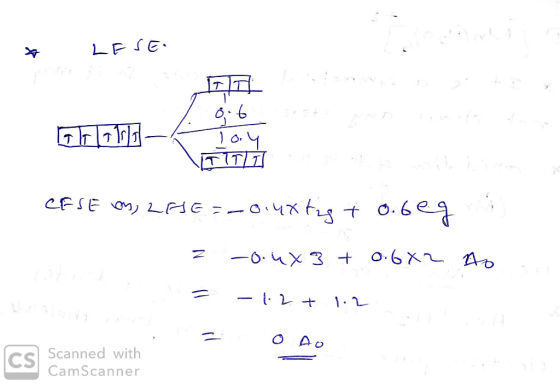
Add Answer to:
1. [Mn(H2O)6]2* Draw the possible stereoisomers. Give the oxidation state of the metal. Identify the donor...
For each of the transition metal ions : (a) [Fe(H2O)4 ]3+ (b) [Mn(H2O)4 Cl2 ]+ (c)...
For each of the transition metal ions : (a) [Fe(H2O)4 ]3+ (b) [Mn(H2O)4 Cl2 ]+ (c) [Re(H2O)4 Cl2 ]+ (d) [Co(NH3)2 (en)2]2+ (i) Draw the structure of each transition metal complex. (ii) Determine the number of d electrons (iii) Draw the arrangement of d electrons in the ground state (iv) Calculate the LFSE (in units of deltao or deltaT ) for each complex
1- Draw the molecular orbital diagram of transition metal ion in high-spin Mn(H2O)4(OH)2 complex, also determine...
1- Draw the molecular orbital diagram of transition metal ion in high-spin Mn(H2O)4(OH)2 complex, also determine the number of unpaired electron. 2- Draw the molecular orbital diagram of transition metal ion in low-spin [Cr(en)2(NH3)2].Cl2 complex, also determine the number of unpaired electron. 3- Draw the molecular orbital diagram of transition metal ion in high-spin K.[Mn(CO)3(OH)3] complex, also determine the number of unpaired electron.
2. For each of the complexes: [Co(H2O)6]Cl3 and [Co(NH3)6]Cl3 Give the oxidation state and the electron...
2. For each of the complexes: [Co(H2O)6]Cl3 and [Co(NH3)6]Cl3 Give the oxidation state and the electron configuration of the transition element as it is in the complex. Say whether the complex is low - spin or high - spin giving a reason for your choice. Draw the d level splitting diagram including the electrons.
1.) Identify the most likely transition metal, M and provide a suitable explanation: a.) A complex...
 1.) Identify the most likely transition metal, M and provide a
suitable explanation:
a.) A complex ion with the formula
[M(H2O)6]3+, where M is a second
row transition metal, that has a LFSE (CFSE) of -2.4
(ignoring pairing and exchange energies). Hint: only the low
spin configuration is observed in second row transition metals.
b.) A tetrahedral complex ion with the formula
[MCl4]-, where M is a first row transtion
metal, that has five unpaired electrons.
1.) Identify the most likely transition metal, M and provide a
suitable explanation:
a.) A complex ion with the formula
[M(H2O)6]3+, where M is a second
row transition metal, that has a LFSE (CFSE) of -2.4
(ignoring pairing and exchange energies). Hint: only the low
spin configuration is observed in second row transition metals.
b.) A tetrahedral complex ion with the formula
[MCl4]-, where M is a first row transtion
metal, that has five unpaired electrons.
3. For each of these following complexes: Hexaaquacobalt(III), Trioxalatocobaltate(III), Triglycinatocobaltate(III),...
3. For each of these following complexes: Hexaaquacobalt(III), Trioxalatocobaltate(III), Triglycinatocobaltate(III), Tricarbonatocobaltate(III), and Tris(1,10-phenanthroline)cobalt(III).... Write out the chemical formula Identify the coordination number of the metal ion Identify whether the ligand is monodentate or polydentate Does the complex form cis-trans isomers? Does the complex form enantiomers? 4. In each of the complexes mentioned, cobalt has an oxidation state of +3. How many d electrons does Co(III) have? 5. Draw the Crystal Field splitting diagram for the Co(III) complex assuming it is...
1. What distinguish a transition metal from a main group metal? 2. Why is zinc not...
 1. What distinguish a transition metal from a main group metal? 2. Why is zinc not considered a transition metal? 3. Write the electronic configuration of the following ions; V". Cr, Mn, Fe, Ni, Ti" 4. What are basic assumptions of Crystal Field Theory? 5. Compounds containing the Scion are colorless whereas those containing Ti* ion are colored. Explain. 6. Predict the number of unpaired electrons in [Cr(en) ions. 7. What are spectrochemical series? 8. The compound hexaminecobalt(III) chloride is...
In the complex ion [ML6]n+, Mn+ has five d electrons and L is a strong field...
In the complex ion [ML6]n+, Mn+ has five d electrons and L is a strong field ligand. According to crystal field theory, the magnetic properties of the complex ion correspond to how many unpaired electrons? A. 0 B. 1 C. 2 D. 3 E. 5 Which one of these complex ions would absorb light with the shortest wavelength? A. [Co(H2O)6]2+ B. [Co(NH3)6]2+ C. [CoF6]4– D. [Co(CN)6]4– E. [Co(en)6]2+ The ion [Co(NH3)6]2+ is octahedral and high spin. This complex is (4pts)...
ANSWER ALL QUESTIONS PLEASE 1. What are the characteristic electron configurations of transition metals? 2. What is...
ANSWER ALL QUESTIONS PLEASE 1. What are the characteristic electron configurations of transition metals? 2. What is the general trend in atomic size across a transition metal series? 3. Which electrons, 3d or 4s, have the lowest ionization energies in a transition metal? 4. What is the general trend of the reducing strength across a transition metal series? 5. Why do transition metals have similar chemical properties? 6. Name four transition metals that are essential to the biological system. 1. Write the...
a. Predict the structure of [Cr(OH2)6]2+ - I wrote that the complex will undergo Jahn-Teller distortion,...
a. Predict the structure of [Cr(OH2)6]2+ - I wrote that the complex will undergo Jahn-Teller distortion, making the octahedral complex become tetragonal (don't know if that's correct) b. Account for the variation in the lattice enthalpy of Mn (2780 kJ/mol), Fe (2926 kJ/mol), Co (2976 kJ/mol), Ni (3060 kJ/mol), and Zn (2985 kJ/mol) flouride given that the metal center in all of the flourides is surrounded by an octahedral array of F-ions. c. Explain the effect on the d-orbital energies...
Help on 54 please Identify the formal are shown charge and oxidation state on each atom...
 Help on 54 please
Identify the formal are shown charge and oxidation state on each atom in the following species. Assume that all valence electrons are shown. The following is a skeleton of a molecular anion having the overall formula C_6H_6NO^-. The hydrogen atoms are not shown. (a) Draw a complete Lewis structure of the species in which the -1 formal charge is on N. Include all H atoms and valence electrons. (b) Do the same for the species with...
Help on 54 please
Identify the formal are shown charge and oxidation state on each atom in the following species. Assume that all valence electrons are shown. The following is a skeleton of a molecular anion having the overall formula C_6H_6NO^-. The hydrogen atoms are not shown. (a) Draw a complete Lewis structure of the species in which the -1 formal charge is on N. Include all H atoms and valence electrons. (b) Do the same for the species with...
 1.) Identify the most likely transition metal, M and provide a
suitable explanation:
a.) A complex ion with the formula
[M(H2O)6]3+, where M is a second
row transition metal, that has a LFSE (CFSE) of -2.4
(ignoring pairing and exchange energies). Hint: only the low
spin configuration is observed in second row transition metals.
b.) A tetrahedral complex ion with the formula
[MCl4]-, where M is a first row transtion
metal, that has five unpaired electrons.
1.) Identify the most likely transition metal, M and provide a
suitable explanation:
a.) A complex ion with the formula
[M(H2O)6]3+, where M is a second
row transition metal, that has a LFSE (CFSE) of -2.4
(ignoring pairing and exchange energies). Hint: only the low
spin configuration is observed in second row transition metals.
b.) A tetrahedral complex ion with the formula
[MCl4]-, where M is a first row transtion
metal, that has five unpaired electrons.
 1. What distinguish a transition metal from a main group metal? 2. Why is zinc not considered a transition metal? 3. Write the electronic configuration of the following ions; V". Cr, Mn, Fe, Ni, Ti" 4. What are basic assumptions of Crystal Field Theory? 5. Compounds containing the Scion are colorless whereas those containing Ti* ion are colored. Explain. 6. Predict the number of unpaired electrons in [Cr(en) ions. 7. What are spectrochemical series? 8. The compound hexaminecobalt(III) chloride is...
 Help on 54 please
Identify the formal are shown charge and oxidation state on each atom in the following species. Assume that all valence electrons are shown. The following is a skeleton of a molecular anion having the overall formula C_6H_6NO^-. The hydrogen atoms are not shown. (a) Draw a complete Lewis structure of the species in which the -1 formal charge is on N. Include all H atoms and valence electrons. (b) Do the same for the species with...
Help on 54 please
Identify the formal are shown charge and oxidation state on each atom in the following species. Assume that all valence electrons are shown. The following is a skeleton of a molecular anion having the overall formula C_6H_6NO^-. The hydrogen atoms are not shown. (a) Draw a complete Lewis structure of the species in which the -1 formal charge is on N. Include all H atoms and valence electrons. (b) Do the same for the species with...
Most questions answered within 3 hours.
-
Where is the error in this code sequence?
String s1 = "Hello";
String s2 = "ello";...
asked 11 months ago -
Financial data for Joel de Paris, Inc., for last year
follow:
Joel de Paris, Inc.
Balance...
asked 11 months ago -
Consider this reaction:
Al2(SO4)3 (aq)+ BaCl3
(aq) Al2Cl6 (aq)- +
3BaSO4(s) . What is the...
asked 11 months ago -
Suppose that Savneet is considering increasing her
recent random sample from 20 car rentals to 40...
asked 11 months ago -
Trucks arrive at an unloading terminal at an average rate of 120
per hour.
Trucks arrive...
asked 11 months ago -
Why are methanol and ethanol completely soluble in water while
octanol is not very little soluble....
asked 11 months ago -
A facilities manager at a university reads in a research report
that the mean amount of...
asked 11 months ago -
When the CuSO4 is rehydrated by adding water to the anhydrous
compound, is this an endothermic...
asked 11 months ago -
A ray of sunlight is passing from diamond into crown glass; the
angle of incidence is...
asked 11 months ago -
A block of mass 0.249 kg is placed on top of a light, vertical
spring of...
asked 11 months ago -
how do the kidneys compensate in the presences of acidosis
a) trigger hyperventilate
b) reserve acid...
asked 11 months ago -
Question 501 pts
The rental rate of capital to the firm increases. Which of the
following...
asked 11 months ago